VIPSolutions logo ✨ VIPSolutions

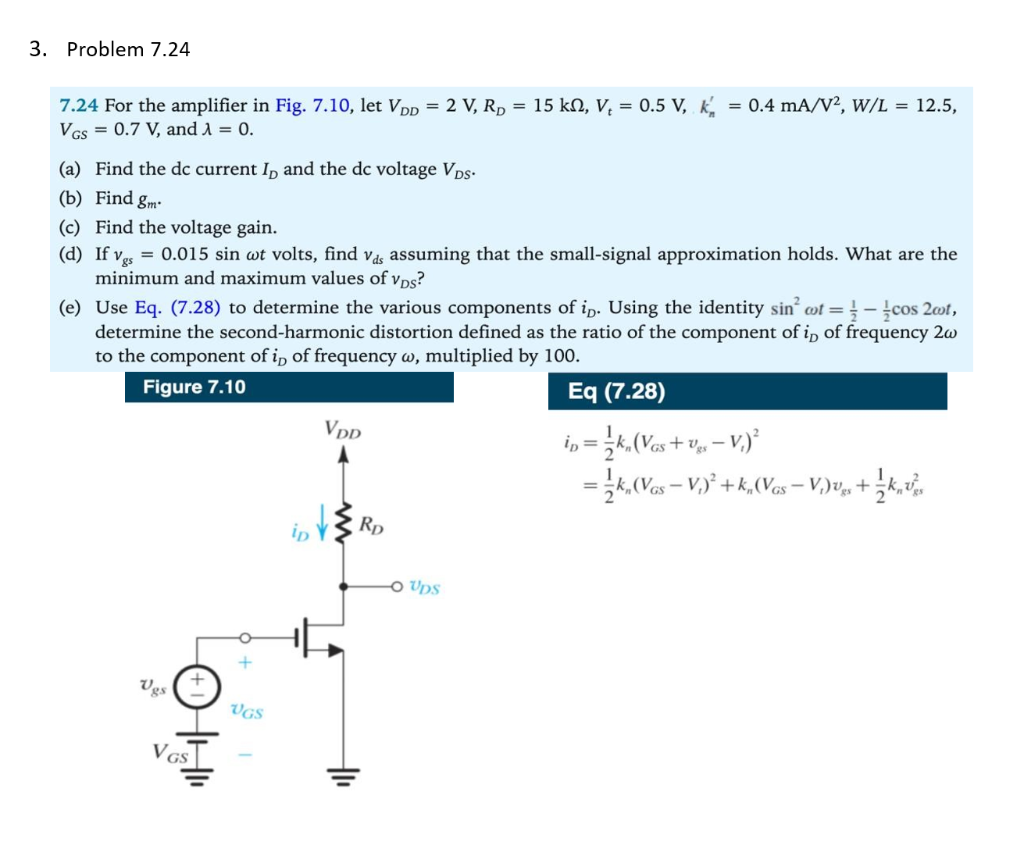
I need answer for part e with step by step solution and explanation please .3. Problem 7.24 7.24 For the amplifier in Fig. 7.10, let Vpp = 2 V, Rp, = 15kQ, V, = 0.5 V, k, = 0.4 mA/V2, W/L = 12.5, Vs =0.7V,and A = 0. (a) Find the dc current I, and the dc voltage Vp. (b) Findg,. (c) Find the voltage gain. (d) If v, = 0.015 sin wt volts, find v,, assuming that the small-signal approximation holds. What are the minimum and maximum values of v;,s? (e) Use Eq. (7.28) to determine the various components of i. Using the identity sin” wf = 1 — cos 20, determine the second-harmonic distortion defined as the ratio of the component of ij, of frequency 2w to the component of i, of frequency w, multiplied by 100. Figure 7.10 Eq (7.28) \7 2 or i= 2k, (Vos +1, =v)? = IVs = VK Vs = Vou, + 3, in V3 Ro Ups Uys Vis vel

Question:

I need answer for part e with step by step solution and explanation please .Uploaded Image3. Problem 7.24 7.24 For the amplifier in Fig. 7.10, let Vpp = 2 V, Rp, = 15kQ, V, = 0.5 V, k, = 0.4 mA/V2, W/L = 12.5, Vs =0.7V,and A = 0. (a) Find the dc current I, and the dc voltage Vp. (b) Findg,. (c) Find the voltage gain. (d) If v, = 0.015 sin wt volts, find v,, assuming that the small-signal approximation holds. What are the minimum and maximum values of v;,s? (e) Use Eq. (7.28) to determine the various components of i. Using the identity sin” wf = 1 — cos 20, determine the second-harmonic distortion defined as the ratio of the component of ij, of frequency 2w to the component of i, of frequency w, multiplied by 100. Figure 7.10 Eq (7.28) \7 2 or i= 2k, (Vos +1, =v)? = IVs = VK Vs = Vou, + 3, in V3 Ro Ups Uys Vis vel

This is AI generated Response.
Asked by: Jack
Created at: 2025-10-12 10:00:57

Final Answer:

Rendered Raw Text
Did you like this answer?
Let's solve **part (e)** step by step: --- ## **Given Data** - \( V_{DD} = 2 \, \text{V} \) - \( R_D = 15\, \text{k}\Omega \) - \( V_t = .5\,\text{V} \) - \( k_n' = .4\,\text{mA/V}^2 \) - \( \frac{W}{L} = 12.5 \) - \( V_{GS} = .7\,\text{V} \) - \( \lambda = \) - \( v_{gs} = .015 \sin \omega t \) - Eq. (7.28): \( i_D = \frac{1}{2} k_n (V_{GS} + v_{gs} - V_t)^2 \) Where \( k_n = k_n' \frac{W}{L} = .4 \times 12.5 = 5\,\text{mA/V}^2 \). --- ## **1. Substitute \( v_{gs} \) into the Equation** \[ i_D = \frac{1}{2} k_n (V_{GS} + v_{gs} - V_t)^2 \] Let \( V_{ov} = V_{GS} - V_t = .7 - .5 = .2\,\text{V} \): \[ i_D = \frac{1}{2} k_n (V_{ov} + v_{gs})^2 \] Expand: \[ i_D = \frac{1}{2} k_n [V_{ov}^2 + 2V_{ov}v_{gs} + v_{gs}^2] \] \[ i_D = \frac{1}{2} k_n V_{ov}^2 + k_n V_{ov} v_{gs} + \frac{1}{2} k_n v_{gs}^2 \] --- ## **2. Substitute \( v_{gs} = .015 \sin \omega t \)** Let \( A = .015 \): \[ i_D = \frac{1}{2} k_n V_{ov}^2 + k_n V_{ov} (A \sin \omega t) + \frac{1}{2} k_n (A \sin \omega t)^2 \] Expand the last term: \[ (A \sin \omega t)^2 = A^2 \sin^2 \omega t \] Recall the identity: \[ \sin^2 \omega t = \frac{1}{2} (1 - \cos 2\omega t) \] So, \[ i_D = \frac{1}{2} k_n V_{ov}^2 + k_n V_{ov} A \sin \omega t + \frac{1}{2} k_n A^2 \frac{1}{2} (1 - \cos 2\omega t) \] \[ i_D = \frac{1}{2} k_n V_{ov}^2 + k_n V_{ov} A \sin \omega t + \frac{1}{4} k_n A^2 (1 - \cos 2\omega t) \] --- ## **3. Identify Harmonic Components** - **DC Component:** \( \frac{1}{2} k_n V_{ov}^2 + \frac{1}{4} k_n A^2 \) - **Fundamental (\(\omega\)) Component:** \( k_n V_{ov} A \sin \omega t \) - **Second Harmonic (\(2\omega\)) Component:** \( -\frac{1}{4} k_n A^2 \cos 2\omega t \) --- ## **4. Find the Second-Harmonic Distortion** Second-harmonic distortion (SHD) is defined as: \[ \text{SHD} = \frac{\text{amplitude of } 2\omega \text{ component}}{\text{amplitude of } \omega \text{ component}} \times 100 \] - Amplitude at \(\omega\): \( k_n V_{ov} A \) - Amplitude at \(2\omega\): \( \frac{1}{4} k_n A^2 \) \[ \text{SHD} = \frac{\frac{1}{4} k_n A^2}{k_n V_{ov} A} \times 100 = \frac{A}{4V_{ov}} \times 100 \] Substitute \( A = .015 \), \( V_{ov} = .2 \): \[ \text{SHD} = \frac{.015}{4 \times .2} \times 100 = \frac{.015}{.8} \times 100 = .01875 \times 100 = 1.875\% \] --- ## **Summary Table** | Component | Value | |---|---| | **DC Component** | \( \frac{1}{2} k_n V_{ov}^2 + \frac{1}{4} k_n A^2 \) | | **\(\omega\) Component** | \( k_n V_{ov} A \sin \omega t \) | | **\(2\omega\) Component** | \( -\frac{1}{4} k_n A^2 \cos 2\omega t \) | | **Second-Harmonic Distortion** | \( 1.88\% \) | --- ## **Final Answers** ### **Various Components of \( i_D \):** \[ i_D = \underbrace{\frac{1}{2} k_n V_{ov}^2 + \frac{1}{4} k_n A^2}_{\text{DC}} + \underbrace{k_n V_{ov} A \sin \omega t}_{\omega} \underbrace{-\frac{1}{4} k_n A^2 \cos 2\omega t}_{2\omega} \] ### **Second-Harmonic Distortion:** \[ \boxed{1.88\%} \] --- **Let me know if you need the values plugged in for the DC and AC components!**

Question:

yes please provide

This is AI generated Response.
Asked by: Jack
Created at: 2025-10-12 10:13:36

Final Answer:

Rendered Raw Text
Did you like this answer?
Sure! Let's plug in the values for the DC and AC components based on the data provided. --- ## **Values Used** - \( k_n = 5 \, \text{mA/V}^2 \) - \( V_{ov} = 0.2 \, \text{V} \) - \( A = 0.015 \) --- ## **1. Calculate the DC Component** The DC component is given by: \[ \text{DC Component} = \frac{1}{2} k_n V_{ov}^2 + \frac{1}{4} k_n A^2 \] Substituting the values: \[ \text{DC Component} = \frac{1}{2} \cdot 5 \cdot (0.2)^2 + \frac{1}{4} \cdot 5 \cdot (0.015)^2 \] Calculating: \[ = \frac{1}{2} \cdot 5 \cdot 0.04 + \frac{1}{4} \cdot 5 \cdot 0.000225 \] \[ = 0.1 + 0.00028125 \] \[ = 0.10028125 \, \text{mA} \] --- ## **2. Calculate the Amplitude of the Fundamental (\(\omega\)) Component** The amplitude at \(\omega\) is given by: \[ \text{Amplitude}_{\omega} = k_n V_{ov} A \] Substituting the values: \[ \text{Amplitude}_{\omega} = 5 \cdot 0.2 \cdot 0.015 \] Calculating: \[ = 5 \cdot 0.003 = 0.015 \, \text{mA} \] --- ## **3. Calculate the Amplitude of the Second Harmonic (\(2\omega\)) Component** The amplitude at \(2\omega\) is given by: \[ \text{Amplitude}_{2\omega} = -\frac{1}{4} k_n A^2 \] Substituting the values: \[ \text{Amplitude}_{2\omega} = -\frac{1}{4} \cdot 5 \cdot (0.015)^2 \] Calculating: \[ = -\frac{1}{4} \cdot 5 \cdot 0.000225 \] \[ = -\frac{1}{4} \cdot 0.001125 = -0.00028125 \, \text{mA} \] --- ## **Final Summary of Components** | Component | Value (mA) | |---|---| | **DC Component** | \( 0.10028125 \) | | **\(\omega\) Component Amplitude** | \( 0.015 \) | | **\(2\omega\) Component Amplitude** | \( -0.00028125 \) | --- ## **Final Second-Harmonic Distortion Calculation** Using the previously calculated values: \[ \text{SHD} = \frac{0.00028125}{0.015} \times 100 \] Calculating: \[ = \frac{0.00028125 \, \text{mA}}{0.015 \, \text{mA}} \times 100 = 1.875\% \] --- ## **Final Answers** ### **Various Components of \( i_D \):** \[ i_D = 0.10028125 \, \text{mA} + 0.015 \sin \omega t - 0.00028125 \cos 2\omega t \] ### **Second-Harmonic Distortion:** \[ \boxed{1.875\%} \] --- This concludes the calculations for the DC and AC components, as well as the second-harmonic distortion. Let me know if you need any further assistance!

📢 Instructions:

  • Ask anything relatd to above question only.
  • For new Question goto :

Study Help, Fast Answers

VIPSolutions focuses on clear, step‑by‑step explanations so you can learn quickly. Whether you need an AI‑generated walkthrough or a short hint to get unstuck, each solution is organized for fast reading and easy review later.

Search similar questions, compare approaches, and bookmark the best answers for revision. Our goal is simple: quick, reliable study help that feels natural—not noisy.