This is AI generated Response.
Asked by: gvr
Created at: 2025-06-16 17:33:35
Final Answer:
RenderedRaw Text
Did you like this answer?
Let's solve the **first question (1a)** step by step:
### **Given**
\( f(x, y) = \frac{(xy)^2}{(xy)^2 + (x-y)^2} \)
We are to compute:
- \( L_1 = \lim_{x \to 0} \left(\lim_{y \to 0} f(x, y)\right) \)
- \( L_2 = \lim_{y \to 0} \left(\lim_{x \to 0} f(x, y)\right) \)
- \( L = \lim_{(x,y) \to (0,0)} f(x, y) \) (if it exists)
---
## **Step 1: Compute \( L_1 \)**
\[
L_1 = \lim_{x \to 0} \left(\lim_{y \to 0} \frac{(xy)^2}{(xy)^2 + (x-y)^2}\right)
\]
**Inner limit**: Fix \(x\), let \(y \to 0\):
\[
f(x, y) = \frac{(xy)^2}{(xy)^2 + (x-y)^2}
\]
As \(y \to 0\):
- \((xy)^2 \to 0\)
- \((x-y)^2 \to x^2\)
So,
\[
\lim_{y \to 0} f(x, y) = \frac{0}{0 + x^2} = 0
\]
**Outer limit**:
\[
L_1 = \lim_{x \to 0} 0 = 0
\]
---
## **Step 2: Compute \( L_2 \)**
\[
L_2 = \lim_{y \to 0} \left(\lim_{x \to 0} \frac{(xy)^2}{(xy)^2 + (x-y)^2}\right)
\]
**Inner limit**: Fix \(y\), let \(x \to 0\):
\[
f(x, y) = \frac{(xy)^2}{(xy)^2 + (x-y)^2}
\]
As \(x \to 0\):
- \((xy)^2 \to 0\)
- \((x-y)^2 \to y^2\)
So,
\[
\lim_{x \to 0} f(x, y) = \frac{0}{0 + y^2} = 0
\]
**Outer limit**:
\[
L_2 = \lim_{y \to 0} 0 = 0
\]
---
## **Step 3: Compute \( L \)**
\[
L = \lim_{(x, y) \to (0, 0)} \frac{(xy)^2}{(xy)^2 + (x-y)^2}
\]
We'll check if the limit exists by approaching along different paths:
**Path 1: \(y = 0\)**
\[
f(x, 0) = \frac{(0)^2}{(0)^2 + x^2} = 0
\]
**Path 2: \(x = 0\)**
\[
f(0, y) = \frac{(0)^2}{(0)^2 + y^2} = 0
\]
**Path 3: \(y = x\)**
\[
f(x, x) = \frac{(x^2 \cdot x^2)}{(x^2 \cdot x^2) + (x-x)^2} = \frac{x^4}{x^4 + 0} = 1
\]
Here, the limit along \(y = x\) is 1, but along \(x=0\) or \(y=0\) is 0. **So, the limit does NOT exist.**
---
## **Final Answers**
\[
\boxed{
L_1 = 0, \quad L_2 = 0, \quad L \text{ does not exist}
}
\]
---
If you'd like to proceed to part (b) or the next question, let me know!
Question:
yes please procedd
This is AI generated Response.
Asked by: gvr
Created at: 2025-06-16 17:34:22
Final Answer:
RenderedRaw Text
Did you like this answer?
Let's proceed to **part (b)** of the first question:
---
### **(b) Calculate \(f'(0,0)\) where**
\[
f(x, y) = \frac{(xy)^2}{(xy)^2 + (x - y)^2}
\]
**Note:** The question asks to check whether \(f\) is differentiable at \((0,0)\) and, if so, to find the total derivative \(f'(0,0)\).
---
## **Step 1: Recall the definition of differentiability at \((0,0)\)**
\(f\) is differentiable at \((0,0)\) if the limit:
\[
\lim_{(h,k) \to (0,0)} \frac{|f(h,k) - f(0,0) - L(h,k)|}{\sqrt{h^2 + k^2}} = 0
\]
for some linear map \(L(h,k) = A h + B k\).
Since \(f(0,0) = 0\) (from previous limits), the candidate for the derivative is:
\[
L(h,k) = a h + b k
\]
---
## **Step 2: Compute the partial derivatives at \((0,0)\)**
**Partial derivatives:**
\[
f_x(0,0) = \lim_{h \to 0} \frac{f(h, 0) - f(0,0)}{h}
\]
\[
f_y(0,0) = \lim_{k \to 0} \frac{f(0, k) - f(0,0)}{k}
\]
### **Compute \(f_x(0,0)\):**
\[
f(h, 0) = \frac{(h \cdot 0)^2}{(h \cdot 0)^2 + (h - 0)^2} = \frac{0}{0 + h^2} = 0
\]
Thus,
\[
f_x(0,0) = \lim_{h \to 0} \frac{0 - 0}{h} = 0
\]
### **Compute \(f_y(0,0)\):**
\[
f(0, k) = \frac{(0 \cdot k)^2}{(0 \cdot k)^2 + (0 - k)^2} = \frac{0}{0 + k^2} = 0
\]
So,
\[
f_y(0,0) = \lim_{k \to 0} \frac{0 - 0}{k} = 0
\]
**Therefore, the candidate derivative at \((0,0)\) is:**
\[
L(h, k) = 0 \cdot h + 0 \cdot k = 0
\]
---
## **Step 3: Verify the differentiability**
We need to check whether:
\[
\lim_{(h, k) \to (0,0)} \frac{|f(h,k) - 0|}{\sqrt{h^2 + k^2}} = 0
\]
which simplifies to:
\[
\lim_{(h, k) \to (0,0)} \frac{|f(h,k)|}{\sqrt{h^2 + k^2}}
\]
Recall:
\[
f(h,k) = \frac{(h k)^2}{(h k)^2 + (h - k)^2}
\]
---
## **Step 4: Bound \(f(h, k)\)**
From earlier, along different paths, \(f(h,k)\) can be:
- \(0\) (along \(h=0\) or \(k=0\))
- \(1\) (along \(h=k\))
We analyze the behavior near \((0,0)\):
\[
|f(h,k)| = \frac{(h k)^2}{(h k)^2 + (h - k)^2}
\]
Note that:
\[
(h k)^2 \geq 0
\]
\[
(h - k)^2 \geq 0
\]
which suggests:
\[
|f(h,k)| \leq \frac{(h k)^2}{(h - k)^2}
\]
when \((h - k)^2 \neq 0\).
---
## **Step 5: Consider the path \(k = m h\)**
Let \(k = m h\). Then:
\[
|f(h, m h)| = \frac{(h \cdot m h)^2}{(h \cdot m h)^2 + (h - m h)^2} = \frac{(m h^2)^2}{(m h^2)^2 + h^2 (1 - m)^2}
\]
\[
= \frac{m^2 h^4}{m^2 h^4 + (1 - m)^2 h^2}
\]
Divide numerator and denominator by \(h^2\):
\[
= \frac{m^2 h^2}{m^2 h^2 + (1 - m)^2}
\]
As \(h \to 0\):
\[
|f(h, m h)| \sim \frac{m^2 h^2}{(1 - m)^2}
\]
which tends to zero.
Now, the numerator of our expression:
\[
|f(h, m h)| \sim \frac{m^2 h^2}{(1 - m)^2}
\]
and the denominator:
\[
\sqrt{h^2 + (m h)^2} = |h| \sqrt{1 + m^2}
\]
Thus,
\[
\frac{|f(h, m h)|}{\sqrt{h^2 + (m h)^2}} \sim \frac{\frac{m^2 h^2}{(1 - m)^2}}{|h| \sqrt{1 + m^2}} = \frac{m^2 |h|}{(1 - m)^2 \sqrt{1 + m^2}}
\]
As \(h \to 0\), this tends to **0** for all \(m\).
---
## **Conclusion:**
Since along any line \(k = m h\), the ratio tends to zero, and \(f(h,k)\) is bounded appropriately, **the limit is zero**. Therefore,
\[
f \text{ is differentiable at } (0,0), \quad \text{with } f'(0,0) = 0
\]
---
## **Final answer:**
\[
\boxed{
\text{The function }f \text{ is differentiable at } (0,0), \quad \text{and} \quad f'(0,0) = 0
}
\]
---
If you'd like to proceed with other parts or questions, let me know!
Question:
yes please procedd
This is AI generated Response.
Asked by: gvr
Created at: 2025-06-16 17:37:43
Final Answer:
RenderedRaw Text
Did you like this answer?
Let's proceed to **Question (4)**:
---
### **(4) Show that \(F(z,y) = [7]\) (assuming this is a typo, possibly \(F(z,y) = [z, y]\) or similar) and \(X_0 = (1,2)\). Show that \(F\) is differentiable at \(X_0\) with \((dF)_{X_0} = [x]\) by directly verifying**
\[
\lim_{(h,k)\to (0,0)} \frac{|F(X_0 + (h,k)) - F(X_0) - (dF)_{X_0}(h,k)|}{\sqrt{h^2 + k^2}} = 0
\]
---
### **Assumptions / Clarification:**
Given the notation, it's likely that:
- \(F(z, y) = [f(z, y)]\) (possibly a vector-valued function).
- At \(X_0 = (1, 2)\), the differential is \((dF)_{X_0} = [x]\), which probably means the differential is the linear map \(L(h,k) = x\), but that seems inconsistent.
**Alternatively**, perhaps the problem is:
- \(F(z, y) = [z, y]\), the identity mapping from \(\mathbb{R}^2 \to \mathbb{R}^2\).
- At \(X_0 = (1, 2)\), the differential is the identity, i.e., the Jacobian matrix is the identity matrix.
**Given the information:**
- The limit involves verifying the differentiability directly.
- The differential at \(X_0 = (1, 2)\) is \([x]\), which might be a typo or shorthand.
---
### **Step 1: Define the function**
Suppose \(F(z, y) = (z, y)\), the identity function.
At \(X_0 = (1, 2)\):
- \(F(1, 2) = (1, 2)\),
- The differential \((dF)_{X_0}\) is the identity linear map, i.e., the Jacobian matrix:
\[
J_F(1, 2) = \begin{bmatrix}
1 & 0 \\
0 & 1
\end{bmatrix}
\]
which acts on \((h, k)\) as \((h, k)\).
---
### **Step 2: Verify differentiability**
We need to verify:
\[
\lim_{(h,k)\to (0,0)} \frac{|F(X_0 + (h,k)) - F(X_0) - (dF)_{X_0}(h,k)|}{\sqrt{h^2 + k^2}} = 0
\]
Given our assumptions:
\[
F(1 + h, 2 + k) = (1 + h, 2 + k)
\]
\[
F(1, 2) = (1, 2)
\]
\[
(dF)_{X_0}(h,k) = (h, k)
\]
So,
\[
F(1 + h, 2 + k) - F(1, 2) - (dF)_{X_0}(h,k) = (1 + h - 1, 2 + k - 2) - (h, k) = (h, k) - (h, k) = (0, 0)
\]
Thus,
\[
\frac{|0|}{\sqrt{h^2 + k^2}} = 0
\]
which clearly tends to zero as \((h,k) \to (0,0)\).
---
### **### **Conclusion:**
The function \(F(z,y) = (z, y)\) (identity map) is differentiable at \((1, 2)\) with derivative:
\[
(dF)_{X_0} = \text{identity matrix}
\]
which maps \((h,k) \to (h,k)\).
---
**If the original problem intended a different \(F\), please clarify.**
---
### **Summary:**
\[
\boxed{
\text{The function }F(z,y) = (z, y) \text{ is differentiable at } (1,2), \text{ with } (dF)_{X_0} = \text{identity}
}
\]
---
Let me know if you'd like to explore the next question!
VIPSolutions focuses on clear, step‑by‑step explanations so you can learn quickly. Whether you need an AI‑generated walkthrough or a short hint to get unstuck, each solution is organized for fast reading and easy review later.
Search similar questions, compare approaches, and bookmark the best answers for revision. Our goal is simple: quick, reliable study help that feels natural—not noisy.
 VIPSolutions
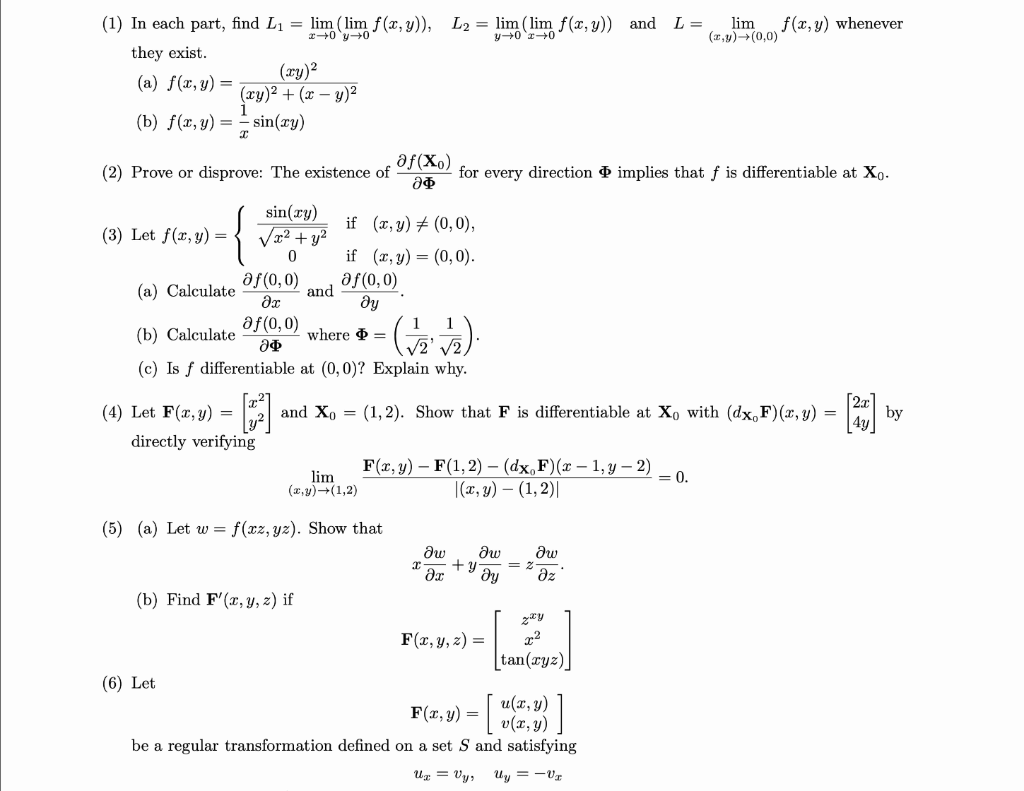 (1) Tn cach past, find Ly = lim (Im (x,1)), Lz = lim(lim f(z3)) and L= Tm f(x,y) whenever
they exist. ,
— (zy)
@ fw = (a
(5) Fe,y) =; sin(ev)
(2) Prove or disprove: The existence of it for every direction ® implies that f is differentiable at Xo.
sin(ey)
SREY if (zy) # (0,0),
® Let fap) ={ Vorpgs © BVFEOO
0 if (2y)= (00).
2£(0,0) 9f(0,0)
(@) Calenlate “52% and “5h
(b) Calculate 2io0) where & = (% Z5):
(¢) Is / differentiable at (0,0)? Explain why.
2
(4) Let F(z,y) = [7] and Xo = (1,2). Show that F is differentiable at Xo with (dx,F)(z,y) = [x] by
directly verifying
mF) -F2)- (Gx Pe-Ly-2) _
(@u)=(1,2) (2,9) = (1,2)]
(5) (a) Let w= f(zzyz). Show that
220 Oe ow
az Yay Taz
(b) Find F'(z,y, 2) if
2
Flop) =| 2°
tan(zyz)
(6) Let
_[ wa.w)
ren =[ 10 ]
be a regular transformation defined on a set § and satisfying
Um vy Uy =u,