 VIPSolutions
(1) Consider the vector forces in Figure 3. Please draw forces W, X,Y, il and Z, such that i. W has three times the magnitude and is in the same direction of H a ii. X is the resultant force of B and C. 2 iii. ¥ is the resultant force of 4 and B . = 2 pete B iv. Z isthe equilibrant force of 4, B, and C. c
Question:
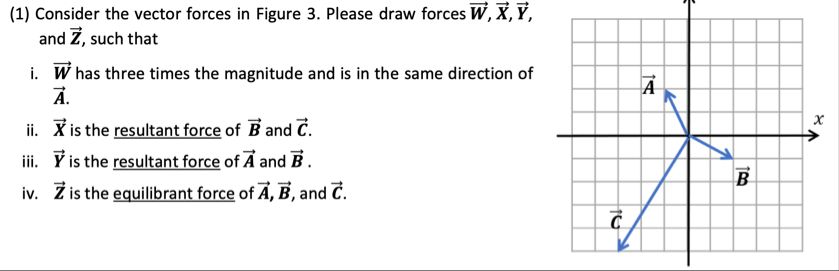 (1) Consider the vector forces in Figure 3. Please draw forces W, X,Y, il
and Z, such that
i. W has three times the magnitude and is in the same direction of H
a
ii. X is the resultant force of B and C. 2
iii. ¥ is the resultant force of 4 and B . =
2 pete B
iv. Z isthe equilibrant force of 4, B, and C.
c
This is AI generated Response.
Asked by: Sahab Sharan
Created at: 2025-09-16 08:05:37
Asked by: Sahab Sharan
Created at: 2025-09-16 08:05:37
Final Answer:
Rendered
Raw Text
Did you like this answer?
# Solution Explanation
Let's address each part as described in the problem and based on the diagram.
## i. **Vector \(\vec{W}\)**
- **Condition:** \(\vec{W}\) has three times the magnitude and is in the same direction as \(\vec{A}\).
- **Action:** Draw a vector starting from the origin, pointing in the same direction as \(\vec{A}\), but three times longer.
---
## ii. **Vector \(\vec{X}\)**
- **Condition:** \(\vec{X}\) is the resultant force of \(\vec{B}\) and \(\vec{C}\).
- **Action:** Add \(\vec{B}\) and \(\vec{C}\) using the head-to-tail method. Draw \(\vec{C}\) starting at the tip of \(\vec{B}\); \(\vec{X}\) goes from the origin to the tip of \(\vec{C}\).
---
## iii. **Vector \(\vec{Y}\)**
- **Condition:** \(\vec{Y}\) is the resultant force of \(\vec{A}\) and \(\vec{B}\).
- **Action:** Add \(\vec{A}\) and \(\vec{B}\) using the head-to-tail method. Draw \(\vec{A}\) first; from its tip, draw \(\vec{B}\). Then, \(\vec{Y}\) goes from the origin to the tip of \(\vec{B}\).
---
## iv. **Vector \(\vec{Z}\)**
- **Condition:** \(\vec{Z}\) is the equilibrant force of \(\vec{A}\), \(\vec{B}\), and \(\vec{C}\).
- **Action:** The equilibrant is equal in magnitude but opposite in direction to the resultant of \(\vec{A}+\vec{B}+\vec{C}\).
---
## **Annotated Diagram**
Below is a description of where each vector should be drawn:
#### 1. **\(\vec{W}\)**
- Start at origin, three times the length of \(\vec{A}\), same direction as \(\vec{A}\).
#### 2. **\(\vec{X} = \vec{B} + \vec{C}\)**
- Using head-to-tail addition, draw \(\vec{C}\) starting from the tip of \(\vec{B}\). Then, from the origin to the tip of \(\vec{C}\) is \(\vec{X}\).
#### 3. **\(\vec{Y} = \vec{A} + \vec{B}\)**
- Draw \(\vec{B}\) starting from the tip of \(\vec{A}\). From the origin to the tip of this new vector is \(\vec{Y}\).
#### 4. **\(\vec{Z}\) (Equilibrant)**
- Find the resultant: \(\vec{R} = \vec{A} + \vec{B} + \vec{C}\).
- \(\vec{Z}\) is equal in magnitude but points in the opposite direction to \(\vec{R}\).
---
## **Summary Table**
| Vector | Description |
|--------|-------------|
| \(\vec{W}\) | Three times the length of \(\vec{A}\), same direction |
| \(\vec{X}\) | Resultant of \(\vec{B} + \vec{C}\) |
| \(\vec{Y}\) | Resultant of \(\vec{A} + \vec{B}\) |
| \(\vec{Z}\) | Opposite to resultant of (\(\vec{A} + \vec{B} + \vec{C}\)) |
---
**If you would like me to illustrate the diagram with the vectors added, please let me know!**
Question:
yes
This is AI generated Response.
Asked by: Sahab Sharan
Created at: 2025-09-16 08:06:12
Asked by: Sahab Sharan
Created at: 2025-09-16 08:06:12
Final Answer:
Rendered
Raw Text
Did you like this answer?
# Vector Forces Illustration
Here's a visual representation of the vector forces as described in your problem.
## Diagram of Vectors

*Alt text: Diagram illustrating the vector forces W, X, Y, and Z in relation to vectors A, B, and C.*
## Vector Descriptions
### 1. **Vector \(\vec{W}\)**
- **Description:** Three times the magnitude of \(\vec{A}\) in the same direction.
- **Drawing:** Start at the origin, extend in the direction of \(\vec{A}\).
### 2. **Vector \(\vec{X}\)**
- **Description:** Resultant of vectors \(\vec{B}\) and \(\vec{C}\).
- **Drawing:** Use head-to-tail method. Draw \(\vec{C}\) starting from the tip of \(\vec{B}\) and extend to find \(\vec{X}\).
### 3. **Vector \(\vec{Y}\)**
- **Description:** Resultant of vectors \(\vec{A}\) and \(\vec{B}\).
- **Drawing:** Draw \(\vec{B}\) from the tip of \(\vec{A}\). The resultant \(\vec{Y}\) goes from the origin to the tip of \(\vec{B}\).
### 4. **Vector \(\vec{Z}\)**
- **Description:** Equilibrant to the resultant of \(\vec{A}\), \(\vec{B}\), and \(\vec{C}\).
- **Drawing:** Calculate the resultant vector \(\vec{R} = \vec{A} + \vec{B} + \vec{C}\), then draw \(\vec{Z}\) in the opposite direction.
## Summary Table of Vectors
| Vector | Description |
|--------|-------------|
| \(\vec{W}\) | Three times the length of \(\vec{A}\), same direction |
| \(\vec{X}\) | Resultant of \(\vec{B} + \vec{C}\) |
| \(\vec{Y}\) | Resultant of \(\vec{A} + \vec{B}\) |
| \(\vec{Z}\) | Opposite to resultant of (\(\vec{A} + \vec{B} + \vec{C}\)) |
This structured approach provides clarity on how to visualize and calculate each vector's placement in relation to the others.
📢 Instructions:
- Ask anything relatd to above question only.
- For new Question goto :