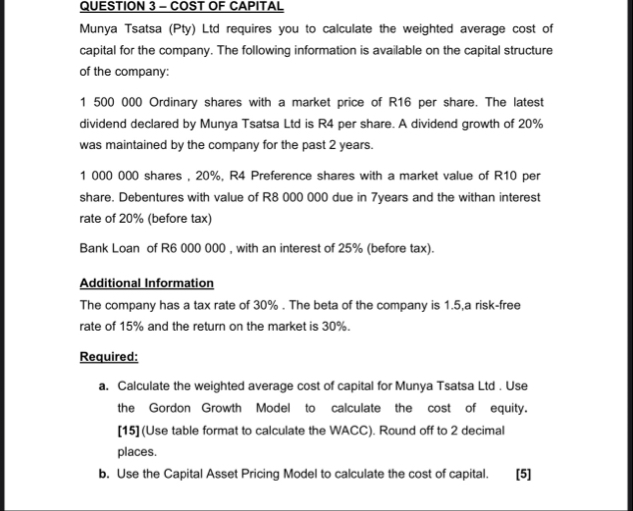
QUESTION 3 - COST OF CAPITAL
Munya Tsatsa (Pty) Lid requires you to calculate the weighted average cost of
capital for the company. The following information is available on the capital structure.
of the company:
1 500 000 Ordinary shares with a market price of R16 per share. The latest
dividend declared by Munya Tsatsa Ltd is Ré per share. A dividend growth of 20%
was maintained by the company for the past 2 years.
1000 000 shares , 20%, Ré Preference shares with a market value of R10 per
share. Debentures with value of RB 000 000 due in 7years and the witha inerost
rate of 20% (before tax)
Bank Loan of R6 000 000 , with an interest of 25% (before tax).
Additional Information
The company has a tax rate of 30% . The beta of the company is 1.5,a risk-free
rate of 15% and the return on the market is 30%.
Required:
a. Calculate the weighted average cost of capital or Munya Tsatsa Lid . Use
the Gordon Growth Model fo calculate the cost of equiy.
[15] (Use table format to calculate the WACC). Round off to 2 decimal
places.
b. Use the Capital Asset Pricing Model to calculate the cost of capital. [5]
Question:
QUESTION 3 - COST OF CAPITAL
Munya Tsatsa (Pty) Lid requires you to calculate the weighted average cost of
capital for the company. The following information is available on the capital structure.
of the company:
1 500 000 Ordinary shares with a market price of R16 per share. The latest
dividend declared by Munya Tsatsa Ltd is Ré per share. A dividend growth of 20%
was maintained by the company for the past 2 years.
1000 000 shares , 20%, Ré Preference shares with a market value of R10 per
share. Debentures with value of RB 000 000 due in 7years and the witha inerost
rate of 20% (before tax)
Bank Loan of R6 000 000 , with an interest of 25% (before tax).
Additional Information
The company has a tax rate of 30% . The beta of the company is 1.5,a risk-free
rate of 15% and the return on the market is 30%.
Required:
a. Calculate the weighted average cost of capital or Munya Tsatsa Lid . Use
the Gordon Growth Model fo calculate the cost of equiy.
[15] (Use table format to calculate the WACC). Round off to 2 decimal
places.
b. Use the Capital Asset Pricing Model to calculate the cost of capital. [5]
This is AI generated Response.
Asked by: Adarsh Tripathi
Created at: 2025-07-25 10:41:00
Final Answer:
RenderedRaw Text
Did you like this answer?
Let's break down the requirements for **QUESTION 3 – COST OF CAPITAL** step by step.
---
### **a. Calculate the weighted average cost of capital (WACC) for Munya Tsatsa Ltd**
#### **Step 1: Calculate Cost of Each Component**
#### **1. Ordinary Shares (Equity) – Use Gordon Growth Model (Dividend Growth Model)**
\[
\text{Cost of Equity (}k_e\text{)} = \frac{D_1}{P_0} + g
\]
- \( D_1 \): Next year's expected dividend = \( 4 \times 1.2 = R4.80 \)
- \( P_0 \): Current share price = R16
- \( g \): Dividend growth rate = 20% = 0.20
\[
k_e = \frac{4.80}{16} + 0.20 = 0.30 + 0.20 = 0.50 = 50\%
\]
---
#### **2. Preference Shares**
\[
\text{Cost of Preference Shares (}k_{ps}\text{)} = \frac{D_{ps}}{P_{ps}}
\]
- Dividend = 20% of R4 = R0.80 per share (assuming 20% is on face value, but if it's 20% on market price, then R2)
- Market price = R10
Assume it's 20% * R4 (as per usual preference share conventions):
\[
k_{ps} = \frac{0.8}{10} = 0.08 = 8\%
\]
---
#### **3. Debentures (After-tax cost)**
\[
\text{Cost of Debt (}k_d\text{)} = \text{Interest rate} \times (1 - \text{Tax rate})
\]
- Interest rate = 20%
- Tax rate = 30%
\[
k_d = 0.20 \times (1 - 0.30) = 0.20 \times 0.70 = 0.14 = 14\%
\]
---
#### **4. Bank Loan (After-tax cost)**
\[
\text{Cost of Loan} = 25\% \times (1 - 0.30) = 0.25 \times 0.70 = 0.175 = 17.5\%
\]
---
#### **Step 2: Calculate Proportions of Each Source (Market Value Weights)**
| Source | Market Value |
|---------------------|----------------------|
| Ordinary shares | 1,500,000 × R16 = R24,000,000 |
| Preference shares | 1,000,000 × R10 = R10,000,000 |
| Debentures | R8,000,000 |
| Bank Loan | R6,000,000 |
| **Total** | R48,000,000 |
#### **Step 3: Calculate Weights**
- **Ordinary shares:** \( \frac{24,000,000}{48,000,000} = 0.50 \) or 50%
- **Preference shares:** \( \frac{10,000,000}{48,000,000} \approx 0.21 \) or 20.83%
- **Debentures:** \( \frac{8,000,000}{48,000,000} \approx 0.17 \) or 16.67%
- **Bank Loan:** \( \frac{6,000,000}{48,000,000} \approx 0.125 \) or 12.5%
---
#### **Step 4: WACC Calculation Table**
| Component | Weight (W) | Cost (R) | Weighted Cost (W × R) |
|--------------------|------------|----------|-----------------------|
| Ordinary Shares | 0.50 | 50% | 0.50 × 0.50 = 0.25 |
| Preference Shares | 0.21 | 8% | 0.21 × 0.08 ≈ 0.017 |
| Debentures | 0.17 | 14% | 0.17 × 0.14 ≈ 0.024 |
| Bank Loan | 0.125 | 17.5% | 0.125 × 0.175 ≈ 0.022 |
| **Total** | 1.00 | | **0.313 ≈ 31.30%** |
---
**Final WACC:**
\[
\boxed{31.30\%}
\]
---
### **b. Use the Capital Asset Pricing Model (CAPM) to calculate the cost of capital**
\[
k_e = R_f + \beta (R_m - R_f)
\]
- \( R_f \): Risk-free rate = 15%
- \( \beta \): Beta = 1.5
- \( R_m \): Market return = 30%
\[
k_e = 0.15 + 1.5 \times (0.30 - 0.15) = 0.15 + 1.5 \times 0.15 = 0.15 + 0.225 = 0.375 = 37.5\%
\]
---
## **Summary Table for WACC Calculation**
| Component | Market Value | Weight (W) | Cost (R) | Weighted Cost (W × R) |
|--------------------|--------------|------------|----------|-----------------------|
| Ordinary Shares | 24,000,000 | 0.50 | 50% | 0.25 |
| Preference Shares | 10,000,000 | 0.21 | 8% | 0.017 |
| Debentures | 8,000,000 | 0.17 | 14% | 0.024 |
| Bank Loan | 6,000,000 | 0.125 | 17.5% | 0.022 |
| **Total** | 48,000,000 | 1.00 | | **0.313** |
---
## **Answers**
**a. WACC = 31.30%**
**b. CAPM Cost of Equity = 37.5%**
Let me know if you need the workings in Excel format!
Question:
yes
This is AI generated Response.
Asked by: Adarsh Tripathi
Created at: 2025-07-25 10:42:21
Final Answer:
RenderedRaw Text
Did you like this answer?
Certainly! Here's a clear, step-by-step breakdown of the calculations in table format for easy reference and use in Excel:
---
### **Part a: Calculation of WACC for Munya Tsatsa Ltd**
| **Component** | **Market Value (R)** | **Weight (W)** | **Cost of Capital (R)** | **Weighted Cost (W × R)** |
|---------------------------|---------------------------------|----------------|------------------------|---------------------------|
| **Ordinary Shares** | 1,500,000 × 16 = 24,000,000 | 24,000,000 / 48,000,000 = **0.50** | 50% (from Gordon Growth Model) | 0.50 × 50% = **0.25** |
| **Preference Shares** | 1,000,000 × 10 = 10,000,000 | 10,000,000 / 48,000,000 ≈ **0.2083** | 8% (assumed from dividend info) | 0.2083 × 8% ≈ **0.0167** |
| **Debentures** | R8,000,000 | 8,000,000 / 48,000,000 ≈ **0.1667** | 14% (after tax) | 0.1667 × 14% ≈ **0.0233** |
| **Bank Loan** | R6,000,000 | 6,000,000 / 48,000,000 ≈ **0.125** | 17.5% (after tax) | 0.125 × 17.5% ≈ **0.0219** |
| **Total** | **-** | **1.00** | **-** | **Sum: 0.25 + 0.0167 + 0.0233 + 0.0219 ≈ 0.3119** |
**Final WACC ≈ 31.19%**
---
### **Part b: CAPM-Based Cost of Equity**
\[
k_e = R_f + \beta (R_m - R_f)
\]
\[
k_e = 15\% + 1.5 \times (30\% - 15\%) = 15\% + 1.5 \times 15\% = 15\% + 22.5\% = \boxed{37.5\%}
\]
---
### **Summary:**
| **WACC (from part a)** | **≈ 31.19%** |
|------------------------|--------------|
| **Cost of Equity (CAPM)** | **37.5%** |
---
Feel free to input these values into Excel using the table format above for further analysis or reporting!
VIPSolutions focuses on clear, step‑by‑step explanations so you can learn quickly. Whether you need an AI‑generated walkthrough or a short hint to get unstuck, each solution is organized for fast reading and easy review later.
Search similar questions, compare approaches, and bookmark the best answers for revision. Our goal is simple: quick, reliable study help that feels natural—not noisy.
 VIPSolutions
 QUESTION 3 - COST OF CAPITAL
Munya Tsatsa (Pty) Lid requires you to calculate the weighted average cost of
capital for the company. The following information is available on the capital structure.
of the company:
1 500 000 Ordinary shares with a market price of R16 per share. The latest
dividend declared by Munya Tsatsa Ltd is Ré per share. A dividend growth of 20%
was maintained by the company for the past 2 years.
1000 000 shares , 20%, Ré Preference shares with a market value of R10 per
share. Debentures with value of RB 000 000 due in 7years and the witha inerost
rate of 20% (before tax)
Bank Loan of R6 000 000 , with an interest of 25% (before tax).
Additional Information
The company has a tax rate of 30% . The beta of the company is 1.5,a risk-free
rate of 15% and the return on the market is 30%.
Required:
a. Calculate the weighted average cost of capital or Munya Tsatsa Lid . Use
the Gordon Growth Model fo calculate the cost of equiy.
[15] (Use table format to calculate the WACC). Round off to 2 decimal
places.
b. Use the Capital Asset Pricing Model to calculate the cost of capital. [5]