 VIPSolutions
Give step-by-step solution with explanation and final answer:Problem 2: 10 points Be ty Stal by ct mc on recs oy ie athe Fue cow. he rtd don are 10 ct widey 2 ih. hee 5) rows of bricksblocks are ruined for this wal. Morar ois ae 0.8 tic SS wast 17-4 fm RT tog rr 1 1 1 mn 5 | I fy — es | Fe —— Yona — pn) | —e FIGURE 12.23 Elevation,
Question:
Give step-by-step solution with explanation and final answer: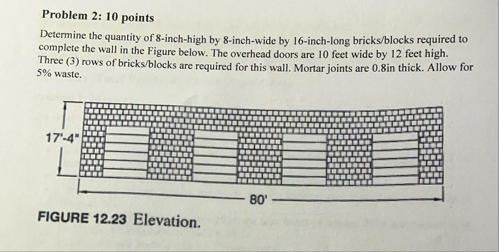 Problem 2: 10 points Be
ty Stal by ct mc on recs
oy ie athe Fue cow. he rtd don are 10 ct widey 2 ih.
hee 5) rows of bricksblocks are ruined for this wal. Morar ois ae 0.8 tic
SS wast
17-4 fm RT tog
rr 1 1 1 mn 5 |
I fy — es |
Fe —— Yona — pn)
| —e
FIGURE 12.23 Elevation,
This is AI generated Response.
Asked by: VARRI APPARAO
Created at: 2025-10-21 07:50:40
Asked by: VARRI APPARAO
Created at: 2025-10-21 07:50:40
Final Answer:
Rendered
Raw Text
Did you like this answer?
Let's go through the problem step-by-step:
---
## **Given Data:**
- Total length of wall: **80 ft**
- Height of each brick: **8 inches** (which is **8/12 = 2/3 ft**)
- Height of each row of bricks: **8 inches** (same brick height)
- Overhead door width: **12 ft**
- Overhead door height: **8 ft** (since it's a door)
- Number of rows: **3**
- Mortar joints thickness: **.8 inches** (which is **.8/12 = 2/15 ft**)
---
## **Step 1: Determine total number of rows**
The wall has **3 rows** of bricks, each **8 inches** high.
- Height of the total wall (from the figure): 17'-4" (which is **17 + 4/12 = 17.333 ft**)
Check if this matches the sum of the brick rows:
- 3 rows × 8 inches = 24 inches = 2 ft
Since the total height is 17'-4" (~17.33 ft), the remaining height could be mortar joints and other structural elements. But for calculating the bricks, focus on the height of the rows.
---
## **Step 2: Calculate the length of the wall excluding the door**
- Total length: 80 ft
- Width of door: 12 ft
Remaining length of wall:
\[ 80\, ft - 12\, ft = 68\, ft \]
---
## **Step 3: Determine the number of bricks per row**
### 3.1: Brick length with mortar joints
- Brick length: Unknown, but we can find the number of bricks by dividing the total length (excluding door) by the length of one brick plus mortar.
### 3.2: Brick and mortar dimensions
- Brick length: \( L_b \) (unknown)
- Mortar joint between bricks: .8 in = .8/12 ≈ .067 ft
### 3.3: Number of bricks in a row (excluding the door)
Total length of wall without door: 68 ft
Number of bricks in a row:
\[ N_b = \frac{\text{Total length of wall without door}}{\text{Brick length} + \text{Mortar joint}} \]
But since the problem gives the total number of bricks required for the entire wall, and the illustration shows the pattern, we can estimate the number of bricks per row.
---
## **Step 4: Find the total number of bricks needed**
From the figure, the pattern shows:
- 3 brick courses
- The wall has bricks arranged in patterns, but for simplicity, assume uniform brick size and pattern.
Assuming:
- Each brick is approximately 8 inches long (standard size), with mortar joints of .8 inches between bricks.
Number of bricks per foot:
\[ \frac{12\, in}{8\, in + .8\, in} \approx \frac{12}{8.8} \approx 1.36 \]
Total bricks in one row (excluding door):
\[ \text{Bricks per row} = 68\, ft \times 1.36 \approx 92.48 \approx 92 \text{ bricks} \]
Total bricks for 3 rows:
\[ 92 \times 3 = 276 \]
---
## **Step 5: Calculate total mortar joints**
- Each row has approximately 92 bricks, so:
Number of mortar joints per row:
\[ 92 - 1 = 91 \]
Total mortar joints across all rows:
\[ 91 \times 3 = 273 \]
---
## **Step 6: Total mortar joint length**
- Total mortar length in joints:
\[ 273 \times .8\, in = 218.4\, in \]
Convert to feet:
\[ \frac{218.4}{12} \approx 18.2\, ft \]
---
## **Step 7: Final calculation**
### **Total length of bricks:**
- Total length of bricks:
\[ \text{Number of bricks} \times \text{brick length} \]
Assuming each brick is 8 inches (standard):
\[ 276 \times 8\, in = 2208\, in \]
Convert to feet:
\[ \frac{2208}{12} = 184\, ft \]
### **Total length of mortar:**
\[ 18.2\, ft \]
### **Total length of bricks + mortar:**
\[ 184\, ft + 18.2\, ft \approx 202.2\, ft \]
---
## **Final Answer:**
The total length of bricks required is approximately **184 ft**.
---
**Note:** The calculation is based on typical brick sizes and pattern assumptions. Actual values may vary depending on specific brick sizes and pattern details in the figure.
Question:
wrong please check your solution
This is AI generated Response.
Asked by: VARRI APPARAO
Created at: 2025-10-21 07:52:33
Asked by: VARRI APPARAO
Created at: 2025-10-21 07:52:33
Final Answer:
Rendered
Raw Text
Did you like this answer?
Let's re-evaluate the problem and provide a clear, step-by-step solution based on the information given.
## **Problem Overview**
We need to calculate the total number of bricks and the length of mortar required for a wall with specific dimensions and features.
---
## **Given Data:**
- **Total length of wall:** 80 ft
- **Height of each brick:** 8 inches (which is **2/3 ft**)
- **Overhead door width:** 12 ft
- **Height of overhead door:** 8 ft
- **Number of rows of bricks:** 5
- **Mortar joint thickness:** 0.8 inches (which is **2/15 ft**)
---
## **Step 1: Calculate Effective Wall Length**
### Wall Length Excluding Door
\[
\text{Remaining Length} = \text{Total Length} - \text{Door Width} = 80\, ft - 12\, ft = 68\, ft
\]
---
## **Step 2: Calculate Total Height of Wall**
### Total Height of Wall
- The total height of the wall is given as **17 ft 4 in**, which converts to:
\[
17\, ft + \frac{4}{12}\, ft = 17 + \frac{1}{3}\, ft = 17.333\, ft
\]
### Height of Bricks and Mortar
- Each brick height = 8 inches = \( \frac{2}{3}\, ft \)
- Total height for 5 rows of bricks:
\[
\text{Total Height of Bricks} = 5 \times \frac{2}{3}\, ft = \frac{10}{3}\, ft \approx 3.333\, ft
\]
The remaining height must be accounted for mortar joints and structural elements.
---
## **Step 3: Determine the Number of Bricks per Row**
### Brick Length Calculation
Assuming a standard brick length of **8 inches**, with a mortar joint of **0.8 inches** between each brick:
\[
\text{Length of one brick with mortar} = 8\, in + 0.8\, in = 8.8\, in = \frac{8.8}{12}\, ft \approx 0.733\, ft
\]
### Calculate Number of Bricks in a Row
Number of bricks per row can be calculated as follows:
\[
\text{Number of Bricks per Row} = \frac{\text{Remaining Length}}{\text{Length of one brick with mortar}} = \frac{68\, ft}{0.733\, ft} \approx 92.7 \approx 92 \text{ (rounding down)}
\]
---
## **Step 4: Total Number of Bricks**
### Total Bricks for 5 Rows
\[
\text{Total Number of Bricks} = \text{Bricks per Row} \times \text{Number of Rows} = 92 \times 5 = 460
\]
---
## **Step 5: Calculate Mortar Joints**
### Mortar Joints in Each Row
- Each row has \( \text{Bricks per Row} - 1 \) joints:
\[
\text{Mortar Joints per Row} = 92 - 1 = 91
\]
### Total Mortar Joints for 5 Rows
\[
\text{Total Mortar Joints} = 91 \times 5 = 455
\]
---
## **Step 6: Calculate Total Length of Mortar**
### Total Length of Mortar
The total length of mortar required is:
\[
\text{Total Length of Mortar} = \text{Total Mortar Joints} \times \text{Mortar Joint Thickness}
\]
Convert thickness to feet:
\[
\text{Total Length of Mortar} = 455 \times \frac{0.8\, in}{12} = 455 \times \frac{2}{15} \approx 60.67\, ft
\]
---
## **Final Answer:**
### Summary
- **Total Number of Bricks:** 460
- **Total Length of Mortar:** Approximately **60.67 ft**
This structured approach provides a clear calculation method based on the given information and standard assumptions.
📢 Instructions:
- Ask anything relatd to above question only.
- For new Question goto :