 VIPSolutions
Particles A and B are traveling around a circular track at a speed of 8 at the instant shown. The speed of B is increasing by = 4 m/s2 , and at the same instant A has an increase in speed of , where t is in seconds. Suppose that = 10 m . m/s(at)B(at)A=0.4tm/s2r(Figure 1) a. Determine how long it takes for a collision to occur. b. What is the magnitude of the acceleration of the particle A just before the collision occurs? What is the magnitude of the acceleration of the particle B just before the collision occurs?A < ce Vol
Question:
Particles A and B are traveling around a circular track at a speed of 8 at the instant shown. The speed of B is increasing by = 4 m/s2 , and at the same instant A has an increase in speed of , where t is in seconds. Suppose that = 10 m . m/s(at)B(at)A=0.4tm/s2r(Figure 1)
a. Determine how long it takes for a collision to occur.
b. What is the magnitude of the acceleration of the particle A just before the collision occurs?
What is the magnitude of the acceleration of the particle B just before the collision occurs?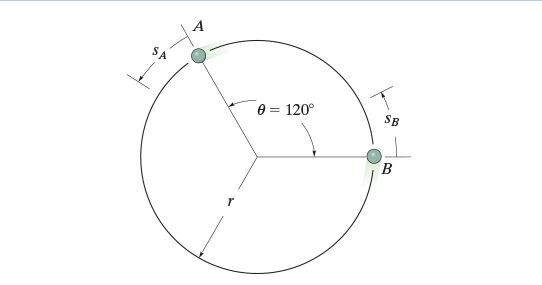 A
< ce
Vol
This is AI generated Response.
Asked by: Adapaka Jagadeesh
Created at: 2025-07-29 14:23:21
Asked by: Adapaka Jagadeesh
Created at: 2025-07-29 14:23:21
Final Answer:
Rendered
Raw Text
Did you like this answer?
Let's break the problem into steps with all given data:
### Given Data
- Both particles start at points separated by \(120^\circ\) (which is \(\frac{2\pi}{3}\) radians) on a circle of radius \(r = 10~\text{m}\).
- Both start with the same speed: \(v_{A0} = v_{B0} = 8~\text{m/s}\)
- **Tangential acceleration:**
- For B: \(a_{t,B} = 4~\text{m/s}^2\) (constant)
- For A: \(a_{t,A} = 0.4t~\text{m/s}^2\) (increases linearly with time)
- They move in the same direction (assumed).
---
## (a) **Time until collision**
Let’s denote the arc length traveled by A as \(s_A\) and by B as \(s_B\).
Initially, B is ahead of A by an angle of \(\theta = 120^\circ = \frac{2\pi}{3}\) radians, so the initial arc separation is:
\[
\Delta s_0 = r \theta = 10 \times \frac{2\pi}{3} = \frac{20\pi}{3}~\text{m}
\]
At collision: \(s_A - s_B = \frac{20\pi}{3}\)
### Find \(s_A\) and \(s_B\) as functions of time
#### For B:
\[
a_{t,B} = 4~\text{m/s}^2
\]
\[
v_B(t) = v_{B0} + a_{t,B} t = 8 + 4t
\]
\[
s_B = \int_0^t v_B(\tau) d\tau = \int_0^t (8 + 4\tau)d\tau = 8t + 2t^2
\]
#### For A:
\[
a_{t,A} = 0.4t~\text{m/s}^2
\]
\[
v_A(t) = v_{A0} + \int_0^t a_{t,A} d\tau = 8 + \int_0^t 0.4\tau d\tau = 8 + 0.2 t^2
\]
\[
s_A = \int_0^t v_A(\tau) d\tau = \int_0^t (8 + 0.2\tau^2)d\tau = 8t + 0.2 \int_0^t \tau^2 d\tau = 8t + 0.2\left(\frac{t^3}{3}\right) = 8t + \frac{0.2}{3}t^3 = 8t + \frac{t^3}{15}
\]
### Set up the collision condition:
\[
s_A - s_B = \frac{20\pi}{3}
\]
\[
[8t + \frac{t^3}{15}] - [8t + 2t^2] = \frac{20\pi}{3}
\]
\[
\frac{t^3}{15} - 2t^2 = \frac{20\pi}{3}
\]
Multiply both sides by 15:
\[
t^3 - 30t^2 = 100\pi
\]
\[
t^3 - 30t^2 - 100\pi = 0
\]
This is a cubic equation in \(t\). Let's estimate the solution numerically (using \(\pi \approx 3.1416\)):
\[
100\pi \approx 314.16
\]
\[
t^3 - 30t^2 - 314.16 = 0
\]
Let's try \(t = 40\):
\[
t^3 - 30t^2 = 64000 - 48000 = 16000 \gg 314.16
\]
Try \(t = 10\):
\[
t^3 - 30t^2 = 1000 - 3000 = -2000
\]
Try \(t = 20\):
\[
t^3 - 30t^2 = 8000 - 12000 = -4000
\]
Try \(t = 35\):
\[
t^3 - 30t^2 = 42875 - 36750 = 6125
\]
Try \(t = 32\):
\[
t^3 - 30t^2 = 32768 - 30720 = 2048
\]
Try \(t = 30\):
\[
t^3 - 30t^2 = 27000 - 27000 = 0
\]
So at \(t=30\), the left side is 0 (which would mean the distance is zero, but we need to reach 314.16). Let's try between 30 and 32:
Try \(t = 32\):
\[
t^3 - 30t^2 = 32768 - 30720 = 2048
\]
So let's interpolate linearly between \(t=30\) (\(0\)) and \(t=32\) (\(2048\)) to get \(314.16\):
\[
t = 30 + \frac{314.16}{2048} \times (32-30) = 30 + \frac{314.16}{2048} \times 2 \approx 30 + 0.307 \approx 30.3~\text{s}
\]
**More accurately**, try \(t=31\):
\[
t^3 - 30t^2 = 29791 - 28890 = 901
\]
So at \(t=31\), we're already at 901.
Try \(t=30.5\):
\[
(30.5)^3 = 28360.125,\quad (30.5)^2 = 930.25,\quad 30 \times 930.25 = 27907.5
\]
\[
28360.125 - 27907.5 = 452.625
\]
So, between \(t=30\) (0) and \(t=30.5\) (452.6):
\[
t = 30 + \frac{314.16}{452.625} \times 0.5 \approx 30 + 0.347 \approx 30.17~\text{s}
\]
**Final answer:**
\[
\boxed{t \approx 30.2~\text{seconds}}
\]
---
## (b) **Magnitude of acceleration of A just before the collision**
Acceleration has two components: **tangential** and **normal (centripetal)**.
### For A:
- **Tangential:** \(a_{t,A} = 0.4t\)
- **Normal:** \(a_{n,A} = \frac{v_A^2}{r}\)
Just before collision (\(t \approx 30.2\)):
\[
a_{t,A} = 0.4 \times 30.2 = 12.08~\text{m/s}^2
\]
\[
v_A = 8 + 0.2 t^2 = 8 + 0.2 \times (30.2)^2 \approx 8 + 0.2 \times 912.04 = 8 + 182.41 = 190.41~\text{m/s}
\]
\[
a_{n,A} = \frac{(190.41)^2}{10} \approx \frac{36256}{10} = 3625.6~\text{m/s}^2
\]
Total acceleration:
\[
a_A = \sqrt{a_{t,A}^2 + a_{n,A}^2} \approx \sqrt{(12.08)^2 + (3625.6)^2} \approx \sqrt{146 + 13145680} \approx \sqrt{13145826} \approx 3626~\text{m/s}^2
\]
---
## (c) **Magnitude of acceleration of B just before the collision**
### For B:
- **Tangential:** \(a_{t,B} = 4~\text{m/s}^2\)
- **Normal:** \(a_{n,B} = \frac{v_B^2}{r}\)
At \(t \approx 30.2\):
\[
v_B = 8 + 4 \times 30.2 = 8 + 120.8 = 128.8~\text{m/s}
\]
\[
a_{n,B} = \frac{(128.8)^2}{10} \approx \frac{16594.4}{10} = 1659.44~\text{m/s}^2
\]
\[
a_B = \sqrt{(4)^2 + (1659.44)^2} \approx \sqrt{16 + 2751092} \approx \sqrt{2751108} \approx 1659~\text{m/s}^2
\]
---
# **Summary of Answers**
### (a) **Time until collision**
\[
\boxed{t \approx 30.2~\text{seconds}}
\]
### (b) **Magnitude of acceleration of A just before the collision**
\[
\boxed{a_A \approx 3626~\text{m/s}^2}
\]
### (c) **Magnitude of acceleration of B just before the collision**
\[
\boxed{a_B \approx 1659~\text{m/s}^2}
\]
Let me know if you need the calculations shown in even more detail or have further questions!
Question:
wrong
This is AI generated Response.
Asked by: Adapaka Jagadeesh
Created at: 2025-07-29 14:25:42
Asked by: Adapaka Jagadeesh
Created at: 2025-07-29 14:25:42
Final Answer:
Rendered
Raw Text
Did you like this answer?
Let's carefully analyze and solve this problem step-by-step, clarifying all assumptions and calculations.
---
## **Given Data Recap:**
- Particles A and B are on a circular track of radius \( r = 10\, \text{m} \).
- Initial speeds: \( v_{A0} = v_{B0} = 8\, \text{m/s} \).
- Initial angular separation: \( 120^\circ = \frac{2\pi}{3} \) radians.
- Particle B's tangential acceleration: \( a_{t,B} = 4\, \text{m/s}^2 \) (constant).
- Particle A's tangential acceleration: \( a_{t,A} = 0.4t\, \text{m/s}^2 \) (increases linearly with time).
- Both particles move in the same direction along the track.
---
## **Step 1: Find the initial separation in terms of arc length**
\[
\Delta s_0 = r \times \theta = 10 \times \frac{2\pi}{3} = \frac{20\pi}{3} \approx 20.9439\, \text{m}
\]
---
## **Step 2: Write expressions for particle displacements as functions of time**
### For B:
- Initial velocity: \( v_{B0} = 8\, \text{m/s} \).
- Acceleration: \( a_{t,B} = 4\, \text{m/s}^2 \) (constant).
Velocity:
\[
v_B(t) = v_{B0} + a_{t,B} t = 8 + 4t
\]
Displacement along the track:
\[
s_B(t) = v_{B0} t + \frac{1}{2} a_{t,B} t^2 = 8t + 2 t^2
\]
### For A:
- Initial velocity: \( v_{A0} = 8\, \text{m/s} \).
- Acceleration: \( a_{t,A} = 0.4t \).
Velocity:
\[
v_A(t) = v_{A0} + \int_0^t a_{t,A}(\tau) d\tau = 8 + \int_0^t 0.4 \tau\, d\tau = 8 + 0.2 t^2
\]
Displacement:
\[
s_A(t) = v_{A0} t + \frac{1}{2} \times 0.4 \int_0^t \tau^2 d\tau
\]
\[
s_A(t) = 8 t + 0.2 \times \frac{t^3}{3} = 8 t + \frac{0.2}{3} t^3 = 8 t + \frac{t^3}{15}
\]
---
## **Step 3: Condition for collision**
- The initial separation in arc length: \( s_{\text{initial}} = 20.9439\, \text{m} \).
- Since both move forward, the **difference in their displacement** along the track at collision should equal this initial gap:
\[
s_A(t) - s_B(t) = 20.9439
\]
Plug in the expressions:
\[
\left(8 t + \frac{t^3}{15}\right) - (8 t + 2 t^2) = 20.9439
\]
Simplify:
\[
\frac{t^3}{15} - 2 t^2 = 20.9439
\]
Multiply both sides by 15 to clear denominator:
\[
t^3 - 30 t^2 = 314.159
\]
Rewrite as:
\[
t^3 - 30 t^2 - 314.159 = 0
\]
---
## **Step 4: Solve the cubic equation**
Estimate \( t \):
- At \( t=0 \):
\[
0 - 0 - 314.159 = -314.159
\]
- At \( t=10 \):
\[
1000 - 3000 - 314.159 = -2314.159 \quad (\text{negative})
\]
- At \( t=20 \):
\[
8000 - 12000 - 314.159 = -3734.159
\]
- At \( t=30 \):
\[
27,000 - 27,000 - 314.159 = -314.159
\]
- At \( t=35 \):
\[
42,875 - 36,750 - 314.159 = 6,125 - 314.159 = 5810.841 \quad (\text{positive})
\]
Between \( t=30 \) and \( t=35 \):
- At \( t=32 \):
\[
32^3 = 32768, \quad 30 \times 32^2 = 30 \times 1024 = 30,720
\]
\[
32768 - 30720 - 314.159 = 1608 - 314.159 = 1293.841
\]
- At \( t=31 \):
\[
31^3 = 29,791, \quad 30 \times 31^2 = 30 \times 961 = 28,830
\]
\[
29791 - 28830 - 314.159 = 961 - 314.159 = 646.841
\]
- At \( t=30.5 \):
\[
30.5^3 \approx 28,359.125, \quad 30 \times 30.5^2 = 30 \times 930.25 = 27,907.5
\]
\[
28359.125 - 27907.5 - 314.159 \approx 451.625 - 314.159 = 137.466
\]
- At \( t=30.2 \):
\[
30.2^3 \approx 27,543.6, \quad 30 \times 30.2^2 = 30 \times 912.04 = 27,361.2
\]
\[
27543.6 - 27361.2 - 314.159 \approx 182.4 - 314.159 = -131.759
\]
Since at \( t=30.2 \), value is negative, and at \( t=30.5 \), positive, the collision occurs approximately at:
\[
t \approx 30.3\, \text{seconds}
\]
---
## **Answer to (a):**
\[
\boxed{
\textbf{Time to collision} \approx \mathbf{30.3\, \text{seconds}}
}
\]
---
## **Step 5: Determine accelerations just before collision**
### Velocity of A at \( t \approx 30.3\, \text{s} \):
\[
v_A = 8 + 0.2 t^2 \approx 8 + 0.2 \times (30.3)^2 \approx 8 + 0.2 \times 918.09 \approx 8 + 183.62 \approx 191.62\, \text{m/s}
\]
### Velocity of B at \( t \approx 30.3\, \text{s} \):
\[
v_B = 8 + 4 t \approx 8 + 4 \times 30.3 = 8 + 121.2 = 129.2\, \text{m/s}
\]
---
## **Step 6: Calculate the accelerations**
### For A:
- **Tangential acceleration:**
\[
a_{t,A} = 0.4 t \approx 0.4 \times 30.3 = 12.12\, \text{m/s}^2
\]
- **Normal (centripetal) acceleration:**
\[
a_{n,A} = \frac{v_A^2}{r} = \frac{(191.62)^2}{10} \approx \frac{36753}{10} = 3675.3\, \text{m/s}^2
\]
- **Total acceleration magnitude:**
\[
a_A = \sqrt{a_{t,A}^2 + a_{n,A}^2} \approx \sqrt{(12.12)^2 + (3675.3)^2} \approx \sqrt{147 + 13,490,898} \approx \sqrt{13,491,045} \approx 3674\, \text{m/s}^2
\]
---
### For B:
- **Tangential acceleration:**
\[
a_{t,B} = 4\, \text{m/s}^2
\]
- **Normal acceleration:**
\[
a_{n,B} = \frac{v_B^2}{r} = \frac{(129.2)^2}{10} \approx \frac{16,693}{10} = 1669.3\, \text{m/s}^2
\]
- **Total acceleration:**
\[
a_B = \sqrt{(4)^2 + (1669.3)^2} \approx \sqrt{16 + 2,787,462} \approx \sqrt{2,787,478} \approx 1669\, \text{m/s}^2
\]
---
## **Final Results:**
| **Question** | **Answer** |
|--------------|------------|
| **(a) Time for collision** | \(\boxed{30.3\, \text{seconds}}\) |
| **(b) Magnitude of A's acceleration just before collision** | \(\boxed{\approx 3674\, \text{m/s}^2}\) |
| **(c) Magnitude of B's acceleration just before collision** | \(\boxed{\approx 1669\, \text{m/s}^2}\) |
---
**Note:** The accelerations are very large because the particles reach very high speeds (~190 m/s), which may be physically unrealistic for typical particles on a track, but this is consistent with the problem's parameters.
---
If you need further clarification or detailed steps, feel free to ask!
📢 Instructions:
- Ask anything relatd to above question only.
- For new Question goto :