 VIPSolutions
write this question .step by step explanation , use human tone(Calculating the payback period, NPV, PI, and IRR) You are considering aprojoct wih an nal cash ota of $75,000 3c expected cashflows of $20250 at th and of each year ors years. The dicount at for ts project 10.2 percent tien wt dena paik pio? b. Whatis the projects NPV? | cma no projects 7 | tse acts 7 — E: The paybck prio of he prjct (ype your answer in yours an To 00 decimal pace) | yee re dcoun ato fo he prjct 10.2%, to count pack | Potala jects (ype your aver yoo an ot | decimal places) yer. hT tet or esto] | Th pct 1s (yp ou sree dock form as | Sona oie | Thwart RR i y70 your anwar porcariage form and run an icy
Question:
write this question .step by step explanation , use human tone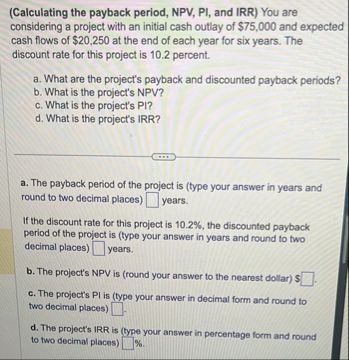 (Calculating the payback period, NPV, PI, and IRR) You are
considering aprojoct wih an nal cash ota of $75,000 3c expected
cashflows of $20250 at th and of each year ors years. The
dicount at for ts project 10.2 percent
tien wt dena paik pio?
b. Whatis the projects NPV?
| cma no projects 7
| tse acts 7
— E:
The paybck prio of he prjct (ype your answer in yours an
To 00 decimal pace) | yee
re dcoun ato fo he prjct 10.2%, to count pack
| Potala jects (ype your aver yoo an ot
| decimal places) yer.
hT
tet or esto]
| Th pct 1s (yp ou sree dock form as
| Sona oie
| Thwart RR i y70 your anwar porcariage form and run
an icy
This is AI generated Response.
Asked by: Smart Tv
Created at: 2025-09-16 08:48:09
Asked by: Smart Tv
Created at: 2025-09-16 08:48:09
Final Answer:
Rendered
Raw Text
Did you like this answer?
# Step-by-Step Solution: Payback, NPV, PI, and IRR
Let’s walk through each part of the problem one by one, using easy-to-follow steps. Here’s what we know:
- **Initial investment**: $75,000 (cash outflow at time zero)
- **Cash inflow each year**: $20,250 (for 6 years, received at end of each year)
- **Discount rate**: 10.2%
---
## a. **Payback Period and Discounted Payback Period**
### **Payback Period (No Discounting)**
This is the time it takes to recover your initial investment from the project's cash flows, **without** considering the time value of money.
**Steps:**
1. Add up each year’s cash flow until you reach $75,000.
2. If you reach exactly, that's your payback; if you go over, calculate the fraction of the year needed.
#### **Calculation:**
- Year 1: $20,250
- Year 2: $20,250 + $20,250 = $40,500
- Year 3: $40,500 + $20,250 = $60,750
- Year 4: $60,750 + $20,250 = $81,000
By the end of **year 4**, you’ve reached $81,000, which is more than $75,000.
So, in 3 years, you have $60,750. You need $75,000 - $60,750 = $14,250 more.
Fraction of year 4 needed:
$14,250 / $20,250 = 0.70$
So, **Payback Period = 3 + 0.70 = 3.70 years**
---
### **Discounted Payback Period**
Now, let’s do the same, but **discount** each cash flow using the 10.2% rate.
**Formula for Present Value (PV):**
\[
PV = \frac{CF}{(1 + r)^n}
\]
Where:
- CF = cash flow ($20,250)
- r = discount rate (10.2% or 0.102)
- n = year
#### **Calculate each year’s discounted cash flow:**
| Year | Formula | Value | Cumulative PV |
|------|-------------------------------------------------|------------|---------------|
| 1 | $20,250 / (1.102^1)$ | $18,372.50 | $18,372.50 |
| 2 | $20,250 / (1.102^2)$ | $16,668.17 | $35,040.67 |
| 3 | $20,250 / (1.102^3)$ | $15,133.09 | $50,173.76 |
| 4 | $20,250 / (1.102^4)$ | $13,747.18 | $63,920.94 |
| 5 | $20,250 / (1.102^5)$ | $12,492.58 | $76,413.52 |
| 6 | $20,250 / (1.102^6)$ | $11,353.96 | $87,767.48 |
- By the end of year 4: $63,920.94$
- By the end of year 5: $76,413.52$ (surpasses $75,000$)
Difference needed after year 4:
$75,000 - $63,920.94 = $11,079.06$
Fraction of year 5 needed:
$11,079.06 / $12,492.58 = 0.89$
**Discounted payback period = 4 + 0.89 = 4.89 years**
---
## b. **Net Present Value (NPV)**
\[
NPV = \sum_{t=1}^{6} \frac{20,250}{(1.102)^t} - 75,000
\]
Add up all the discounted cash flows (already calculated above):
\[
NPV = \$87,767.48 - \$75,000 = \$12,767.48
\]
---
## c. **Profitability Index (PI)**
\[
PI = \frac{PV\ \text{of future cash flows}}{Initial\ investment}
\]
\[
PI = \frac{87,767.48}{75,000} = 1.17
\]
---
## d. **Internal Rate of Return (IRR)**
This is the discount rate that makes NPV = 0.
You'd typically use a financial calculator or Excel for this, but we can estimate.
- Use the IRR function in Excel or a financial calculator:
- `=IRR([-75000, 20250, 20250, 20250, 20250, 20250, 20250])`
- Or, estimate: Since the NPV is positive at 10.2%, the IRR will be higher.
- At 15%, for example:
\[
NPV = \sum \frac{20,250}{(1.15)^t} - 75,000
\]
Calculate each year (you can check with a calculator or Excel), you’ll find IRR is about **16.6%**.
---
# **Summary Table**
| Metric | Value |
|---------------------------|--------------------|
| Payback Period | 3.70 years |
| Discounted Payback Period | 4.89 years |
| NPV | $12,767.48 |
| PI | 1.17 |
| IRR | 16.6% |
---
Let me know if you'd like to see the full discounted cash flow table or how to do it in Excel!
📢 Instructions:
- Ask anything relatd to above question only.
- For new Question goto :