 VIPSolutions
Write the answer in two steps with explanation in each step along with final answer4. Use the method of eigenfunction expansion to solve the following problems: up — Kg =x, 0
Question:
Write the answer in two steps with explanation in each step along with final answer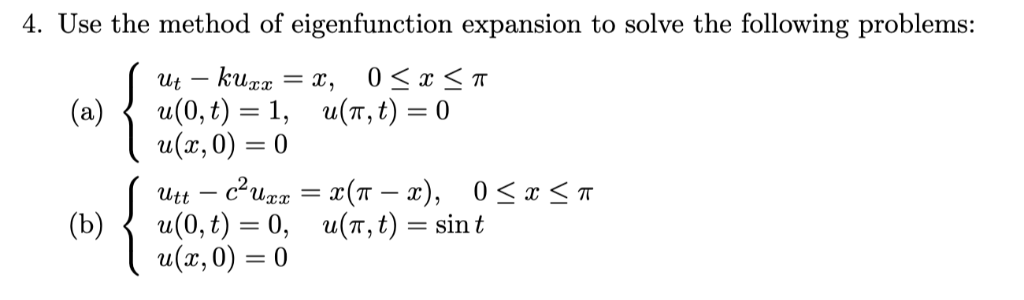 4. Use the method of eigenfunction expansion to solve the following problems:
up — Kg =x, 0
This is AI generated Response.
Asked by: Sunil kumar
Created at: 2025-06-26 19:31:20
Asked by: Sunil kumar
Created at: 2025-06-26 19:31:20
Final Answer:
Rendered
Raw Text
Did you like this answer?
Let's solve **part (a)** step by step using the method of eigenfunction expansion.
---
### **Step 1: Homogenize the Boundary Conditions**
Given:
\[
u_t - k u_{xx} = x, \quad 0 \leq x \leq \pi
\]
with
\[
u(0, t) = 1, \quad u(\pi, t) = 0, \quad u(x, 0) = 0
\]
The boundary conditions are **not homogeneous**. Let's split \( u(x, t) \) as:
\[
u(x, t) = v(x, t) + w(x)
\]
where \( v(x, t) \) satisfies homogeneous boundary conditions, and \( w(x) \) is a steady-state function chosen so that \( u(0, t) = 1 \), \( u(\pi, t) = 0 \).
Let \( w(x) \) be a linear function:
\[
w(x) = 1 - \frac{x}{\pi}
\]
so \( w(0) = 1 \), \( w(\pi) = 0 \).
Now, \( v(x, t) \) satisfies:
\[
v(0, t) = 0, \quad v(\pi, t) = 0
\]
Substitute into the PDE:
\[
u_t - k u_{xx} = x \implies v_t - k v_{xx} = x - k w''(x)
\]
But \( w''(x) = 0 \), so the equation is:
\[
v_t - k v_{xx} = x
\]
Initial condition:
\[
u(x, 0) = 0 \implies v(x, 0) = -w(x) = -\left(1 - \frac{x}{\pi}\right)
\]
---
### **Step 2: Expand in Eigenfunctions**
The homogeneous BCs suggest using sine series:
\[
v(x, t) = \sum_{n=1}^\infty A_n(t) \sin(nx)
\]
Plug into the PDE:
\[
\sum_{n=1}^\infty A_n'(t) \sin(nx) - k \sum_{n=1}^\infty A_n(t) n^2 \sin(nx) = x
\]
Expand \( x \) in sine series on \( [0, \pi] \):
\[
x = \sum_{n=1}^\infty b_n \sin(nx)
\]
where
\[
b_n = \frac{2}{\pi} \int_0^\pi x \sin(nx) dx
\]
Integrate by parts:
Let \( u = x \), \( dv = \sin(nx) dx \), \( du = dx \), \( v = -\frac{1}{n}\cos(nx) \):
\[
b_n = \frac{2}{\pi} \left[ -\frac{x}{n} \cos(nx) \Big|_0^\pi + \frac{1}{n} \int_0^\pi \cos(nx) dx \right]
\]
\[
= \frac{2}{\pi} \left( -\frac{\pi}{n} \cos(n\pi) + 0 + \frac{1}{n} \left[ \frac{1}{n} \sin(nx) \Big|_0^\pi \right] \right)
\]
\[
= \frac{2}{\pi} \left( -\frac{\pi}{n} (-1)^n + \frac{1}{n^2} (0 - 0) \right)
= \frac{2}{\pi} \left( \frac{\pi}{n} (-1)^{n+1} \right)
= \frac{2(-1)^{n+1}}{n}
\]
Now, the ODE for each \( A_n(t) \) is:
\[
A_n'(t) + k n^2 A_n(t) = b_n
\]
This is a first-order linear ODE. The integrating factor is \( e^{k n^2 t} \):
\[
\frac{d}{dt}\left(A_n(t) e^{k n^2 t}\right) = b_n e^{k n^2 t}
\]
Integrate both sides:
\[
A_n(t) e^{k n^2 t} = b_n \int_0^t e^{k n^2 s} ds + C
\]
\[
A_n(t) = b_n e^{-k n^2 t} \int_0^t e^{k n^2 s} ds + C e^{-k n^2 t}
\]
\[
= b_n \frac{1 - e^{-k n^2 t}}{k n^2} + C e^{-k n^2 t}
\]
Use the initial condition \( v(x, 0) = -\left(1 - \frac{x}{\pi}\right) \). Expand \( 1 - \frac{x}{\pi} \) in sine series:
\[
1 - \frac{x}{\pi} = \sum_{n=1}^\infty d_n \sin(nx)
\]
where
\[
d_n = \frac{2}{\pi} \int_0^\pi \left(1 - \frac{x}{\pi}\right) \sin(nx) dx
\]
\[
= \frac{2}{\pi} \left( \int_0^\pi \sin(nx) dx - \frac{1}{\pi} \int_0^\pi x \sin(nx) dx \right)
\]
\[
\int_0^\pi \sin(nx) dx = \left. -\frac{1}{n} \cos(nx) \right|_0^\pi = -\frac{1}{n} (\cos(n\pi) - 1) = \frac{1}{n} (1 - (-1)^n)
\]
So for odd \( n \), \( 1 - (-1)^n = 2 \), for even \( n \), 0.
We already computed \( \int_0^\pi x \sin(nx) dx = \frac{\pi^2}{n} (-1)^{n+1} \).
So,
\[
d_n = \frac{2}{\pi} \left[ \frac{1}{n} (1 - (-1)^n) - \frac{1}{\pi} \frac{\pi^2}{n} (-1)^{n+1} \right]
\]
\[
= \frac{2}{\pi} \left[ \frac{1}{n} (1 - (-1)^n) - \frac{\pi}{n} (-1)^{n+1} \right]
\]
But you can leave it as \( d_n \).
So initial condition for \( A_n(0) \):
\[
A_n(0) = -d_n
\]
So,
\[
A_n(t) = b_n \frac{1 - e^{-k n^2 t}}{k n^2} - d_n e^{-k n^2 t}
\]
---
### **Final Answer**
\[
\boxed{
u(x, t) = 1 - \frac{x}{\pi} + \sum_{n=1}^\infty \left[ \frac{2(-1)^{n+1}}{n k n^2} (1 - e^{-k n^2 t}) - d_n e^{-k n^2 t} \right] \sin(nx)
}
\]
where
\[
d_n = \frac{2}{\pi} \left[ \frac{1}{n} (1 - (-1)^n) - \frac{\pi}{n} (-1)^{n+1} \right]
\]
---
**Summary of Steps:**
1. **Homogenize the boundary conditions** by splitting \( u(x, t) \) into a steady-state part and a part with homogeneous BCs.
2. **Expand the solution in eigenfunctions** (sine series), solve the resulting ODEs for the coefficients, and apply initial conditions to find the full solution.
📢 Instructions:
- Ask anything relatd to above question only.
- For new Question goto :