 VIPSolutions
Act like a helpful tutor and exlain me :At an instance during the calibration process of a coordinate measuring machine, its arms bh R are inthe position shown. For known lengths Ly, Ly, L, and for variable angles 6, & 6, write down the position vector denoting the tip R with respect to the origin 0. 0 I. Your answer should be of the form 7 = (_ I, + ( J, where fi, and fi, are t unit vectors shown in the figure. 2) 6 & I,
Question:
Act like a helpful tutor and exlain me :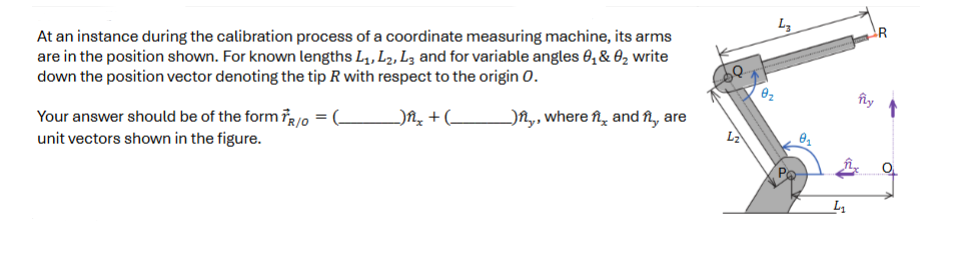 At an instance during the calibration process of a coordinate measuring machine, its arms bh R
are inthe position shown. For known lengths Ly, Ly, L, and for variable angles 6, & 6, write
down the position vector denoting the tip R with respect to the origin 0.
0 I.
Your answer should be of the form 7 = (_ I, + ( J, where fi, and fi, are t
unit vectors shown in the figure. 2) 6
&
I,
This is AI generated Response.
Asked by: Alok Kumar
Created at: 2026-01-27 06:10:01
Asked by: Alok Kumar
Created at: 2026-01-27 06:10:01
Final Answer:
Rendered
Raw Text
Did you like this answer?
# Explanation: Position Vector of the Tip \( R \) with Respect to Origin \( O \)
Let's break down the problem step by step.
## **Understanding the Setup**
- The arm consists of **three segments** with lengths \( L_1 \), \( L_2 \), and \( L_3 \).
- The angles \( \theta_1 \) and \( \theta_2 \) denote the rotations at the joints.
- You are to find the position vector of point \( R \) (the tip) **relative to the origin \( O \)**.
- The answer should be in the form:
\[
\vec{r}_{R/O} = (\text{_____})\hat{n}_x + (\text{_____})\hat{n}_y
\]
where \( \hat{n}_x \) and \( \hat{n}_y \) are the unit vectors along the \( x \) and \( y \) axes.
---
## **Step-by-Step Solution**
### **1. Decompose Each Segment**
#### **Segment 1: \( O \) to \( P \)**
- Length: \( L_1 \)
- Direction: Along \( x \)-axis.
- Position of \( P \) relative to \( O \):
\[
\vec{r}_{P/O} = L_1 \hat{n}_x
\]
#### **Segment 2: \( P \) to \( Q \)**
- Length: \( L_2 \)
- Angle: \( \theta_1 \) from the \( x \)-axis.
- The \( x \) and \( y \) components:
\[
\vec{r}_{Q/P} = L_2 \cos \theta_1 \hat{n}_x + L_2 \sin \theta_1 \hat{n}_y
\]
#### **Segment 3: \( Q \) to \( R \)**
- Length: \( L_3 \)
- Angle: \( \theta_1 + \theta_2 \) from the \( x \)-axis (because the second arm rotates by \( \theta_2 \) relative to the previous segment).
- The \( x \) and \( y \) components:
\[
\vec{r}_{R/Q} = L_3 \cos (\theta_1 + \theta_2) \hat{n}_x + L_3 \sin (\theta_1 + \theta_2) \hat{n}_y
\]
---
### **2. Add the Vectors Together**
The total position vector from \( O \) to \( R \) is:
\[
\vec{r}_{R/O} = \vec{r}_{P/O} + \vec{r}_{Q/P} + \vec{r}_{R/Q}
\]
Substitute the values:
\[
\begin{align*}
\vec{r}_{R/O} = \; & [L_1 \hat{n}_x] + [L_2 \cos \theta_1 \hat{n}_x + L_2 \sin \theta_1 \hat{n}_y] \\
& + [L_3 \cos (\theta_1 + \theta_2) \hat{n}_x + L_3 \sin (\theta_1 + \theta_2) \hat{n}_y]
\end{align*}
\]
---
### **3. Group the \( \hat{n}_x \) and \( \hat{n}_y \) Components**
- \( \hat{n}_x \) component:
\[
L_1 + L_2 \cos \theta_1 + L_3 \cos (\theta_1 + \theta_2)
\]
- \( \hat{n}_y \) component:
\[
L_2 \sin \theta_1 + L_3 \sin (\theta_1 + \theta_2)
\]
---
## **Final Answer**
\[
\boxed{
\vec{r}_{R/O} = \left[ L_1 + L_2 \cos \theta_1 + L_3 \cos (\theta_1 + \theta_2) \right] \hat{n}_x
+ \left[ L_2 \sin \theta_1 + L_3 \sin (\theta_1 + \theta_2) \right] \hat{n}_y
}
\]
**This expression gives you the position of the tip \( R \) with respect to the origin \( O \) for any values of \( L_1, L_2, L_3, \theta_1, \) and \( \theta_2 \).**
---
### **Summary Table**
| Segment | \( x \)-component | \( y \)-component |
|-------------|----------------------------------|-------------------------------------|
| \( O \to P \) | \( L_1 \) | \( \) |
| \( P \to Q \) | \( L_2 \cos \theta_1 \) | \( L_2 \sin \theta_1 \) |
| \( Q \to R \) | \( L_3 \cos(\theta_1+\theta_2) \) | \( L_3 \sin(\theta_1+\theta_2) \) |
Question:
without tabular form solution
This is AI generated Response.
Asked by: Alok Kumar
Created at: 2026-01-27 06:10:36
Asked by: Alok Kumar
Created at: 2026-01-27 06:10:36
Final Answer:
Rendered
Raw Text
Did you like this answer?
# Position Vector of the Tip \( R \) with Respect to Origin \( O \)
This guide explains how to derive the position vector of point \( R \) in a 2D coordinate system based on the lengths of the arms and the angles at the joints.
## **Setup Description**
- **Segments:** The arm consists of three segments with lengths \( L_1 \), \( L_2 \), and \( L_3 \).
- **Angles:** The angles \( \theta_1 \) and \( \theta_2 \) are the rotations at the joints.
- **Objective:** Find the position vector \( \vec{r}_{R/O} \) in the form:
\[
\vec{r}_{R/O} = (x_R) \hat{n}_x + (y_R) \hat{n}_y
\]
---
## **Step-by-Step Calculation**
### **1. Calculate Position of Each Segment**
#### **Segment 1: From \( O \) to \( P \)**
- **Length:** \( L_1 \)
- **Position Vector:**
\[
\vec{r}_{P/O} = L_1 \hat{n}_x
\]
#### **Segment 2: From \( P \) to \( Q \)**
- **Length:** \( L_2 \)
- **Direction:** At angle \( \theta_1 \)
- **Position Vector:**
\[
\vec{r}_{Q/P} = L_2 \cos \theta_1 \hat{n}_x + L_2 \sin \theta_1 \hat{n}_y
\]
#### **Segment 3: From \( Q \) to \( R \)**
- **Length:** \( L_3 \)
- **Direction:** At angle \( \theta_1 + \theta_2 \)
- **Position Vector:**
\[
\vec{r}_{R/Q} = L_3 \cos(\theta_1 + \theta_2) \hat{n}_x + L_3 \sin(\theta_1 + \theta_2) \hat{n}_y
\]
---
### **2. Sum the Position Vectors**
The total position vector from \( O \) to \( R \) is given by:
\[
\vec{r}_{R/O} = \vec{r}_{P/O} + \vec{r}_{Q/P} + \vec{r}_{R/Q}
\]
Substituting the individual vectors:
\[
\begin{align*}
\vec{r}_{R/O} = & \, L_1 \hat{n}_x + \left( L_2 \cos \theta_1 \hat{n}_x + L_2 \sin \theta_1 \hat{n}_y \right) \\
& + \left( L_3 \cos(\theta_1 + \theta_2) \hat{n}_x + L_3 \sin(\theta_1 + \theta_2) \hat{n}_y \right)
\end{align*}
\]
### **3. Combine Components**
#### **\( x \)-Component:**
\[
x_R = L_1 + L_2 \cos \theta_1 + L_3 \cos(\theta_1 + \theta_2)
\]
#### **\( y \)-Component:**
\[
y_R = L_2 \sin \theta_1 + L_3 \sin(\theta_1 + \theta_2)
\]
---
## **Final Position Vector**
Combining the components, the position vector of the tip \( R \) is:
\[
\boxed{
\vec{r}_{R/O} = \left[ L_1 + L_2 \cos \theta_1 + L_3 \cos(\theta_1 + \theta_2) \right] \hat{n}_x
+ \left[ L_2 \sin \theta_1 + L_3 \sin(\theta_1 + \theta_2) \right] \hat{n}_y
}
\]
This expression represents the position of point \( R \) relative to the origin \( O \) based on the given lengths and angles.
📢 Instructions:
- Ask anything relatd to above question only.
- For new Question goto :