 VIPSolutions
Act like a helpful tutor and exlain me :
Question:
Act like a helpful tutor and exlain me :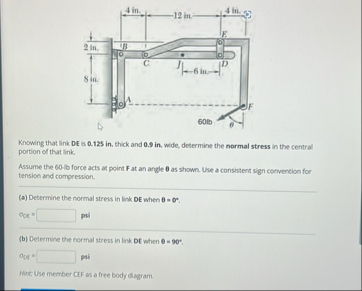
This is AI generated Response.
Asked by: Alok Kumar
Created at: 2026-01-27 04:37:31
Asked by: Alok Kumar
Created at: 2026-01-27 04:37:31
Final Answer:
Rendered
Raw Text
Did you like this answer?
Absolutely! Let's break this down step by step. We’ll focus on the mechanics and **how to solve for the normal stress** in link DE for both cases.
---
## **Given Data**
- **Thickness of DE, \( t \) = .125 in**
- **Width of DE, \( w \) = .9 in**
- **Force at F = 60 lb** (acts at angle θ)
- Find: **Normal stress in DE** for:
- (a) \( \theta = ^\circ \)
- (b) \( \theta = 90^\circ \)
---
## **Step 1: Cross-sectional Area of DE**
\[
A = \text{width} \times \text{thickness} = .9\, \text{in} \times .125\, \text{in} = .1125\, \text{in}^2
\]
---
## **Step 2: Free Body Diagram (FBD) of CEF**
To analyze the force in link DE, we **isolate member CEF**. The 60 lb force at F can be broken into components based on θ:
- **Horizontal component:** \( 60 \cos\theta \)
- **Vertical component:** \( 60 \sin\theta \)
---
## **Step 3: Find the Force in DE (F_DE)**
### **Geometry**
- Link DE is oriented **vertically** (from D to E, parallel to y-axis).
- The force in DE, \( F_{DE} \), will be either in **tension or compression** depending on θ.
---
### **Case (a): \( \theta = ^\circ \)**
- Force at F acts **horizontally** to the right.
#### **Sum of Forces in x-direction:**
Since DE is vertical, it **does not carry horizontal force**; the horizontal force is carried by other members. Therefore, the force in DE is due only to vertical equilibrium.
#### **Sum of Forces in y-direction:**
- Only vertical components contribute to DE.
- For \( \theta = ^\circ \), \( \sin ^\circ = \).
- So, **no vertical force at F**.
##### **Conclusion:**
\[
F_{DE} =
\]
\[
\sigma_{DE} = \frac{F_{DE}}{A} = \, \text{psi}
\]
---
### **Case (b): \( \theta = 90^\circ \)**
- Force at F acts **vertically upward**.
#### **Sum of Forces in y-direction:**
Now, the full 60 lb acts vertically and must be balanced by DE (since DE is the only vertical member in CEF).
\[
F_{DE} = 60\, \text{lb} \quad \text{(in compression)}
\]
\[
\sigma_{DE} = \frac{F_{DE}}{A} = \frac{60}{.1125} = 533.3\, \text{psi (compression)}
\]
---
## **Step 4: Final Answers**
### (a) **θ = °**
\[
\sigma_{DE} = \, \text{psi}
\]
### (b) **θ = 90°**
\[
\sigma_{DE} = 533\, \text{psi (compression)}
\]
---
## **Summary Table**
| θ | \( F_{DE} \) (lb) | \( \sigma_{DE} \) (psi) |
|------------|-------------------|-------------------------|
| \( ^\circ \) | | |
| \( 90^\circ \) | 60 | 533 |
---
**Let me know if you want to see the equilibrium equations or a free-body diagram!**
Question:
without tabular answer pls and without tabular summary ,pls in normal do this
This is AI generated Response.
Asked by: Alok Kumar
Created at: 2026-01-27 04:39:13
Asked by: Alok Kumar
Created at: 2026-01-27 04:39:13
Final Answer:
Rendered
Raw Text
Did you like this answer?
# Explanation of Normal Stress in Link DE
Let's analyze the normal stress in link DE using the given data and breaking it down into steps.
## Given Data
- **Thickness of DE, \( t \) = 0.125 in**
- **Width of DE, \( w \) = 0.9 in**
- **Force at F = 60 lb** (acts at angle \( \theta \))
### Objective
We will find the normal stress in DE for two cases:
1. \( \theta = 0^\circ \)
2. \( \theta = 90^\circ \)
## Step 1: Cross-sectional Area of DE
The cross-sectional area \( A \) of DE is calculated as follows:
\[
A = w \times t = 0.9\, \text{in} \times 0.125\, \text{in} = 0.1125\, \text{in}^2
\]
## Step 2: Free Body Diagram (FBD) of CEF
To isolate the forces in link DE, we consider the force \( F \) acting at an angle \( \theta \):
- **Horizontal component:** \( F_x = 60 \cos\theta \)
- **Vertical component:** \( F_y = 60 \sin\theta \)
## Step 3: Force in DE (\( F_{DE} \))
### Geometry
Link DE is oriented vertically. The force in DE, \( F_{DE} \), is determined based on the angle \( \theta \).
### Case (a): \( \theta = 0^\circ \)
Here, the force acts horizontally to the right. As DE is vertical, it does not carry horizontal forces. Thus, the vertical force from \( F \) is zero:
\[
F_{DE} = 0
\]
Calculating the normal stress:
\[
\sigma_{DE} = \frac{F_{DE}}{A} = \frac{0}{0.1125} = 0\, \text{psi}
\]
### Case (b): \( \theta = 90^\circ \)
In this case, the force acts vertically upward, fully contributing to the load in DE:
\[
F_{DE} = 60\, \text{lb} \quad \text{(in compression)}
\]
Calculating the normal stress:
\[
\sigma_{DE} = \frac{F_{DE}}{A} = \frac{60}{0.1125} = 533.3\, \text{psi (compression)}
\]
## Final Answers
- For \( \theta = 0^\circ \):
- \( \sigma_{DE} = 0\, \text{psi} \)
- For \( \theta = 90^\circ \):
- \( \sigma_{DE} = 533.3\, \text{psi (compression)} \)
Feel free to ask if you need more details or clarifications!
📢 Instructions:
- Ask anything relatd to above question only.
- For new Question goto :