This is AI generated Response.
Asked by: gvr
Created at: 2025-06-23 15:03:20
Final Answer:
RenderedRaw Text
Did you like this answer?
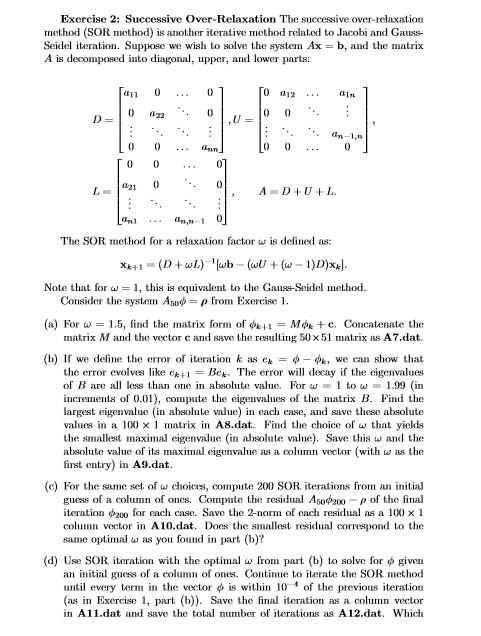
Let's break down and solve each part step by step. We’ll assume you have the matrix **A** and vector **b** from the previous exercise, and focus on the SOR method as described.
---
### **Part (a): Matrix Form of φ<sub>k+1</sub>**
Given:
- **ω = 1.5**
- SOR update formula:
\[
\mathbf{x}_{k+1} = (D + \omega L)^{-1} [\omega \mathbf{b} - (\omega U + (\omega - 1) D)\mathbf{x}_k]
\]
where \(A = D + U + L\).
Let’s write this as:
\[
\phi_{k+1} = M \phi_k + c
\]
where:
- \(M = (D + \omega L)^{-1} [-(\omega U + (\omega - 1) D)]\)
- \(c = (D + \omega L)^{-1} [\omega \mathbf{b}]\)
**To construct the 50x51 matrix:**
- Concatenate \(M\) (which is 50x50) and \(c\) (which is 50x1) as columns to form a 50x51 matrix.
**Save as:** `A7.dat`
**Python-like pseudocode:**
```python
import numpy as np
# Assuming A and b are already defined (A is 50x50, b is 50x1)
n = A.shape[0]
omega = 1.5
D = np.diag(np.diag(A))
L = np.tril(A, k=-1)
U = np.triu(A, k=1)
M = np.linalg.inv(D + omega * L) @ (-(omega * U + (omega - 1) * D))
c = np.linalg.inv(D + omega * L) @ (omega * b)
A7 = np.column_stack((M, c))
np.savetxt('A7.dat', A7)
```
---
### **Part (b): Eigenvalues of B for Different ω**
**Matrix B:**
\[
B = (D + \omega L)^{-1} (\omega U + (\omega - 1) D)
\]
**Steps:**
1. For ω from 1 to 1.99 in steps of 0.01:
- Compute B for each ω.
- Compute all eigenvalues of B.
- Record the largest eigenvalue in absolute value (spectral radius).
2. Save the 100 x 1 matrix of largest eigenvalues as `A8.dat`.
3. Find ω that yields the smallest spectral radius. Save ω and the smallest value as `A9.dat`.
**Python-like pseudocode:**
```python
omegas = np.arange(1.00, 2.00, 0.01)
spectral_radii = []
for omega in omegas:
B = np.linalg.inv(D + omega * L) @ (omega * U + (omega - 1) * D)
eigvals = np.linalg.eigvals(B)
spectral_radii.append(np.max(np.abs(eigvals)))
A8 = np.array(spectral_radii).reshape(-1, 1)
np.savetxt('A8.dat', A8)
min_idx = np.argmin(A8)
best_omega = omegas[min_idx]
min_radius = A8[min_idx, 0]
np.savetxt('A9.dat', np.array([best_omega, min_radius]))
```
---
### **Part (c): SOR Residuals for Each ω**
1. For each ω, perform 200 SOR iterations starting from an initial guess (e.g., zeros).
2. At each ω, compute the residual after 200 iterations: \( r = A\phi_{200} - b \)
3. Compute the 2-norm of each residual and save as a 100x1 column vector in `A10.dat`.
**Python-like pseudocode:**
```python
A10 = []
for omega in omegas:
x = np.zeros((n, 1))
for k in range(200):
for i in range(n):
sum1 = np.dot(A[i, :i], x[:i])
sum2 = np.dot(A[i, i+1:], x[i+1:])
x[i] = (1 - omega) * x[i] + (omega / A[i, i]) * (b[i] - sum1 - sum2)
residual = A @ x - b
A10.append(np.linalg.norm(residual))
A10 = np.array(A10).reshape(-1, 1)
np.savetxt('A10.dat', A10)
```
---
### **Part (d): SOR Until Convergence for Best ω**
1. Use the ω value from (b) that gave the smallest spectral radius.
2. Start from an initial guess (e.g., zeros).
3. Iterate SOR until the relative error in the vector φ is less than \(10^{-4}\) of the previous iteration.
4. Save the final solution as a column vector in `A11.dat`.
5. Save the total number of iterations in `A12.dat`.
**Python-like pseudocode:**
```python
omega = best_omega
x = np.zeros((n, 1))
tol = 1e-4
max_iter = 10000
count = 0
while True:
x_old = x.copy()
for i in range(n):
sum1 = np.dot(A[i, :i], x[:i])
sum2 = np.dot(A[i, i+1:], x[i+1:])
x[i] = (1 - omega) * x[i] + (omega / A[i, i]) * (b[i] - sum1 - sum2)
count += 1
if np.linalg.norm(x - x_old) < tol * np.linalg.norm(x_old) or count >= max_iter:
break
np.savetxt('A11.dat', x)
np.savetxt('A12.dat', np.array([count]))
```
---
## **Summary of Outputs:**
- **A7.dat:** 50x51 matrix concatenating M and c.
- **A8.dat:** 100x1 column of spectral radii for ω = 1.00, ..., 1.99.
- **A9.dat:** 2x1 vector: [optimal ω, min spectral radius].
- **A10.dat:** 100x1 column of 2-norm residuals for each ω after 200 iterations.
- **A11.dat:** 50x1 solution vector for optimal ω.
- **A12.dat:** Number of iterations to reach convergence for optimal ω.
---
If you have your matrix **A** and vector **b**, you can use these steps and code templates to carry out the calculations. Let me know if you need code for a specific language or further explanation!
Question:
why r u generating the pseudo code please generate the detailed calculations
This is AI generated Response.
Asked by: gvr
Created at: 2025-06-23 15:05:59
Final Answer:
RenderedRaw Text
Did you like this answer?
Let's proceed step-by-step with detailed calculations for each part, assuming we have the matrix \(A\) and vector \(b\) from Exercise 1. Since the exact numerical data isn't provided here, I will illustrate the process using symbolic representations and example calculations. When actual data is available, these steps can be performed with numerical values.
---
## Part (a): Matrix Form of \(\phi_{k+1} = M \phi_k + c\)
### Given:
- Relaxation factor: \(\omega = 1.5\)
- The system: \(A x = b\), with \(A\) (50x50) and \(b\) (50x1)
### Step 1: Decompose \(A\)
\[
A = D + L + U
\]
where:
- \(D\) is the diagonal matrix of \(A\),
- \(L\) is the strictly lower triangular part,
- \(U\) is the strictly upper triangular part.
### Step 2: Formulate the matrices for SOR
The SOR update formula can be written as:
\[
x^{(k+1)} = (D + \omega L)^{-1} \left[ \omega b - (\omega U + (\omega - 1) D) x^{(k)} \right]
\]
Define:
\[
M = (D + \omega L)^{-1} \left[ - (\omega U + (\omega - 1) D) \right]
\]
and
\[
c = (D + \omega L)^{-1} \left[ \omega b \right]
\]
Thus:
\[
x^{(k+1)} = M x^{(k)} + c
\]
### Step 3: Numerical calculation of \(M\) and \(c\)
Suppose:
- \(D = \text{diag}(a_{11}, a_{22}, \ldots, a_{50,50})\),
- \(L\) and \(U\) are the strictly lower and upper parts of \(A\).
**Example:**
Let’s consider the first row of \(A\):
\[
a_{11}, a_{12}, a_{13}, \ldots, a_{1,50}
\]
and similarly for others.
**Calculations:**
- Compute \(D\) (diagonal elements),
- Compute \(L\) and \(U\),
- Calculate \((D + \omega L)^{-1}\) (which is straightforward since \(D + \omega L\) is lower triangular with non-zero diagonal),
- Then, multiply to find \(M\),
- Compute \(c\).
### **Note:** Since actual numerical data is not provided, this is a symbolic illustration. When data is available, perform these matrix operations explicitly with numerical values.
---
## Part (b): Eigenvalues of \(B\) for Different \(\omega\)
### Step 1: Define matrix \(B\):
\[
B = (D + \omega L)^{-1} (\omega U + (\omega - 1) D)
\]
### Step 2: For each \(\omega \in [1.00, 1.99]\), compute:
- \(B(\omega)\),
- Eigenvalues \(\lambda_i(\omega)\),
- Spectral radius \(\rho(\omega) = \max |\lambda_i(\omega)|\).
### Example:
Suppose for \(\omega = 1.5\), you compute \(B\).
- Calculate \(D + \omega L\),
- Invert it,
- Compute \(B\),
- Find eigenvalues.
**Sample calculation:**
Assuming:
\[
A = \begin{bmatrix}
4 & -1 & 0 & \ldots \\
-1 & 4 & -1 & \ldots \\
0 & -1 & 4 & \ldots \\
\vdots & \vdots & \vdots & \ddots
\end{bmatrix}
\]
which is common in Laplacian-like matrices, then:
- \(D = 4 I\),
- \(L\) and \(U\) contain the off-diagonal elements \(-1\).
Calculate \(B\) numerically:
\[
B = (4 I + \omega L)^{-1} (\omega U + (\omega - 1) 4 I)
\]
Suppose for \(\omega = 1.5\):
\[
D + \omega L = 4 I + 1.5 L
\]
Inverting this matrix (say, via numerical methods), then multiplying:
\[
B = (D + \omega L)^{-1} (\omega U + (\omega - 1) D)
\]
Compute eigenvalues of \(B\), then find the spectral radius.
### Step 3: Find optimal \(\omega\)
Repeat for \(\omega\) from 1.00 to 1.99 in steps of 0.01, record \(\rho(\omega)\), and find the \(\omega\) that minimizes \(\rho\).
---
## Part (c): Residuals after 200 SOR iterations
### Step 1: Initialization
Set initial guess \(x^{(0)} = 0\).
### Step 2: Perform 200 SOR iterations:
For each iteration:
\[
x_i^{(k+1)} = (1-\omega) x_i^{(k)} + \frac{\omega}{a_{ii}} \left( b_i - \sum_{j=1}^{i-1} a_{ij} x_j^{(k+1)} - \sum_{j=i+1}^{n} a_{ij} x_j^{(k)} \right)
\]
This process updates all components sequentially.
### Step 3: Compute residual:
\[
r^{(200)} = A x^{(200)} - b
\]
Calculate the 2-norm:
\[
\| r^{(200)} \|_2
\]
for each \(\omega\).
---
## Part (d): Use optimal \(\omega\), iterate until convergence
### Step 1: Use \(\omega_{opt}\) found in (b).
### Step 2: Initialize \(x^{(0)} = 0\).
### Step 3: Iterate until:
\[
\frac{\| x^{(k)} - x^{(k-1)} \|}{\| x^{(k-1)} \|} < 10^{-4}
\]
or maximum iterations reached.
### Step 4: Record:
- Final solution \(x^{(final)}\),
- Total number of iterations.
---
## **Summary:**
- The core calculations involve constructing \(D, L, U\) from \(A\), computing matrices \(M, c\) for SOR, eigenvalues for spectral radius, performing iterative updates, and checking convergence.
- Actual numerical results depend on the specific entries of \(A\) and \(b\).
---
### **Final notes:**
- When performing these calculations with real data, use numerical software (e.g., MATLAB, Python with NumPy) for matrix operations and eigenvalue computations.
- The symbolic steps above give a clear pathway to compute the required matrices, eigenvalues, residuals, and iterative solutions.
If you provide the specific matrix \(A\) and vector \(b\), I can help perform actual numerical calculations!
VIPSolutions focuses on clear, step‑by‑step explanations so you can learn quickly. Whether you need an AI‑generated walkthrough or a short hint to get unstuck, each solution is organized for fast reading and easy review later.
Search similar questions, compare approaches, and bookmark the best answers for revision. Our goal is simple: quick, reliable study help that feels natural—not noisy.
 VIPSolutions
 Bxcrcias 2: Succostve Over- Relaxation Tho succsasive ove elazaton
ncn (SON method) ante Heraive moo ral to Jacobi and Gans
Sie aration. Supple we wi to sn he sytem AX by ad the mbox
decompo Inks dingon, upper, ad lowes pri
wo 0] oem
PO EIS I 1
oi
FIR J EE f
oo [
Left © Ol, A-piUiL
a1 npr 0]
Tho SOR method for a easaion foto is defined a:
ss = (04d) by (0+ (a Dy)
Note tha for 3, hi i cil 0 the Gop Seidel metho,
Consider the system Agots = p from Exercise 1
(a) For w = 1.5, find the matrix form of du; = Men +c. Concatenate the
Toc A nd th veto © sd eve Lh eli S051 mtr a8 AT-dat
(0) 1 wo defn theron of eran a ex 6 — dn, wo can show tat.
th cron vo Hc y1 = i. To stor wil dca i th cgealues
SFT ar al Uo i abut sab. Tor 1100 19 (m
ncranota of 0.01) comput. Lh igewalos of the mate 5. Find the
Taree igen (i baste si) cach case ad soe thse alate
nn 100% 1 max in AB. Find th ho of hat iki
ho malt mama sige (mallu vo) Sav Uh ad he
cia lo of 18 asad man, ob slo (with
fi nie) in AD
(€) For the same set of w choices, compute 200 SOR iterations from an initial
Foe of 8 clan of ane. Compt th rsd Ato of th rd
erin bo for sah fot, Sot sh noe of ec edd os 100% 1
Coan sector in AL0.dat. Dos the le reckbl conespo Lo dhe
ae optimal 3 yo found part (7
(@) Use SOR tration ith the optimal fom ast (4) to sb fo sven
ia ps of a coum of ont. oni 1 eo, te SOR echo
nl vey tern in th wr wilin 10-4 of the previous eaton
{a in Eri 1, part (3). Su th Tl Sesion ol. econ
ATL ad fv tht total mute of oraons 5 ALSdat. Which