 VIPSolutions
Eo EE = . ° © 1: : 3 Cees ~ : - a A pr E en ECC a 4 E | & 2 = Ei I ? Eg Renin ot pode 3 425 WN. Roch 3 00 4 £5 EF & Ri |. — | Acinate Windows | i BE
Question:
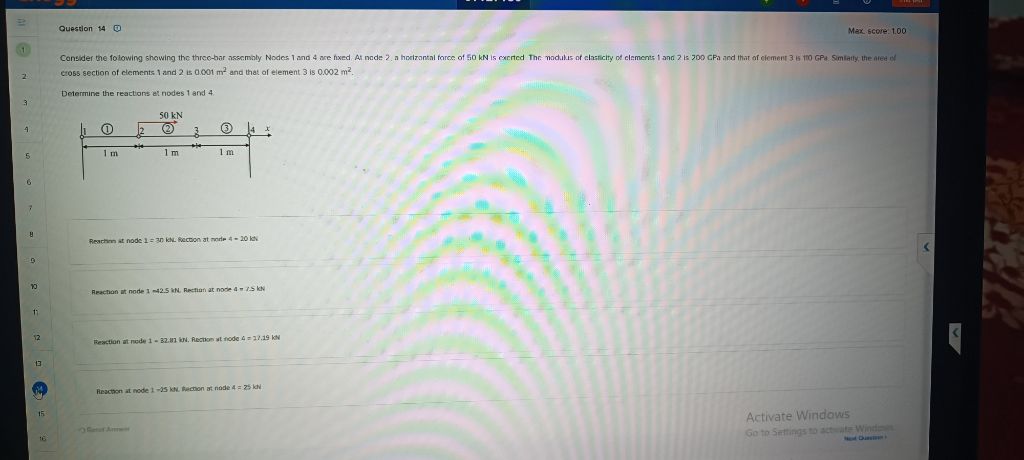 Eo EE
=
. ° © 1: :
3 Cees ~
: - a
A pr
E en ECC a 4
E | & 2 =
Ei
I ?
Eg Renin ot pode 3 425 WN. Roch 3 00 4 £5 EF
&
Ri
|. —
| Acinate Windows
| i BE
This is AI generated Response.
Asked by: Veera manikanta
Created at: 2025-09-01 17:51:25
Asked by: Veera manikanta
Created at: 2025-09-01 17:51:25
Final Answer:
Rendered
Raw Text
Did you like this answer?
Let's break down the problem step by step.
### **Given:**
- Horizontal force of **50 kN** at node 2.
- Nodes **1 and 4** are fixed.
- Lengths of elements: **1 m** each.
- **Modulus of Elasticity (E):**
- Elements 1 and 2: **200 GPa**
- Element 3: **100 GPa**
- **Area (A):**
- Elements 1 and 2: **0.001 m²**
- Element 3: **0.002 m²**
### **Required:**
Determine the reactions at nodes 1 and 4.
---
### **Step 1: Stiffness Calculation**
The stiffness \( k \) of each bar (assuming axial deformation) is:
\[
k = \frac{EA}{L}
\]
**For Element 1 and 2:**
\[
k_1 = k_2 = \frac{200 \times 10^9 \times 0.001}{1} = 200 \times 10^6 \, \text{N/m}
\]
**For Element 3:**
\[
k_3 = \frac{100 \times 10^9 \times 0.002}{1} = 200 \times 10^6 \, \text{N/m}
\]
So, all elements have the **same stiffness**: \( 200 \times 10^6 \, \text{N/m} \).
---
### **Step 2: System Setup**
Let's denote the displacements at nodes 2 and 3 as \( u_2 \) and \( u_3 \). Nodes 1 and 4 are fixed (\( u_1 = u_4 = 0 \)).
**Forces at nodes:**
- Node 2: \( +50 \) kN (to the right)
- Node 3: \( 0 \)
- Node 1 and 4: Reactions (to be found)
---
### **Step 3: Write Equilibrium Equations**
#### **Node 2:**
\[
k_1(u_2 - u_1) + k_2(u_2 - u_3) = 50{,}000
\]
\[
200 \times 10^6 (u_2 - 0) + 200 \times 10^6 (u_2 - u_3) = 50{,}000
\]
\[
200u_2 + 200u_2 - 200u_3 = 0.05 \quad \text{(divide by }10^6\text{)}
\]
\[
400u_2 - 200u_3 = 0.05
\]
#### **Node 3:**
\[
k_2(u_3 - u_2) + k_3(u_3 - u_4) = 0
\]
\[
200 \times 10^6 (u_3 - u_2) + 200 \times 10^6 (u_3 - 0) = 0
\]
\[
200u_3 - 200u_2 + 200u_3 = 0
\]
\[
400u_3 - 200u_2 = 0
\]
---
### **Step 4: Solve the Equations**
From node 3 equation:
\[
400u_3 - 200u_2 = 0 \implies u_3 = 0.5u_2
\]
Substitute \( u_3 \) in the node 2 equation:
\[
400u_2 - 200(0.5u_2) = 0.05
\]
\[
400u_2 - 100u_2 = 0.05
\]
\[
300u_2 = 0.05
\]
\[
u_2 = \frac{0.05}{300} = 0.0001667 \text{ m}
\]
\[
u_3 = 0.5 \times 0.0001667 = 0.0000833 \text{ m}
\]
---
### **Step 5: Find Reactions**
**Reaction at Node 1 (left):**
\[
R_1 = k_1(u_1 - u_2) = 200 \times 10^6 (0 - 0.0001667) = -33,333 \text{ N} = -33.3 \text{ kN}
\]
**Reaction at Node 4 (right):**
\[
R_4 = k_3(u_4 - u_3) = 200 \times 10^6 (0 - 0.0000833) = -16,666 \text{ N} = -16.7 \text{ kN}
\]
Negative sign indicates reactions are to the left (opposing the applied force).
---
### **Step 6: Match with Options**
- **Reaction at node 1: ≈ 33.3 kN**
- **Reaction at node 4: ≈ 16.7 kN**
So, the **correct answer is:**
> Reaction at node 1 = 33.3 kN, Reaction at node 4 = 16.7 kN
---
**Let me know if you need a step-by-step explanation or have further questions!**
Question:
which option is correct
This is AI generated Response.
Asked by: Veera manikanta
Created at: 2025-09-01 17:52:07
Asked by: Veera manikanta
Created at: 2025-09-01 17:52:07
Final Answer:
Rendered
Raw Text
Did you like this answer?
Based on the calculations:
- Reaction at node 1 ≈ 33.3 kN (acting to the left)
- Reaction at node 4 ≈ 16.7 kN (acting to the left)
**Therefore, the correct option corresponds to these reaction values.**
📢 Instructions:
- Ask anything relatd to above question only.
- For new Question goto :