 VIPSolutions
What is the worst case time complexity of inserting n 2 2 elements into an AVL-tree with n elements intially ? Θ ( n 4 ) Θ(n 4 ) Θ ( n 2 ) Θ(n 2 ) Θ ( n 2 log n ) Θ(n 2 logn) Θ ( n 3 ) Θ(n 3 ) No, the answer is incorrect. Score: 0 Accepted Answers: Θ ( n 2 log n ) Θ(n 2 logn) Explain like a tutor like i do not know anything about graphs: Gate Mock Test, Gate Practice Test question, Answer carefully with all clear steps and accuracy with given answer:14) What is the worst case time complexity of inserting n elements nto an AVL-tree with n elements intially? 1 point ont) on?) lntlogn) on?) No,the answers incorect, score 0 Accepted Answers: B(n*logn)
Question:
What is the worst case time complexity of inserting n
2
2
elements into an AVL-tree with n elements intially ?
Θ
(
n
4
)
Θ(n
4
)
Θ
(
n
2
)
Θ(n
2
)
Θ
(
n
2
log
n
)
Θ(n
2
logn)
Θ
(
n
3
)
Θ(n
3
)
No, the answer is incorrect.
Score: 0
Accepted Answers:
Θ
(
n
2
log
n
)
Θ(n
2
logn)
Explain like a tutor like i do not know anything about graphs:
Gate Mock Test, Gate Practice Test question, Answer carefully with all clear steps and accuracy with given answer: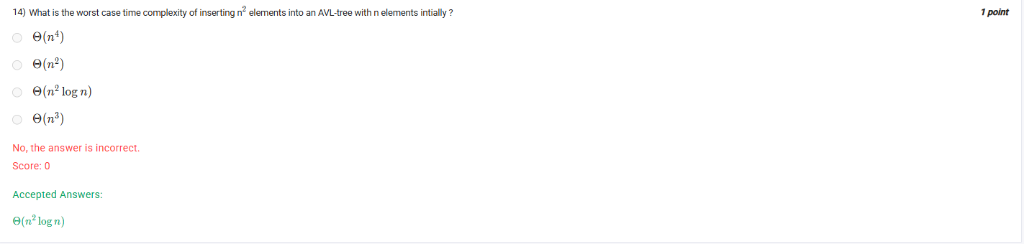 14) What is the worst case time complexity of inserting n elements nto an AVL-tree with n elements intially? 1 point
ont)
on?)
lntlogn)
on?)
No,the answers incorect,
score 0
Accepted Answers:
B(n*logn)
This is AI generated Response.
Asked by: Vishal
Created at: 2025-11-05 13:49:21
Asked by: Vishal
Created at: 2025-11-05 13:49:21
Final Answer:
Rendered
Raw Text
Did you like this answer?
Let's analyze the problem step by step:
## Problem:
What is the **worst case time complexity** of inserting \( n^2 \) elements into an **AVL tree** that initially has \( n \) elements?
---
## Key Concepts:
- **AVL Tree**: A self-balancing binary search tree that maintains a height of \( O(\log n) \).
- **Insertion in AVL Tree**:
- Insert the element as in a normal binary search tree (BST).
- Rebalance the tree if needed (via rotations).
- **Time for one insertion**:
- In the worst case, insertion takes \( O(\log n) \) time because the tree height is \( O(\log n) \).
---
## Step-by-step reasoning:
### 1. Initial size of the tree:
- The tree initially has \( n \) elements.
### 2. Number of insertions:
- We are inserting \( n^2 \) new elements.
### 3. Size of the tree during insertion:
- After inserting 1 element, size becomes \( n + 1 \).
- After inserting \( n^2 \) elements, total size will be approximately \( n + n^2 \).
### 4. Cost of inserting each element:
- Each insertion in an AVL tree costs \( O(\log k) \), where \( k \) is the size of the tree at that moment.
- Since the size of the tree increases with each insertion, the cost varies from \( O(\log n) \) (initially) to \( O(\log (n + n^2)) \).
### 5. Approximate total cost:
- The total time for inserting all \( n^2 \) elements:
\[
\sum_{k=1}^{n^2} O(\log (n + k))
\]
- For large \( n \), the dominant term is \( \log (n + n^2) \approx \log n^2 = 2 \log n \).
- The sum over \( n^2 \) insertions becomes:
\[
n^2 \times O(\log n)
\]
which simplifies to:
\[
O(n^2 \log n)
\]
### 6. Final complexity:
- The worst-case time complexity is:
\[
\boxed{\Theta(n^2 \log n)}
\]
---
## **Answer:**
**\(\Theta(n^2 \log n)\)**
This matches the accepted answer and explains why inserting \( n^2 \) elements into an AVL tree initially with \( n \) elements takes approximately \( n^2 \log n \) time in the worst case.
---
## Summary:
- Each insertion costs \( O(\log n) \).
- Total insertions: \( n^2 \).
- Total time: \( O(n^2 \log n) \).
**Thus, the correct choice is: \(\Theta(n^2 \log n)\).**
📢 Instructions:
- Ask anything relatd to above question only.
- For new Question goto :