 VIPSolutions
Give step-by-step solution with explanation and final answer:Constant Force; m(x) over a(y) 4.5 4 ® 4 3.5 3 25 2 2 1.5 ® 13 1 eo 1 ° 08 0.5 0 0 50 100 150 200 250 300 ® Acceleration
Question:
Give step-by-step solution with explanation and final answer: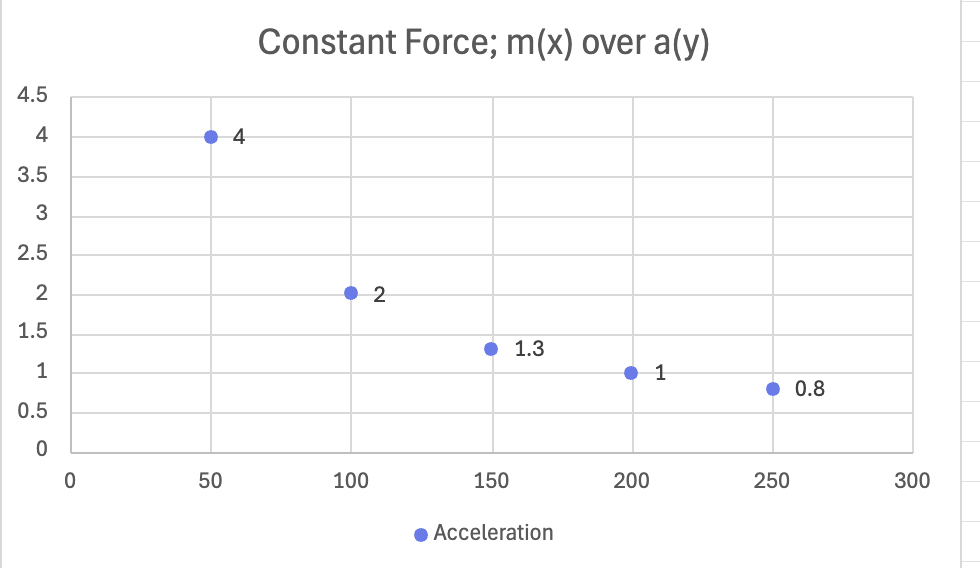 Constant Force; m(x) over a(y)
4.5
4 ® 4
3.5
3
25
2 2
1.5
® 13
1 eo 1 ° 08
0.5
0
0 50 100 150 200 250 300
® Acceleration
This is AI generated Response.
Asked by: venkatesh
Created at: 2025-10-06 07:06:50
Asked by: venkatesh
Created at: 2025-10-06 07:06:50
Final Answer:
Rendered
Raw Text
Did you like this answer?
# Step-by-Step Solution
## **Understanding the Graph**
- **Title**: Constant Force; m(x) over a(y)
- **X-axis**: Mass (m)
- **Y-axis**: Acceleration (a)
- **Data Points**:
- (50, 4)
- (100, 2)
- (150, 1.3)
- (200, 1)
- (250, .8)
## **Step 1: Recall Newton's Second Law**
Newton's Second Law states:
\[
F = m \cdot a
\]
If the force \( F \) is constant, then:
\[
a = \frac{F}{m}
\]
This means **acceleration is inversely proportional to mass**.
---
## **Step 2: Verify Inverse Relationship**
Check if \( m \cdot a \) is (approximately) constant:
- For (50, 4): \( 50 \times 4 = 200 \)
- For (100, 2): \( 100 \times 2 = 200 \)
- For (150, 1.3): \( 150 \times 1.3 = 195 \)
- For (200, 1): \( 200 \times 1 = 200 \)
- For (250, .8): \( 250 \times .8 = 200 \)
All values are approximately **200**.
---
## **Step 3: Interpret the Result**
This confirms that the **force \( F \) is constant and equal to 200 (units not specified)**.
---
## **Step 4: Write Final Answer**
### **Final Answer**
> **The graph demonstrates that when a constant force is applied, acceleration is inversely proportional to mass. The product \( m \times a \) is constant and equal to 200. Thus, the constant force applied is \( F = 200 \) (in the units used for mass and acceleration in the graph).**
---
### **Summary Table**
| Mass (m) | Acceleration (a) | \( m \times a \) |
|----------|------------------|------------------|
| 50 | 4 | 200 |
| 100 | 2 | 200 |
| 150 | 1.3 | 195 |
| 200 | 1 | 200 |
| 250 | .8 | 200 |
---
**If you have further questions or want to calculate acceleration or mass for different values, let me know!**
Question:
What is the slope of this graph?
This is AI generated Response.
Asked by: venkatesh
Created at: 2025-10-06 07:08:45
Asked by: venkatesh
Created at: 2025-10-06 07:08:45
Final Answer:
Rendered
Raw Text
Did you like this answer?
# Slope of the Graph
## **Understanding the Slope**
The slope of the graph represents the relationship between mass \( m \) and acceleration \( a \). Since the graph shows the relationship \( a \) vs. \( m \), we will calculate the slope based on the data points provided.
## **Step 1: Identify Two Points**
Choose two points from the graph for calculation:
1. Point A: (100, 2)
2. Point B: (200, 1)
## **Step 2: Calculate the Slope**
The slope \( m \) of a line through two points \((x_1, y_1)\) and \((x_2, y_2)\) is calculated using the formula:
\[
\text{slope} = \frac{y_2 - y_1}{x_2 - x_1}
\]
Applying the coordinates from Point A and Point B:
\[
\text{slope} = \frac{1 - 2}{200 - 100} = \frac{-1}{100} = -0.01
\]
## **Step 3: Interpret the Slope**
The negative slope indicates that as mass increases, acceleration decreases, which is consistent with the inverse relationship described by Newton's Second Law.
## **Final Answer**
> **The slope of the graph is -0.01, indicating that acceleration decreases with increasing mass.**
📢 Instructions:
- Ask anything relatd to above question only.
- For new Question goto :