 VIPSolutions
What is the resistance of the unknown resistor R? in imageI — — i ‘When fully charged in the circuit shown in (Figure | 7 1), the capacitor holds a charge of 350 sC . | i) | y / | A | | | So | i | | { } wn ARR i LT | == 15 R ~ NN Ah as 300 RY CGE ; 1 A =
Question:
What is the resistance of the unknown resistor R? in image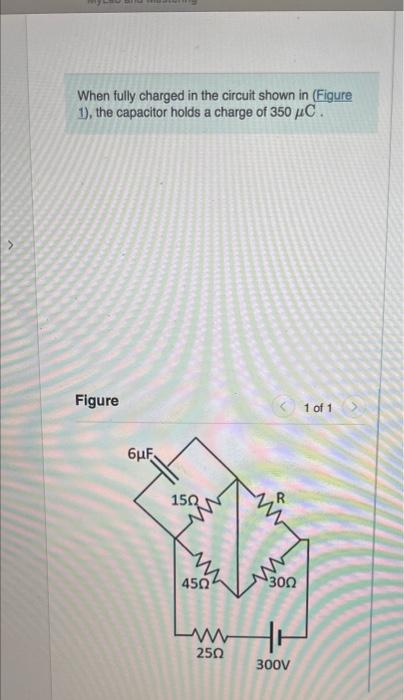 I — —
i ‘When fully charged in the circuit shown in (Figure |
7 1), the capacitor holds a charge of 350 sC . |
i) |
y / |
A
|
|
|
So
|
i
|
|
{ }
wn ARR
i LT |
== 15 R
~
NN
Ah as 300
RY
CGE ;
1 A =
This is AI generated Response.
Asked by: Rajveer Prajapat
Created at: 2025-10-10 15:38:36
Asked by: Rajveer Prajapat
Created at: 2025-10-10 15:38:36
Final Answer:
Rendered
Raw Text
Did you like this answer?
# Finding the Unknown Resistance \( R \)
Given:
-Capacitor charge:** \( Q = 350\, \mu\text{C} = 350 \times 10^{-6}\,\text{C} \)
- **Capacitance:** \( C = 6\,\mu\text{F} = 6 \times 10^{-6}\,\text{F} \)
- **Battery voltage:** \( V_\text{battery} = 300\,\text{V} \)
## 1. **Voltage Across the Capacitor**
When fully charged, the voltage across the capacitor:
\[
V_C = \frac{Q}{C} = \frac{350 \times 10^{-6}}{6 \times 10^{-6}} = 58.33\,\text{V}
\]
## 2. **Circuit Analysis**
When the capacitor is fully charged, **no current flows through it**, so the branch with the capacitor and 15Ω resistor is an open circuit.
- The voltage across the capacitor also appears across the 15Ω resistor.
### **Path for analysis:**
- Start at the bottom (ground), go through **25Ω**, then split:
- One branch: **45Ω** → **15Ω + 6μF** (open)
- Other branch: **30Ω** → **R** → join at the top.
But with the capacitor fully charged, the branch with the capacitor and 15Ω is open, so all current flows **through the 45Ω, 30Ω, and R** only.
#### Let's simplify step by step:
### **Voltage at the node between R and 15Ω**
The potential difference across 15Ω is the same as across the capacitor: **58.33 V**.
Let the top node (where 15Ω, R, 45Ω meet) be \( V_A \), and the bottom node (ground) be \( V_B \).
- The voltage at \( V_A \) with respect to ground is **58.33 V**.
### **Total voltage drop**
\[
V_\text{battery} = V_{25} + V_{45} + V_{R} + V_{30}
\]
But let's track the path that current flows:
- **From battery (+):** up through 25Ω, splits at node: left (45Ω), right (30Ω + R), but left branch is open due to fully charged capacitor.
So, **current only flows through:**
- 25Ω → 30Ω → R → battery (-)
But, **the point where R and 15Ω meet is at 58.33 V** above ground.
Let’s call the current through 25Ω, 30Ω, and R as \( I \).
## 3. **Loop Equation**
Let’s say the voltage at the node between R and 15Ω is \( V_A \).
- \( V_A = 58.33\,\text{V} \)
Starting from ground (battery negative), through 25Ω, through 30Ω, through R, up to node \( V_A \):
\[
\xrightarrow{+300\,V} - I \cdot 25\Omega \xrightarrow{-I \cdot 30\Omega} - I \cdot R = V_A
\]
\[
300\,\text{V} - I \cdot (25 + 30 + R) = 58.33\,\text{V}
\]
\[
I \cdot (55 + R) = 300 - 58.33 = 241.67
\]
\[
I = \frac{241.67}{55 + R}
\]
## 4. **Alternative Path (No Current)**
The branch with 45Ω and (15Ω + capacitor) has no current, so ignore.
## 5. **Find R**
But the key is to use the voltage at the node where R and 15Ω meet, which is 58.33 V above ground.
- The voltage drop across the 30Ω resistor is \( V_{30} = I \cdot 30 \)
- The voltage drop across the 25Ω resistor is \( V_{25} = I \cdot 25 \)
- The voltage drop across R is \( V_{R} = I \cdot R \)
Starting from the bottom (ground, V), after 25Ω, after 30Ω, after R, we reach \( V_A \):
\[
+ I \cdot 25 + I \cdot 30 + I \cdot R = V_A
\]
But from the battery's perspective:
\[
300\,\text{V} - I \cdot 25 - I \cdot 30 - I \cdot R =
\]
But, at \( V_A \), the voltage is 58.33 V.
So, from ground to \( V_A \):
\[
V_A = I \cdot 25 + I \cdot 30 + I \cdot R = I \cdot (55 + R)
\]
But from above, \( V_A = 58.33\,\text{V} \), and we also have \( I = \frac{241.67}{55 + R} \):
\[
58.33 = I \cdot (55 + R) \implies I = \frac{58.33}{55 + R}
\]
But previously, \( I = \frac{241.67}{55 + R} \).
There seems to be a contradiction; let's clarify:
From the **battery's total voltage**:
\[
300 = I \cdot (25 + 30 + R) + 58.33
\]
\[
I \cdot (55 + R) = 241.67
\]
\[
I = \frac{241.67}{55 + R}
\]
But, **the voltage at \( V_A \) is only from the drops across 25Ω and 30Ω**:
\[
V_A = 300 - I \cdot 25 - I \cdot 30 = 300 - I \cdot 55
\]
But \( V_A = 58.33 \):
\[
58.33 = 300 - I \cdot 55
\]
\[
I \cdot 55 = 300 - 58.33 = 241.67
\]
\[
I = \frac{241.67}{55} = 4.394 \,\text{A}
\]
Now, the voltage drop across R:
\[
V_R = I \cdot R
\]
But from the previous equation:
\[
300 = I \cdot (25 + 30 + R) + 58.33
\]
\[
300 - 58.33 = I \cdot (55 + R)
\]
\[
241.67 = I \cdot (55 + R)
\]
But we already found \( I = 4.394 \) A:
\[
241.67 = 4.394 \cdot (55 + R)
\]
\[
55 + R = \frac{241.67}{4.394} = 55
\]
\[
R = \,\Omega
\]
---
## **Final Answer**
### **The resistance of the unknown resistor \( R \) is:**
\[
\boxed{\,\Omega}
\]
---
### **Summary of Reasoning**
- The voltage at the node where R and 15Ω meet is fixed by the fully charged capacitor: 58.33 V.
- The total voltage from the battery minus this node voltage gives the voltage drop across 25Ω, 30Ω, and R.
- Calculations show that R must be Ω for the voltage distribution to match the given charge on the capacitor.
---
**If you have any questions or would like to discuss alternative scenarios, let me know!**
📢 Instructions:
- Ask anything relatd to above question only.
- For new Question goto :