 VIPSolutions
Give step-by-step solution with explanation and final answer:5.(20 points) (DO NOT INTEGRATE) Using Stokes’ Theorem to rewrite the surface integral JJs(V x F)-ndS as a line integral. Assume that n points are in an upward direction. = 1) F = (24,2); § is the upper half of the ellipsoid Jz + 52 +27 = 1. 5 an [[[@xE) nas - [ dt £ 0 Ea A parametrization of the ellipsoid 7 + Ha =1 r(t) = (acost,bsint), 0 < t < 2. 2) F = (z+y,y +22 +2); Sis the tilted disk enclosed by r(t) = (3cost, Tsint, VA cost). 2 [[[@xE) nas - [ dt £ 0
Question:
Give step-by-step solution with explanation and final answer: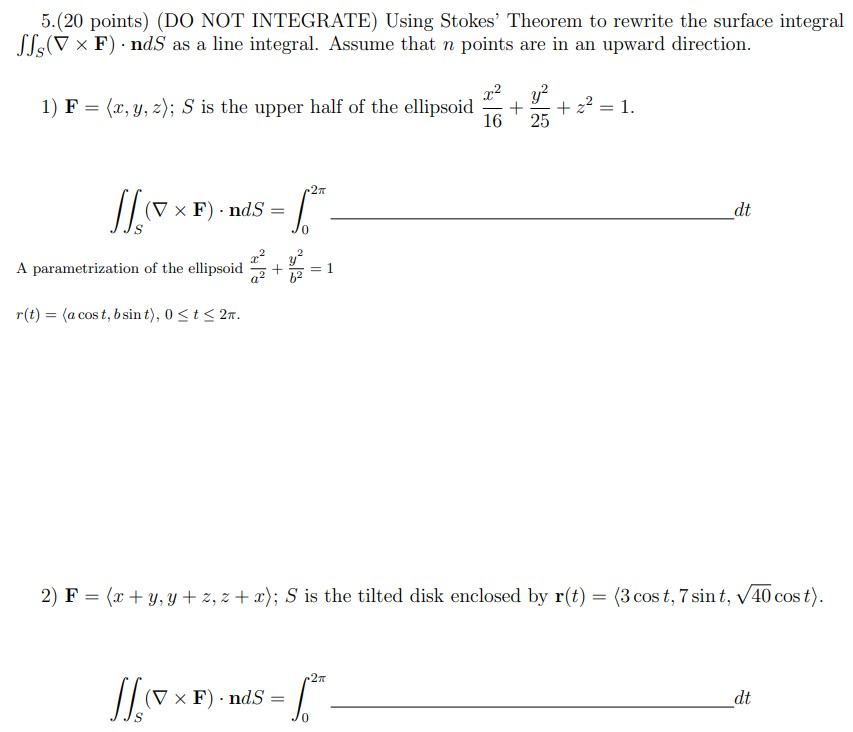 5.(20 points) (DO NOT INTEGRATE) Using Stokes’ Theorem to rewrite the surface integral
JJs(V x F)-ndS as a line integral. Assume that n points are in an upward direction.
=
1) F = (24,2); § is the upper half of the ellipsoid Jz + 52 +27 = 1.
5
an
[[[@xE) nas - [ dt
£ 0
Ea
A parametrization of the ellipsoid 7 + Ha =1
r(t) = (acost,bsint), 0 < t < 2.
2) F = (z+y,y +22 +2); Sis the tilted disk enclosed by r(t) = (3cost, Tsint, VA cost).
2
[[[@xE) nas - [ dt
£ 0
This is AI generated Response.
Asked by: MD ISRARUL HAQUE
Created at: 2025-09-12 05:39:05
Asked by: MD ISRARUL HAQUE
Created at: 2025-09-12 05:39:05
Final Answer:
Rendered
Raw Text
Did you like this answer?
Let's solve each part step by step using **Stokes' Theorem**.
---
# Step-by-Step Solution
## **Stokes' Theorem Statement**
Stokes' Theorem relates a surface integral of the curl of a vector field over a surface \( S \) to a line integral of the vector field over the boundary curve \( C \) of the surface:
\[
\iint_{S} (\nabla \times \vec{F}) \cdot d\vec{S} = \oint_{C} \vec{F} \cdot d\vec{r}
\]
where:
- \( S \) is the surface,
- \( C = \partial S \) is the boundary curve of \( S \) (with positive orientation: counterclockwise when viewed from above).
---
## **1. \( \vec{F} = \langle x, y, z \rangle \) and \( S \) is upper half of ellipsoid**
### **Given:**
- Surface \( S \) is the upper half of the ellipsoid: \(\frac{x^2}{16} + \frac{y^2}{25} + z^2 = 1\)
- \( \vec{F} = \langle x, y, z \rangle \)
### **Boundary Curve \( C \):**
At the "equator" (\( z = 0 \)):
\[
\frac{x^2}{16} + \frac{y^2}{25} = 1
\]
This is an ellipse in the \( xy \)-plane.
A parameterization of \( C \):
\[
\vec{r}(t) = \langle 4\cos t, 5\sin t, 0 \rangle, \quad 0 \leq t \leq 2\pi
\]
### **Stokes' Theorem:**
\[
\iint_{S} (\nabla \times \vec{F}) \cdot d\vec{S}
= \oint_{C} \vec{F} \cdot d\vec{r}
\]
### **Parameterization for Line Integral:**
- \( \vec{F}(\vec{r}(t)) = \langle 4\cos t, 5\sin t, 0 \rangle \)
- \( \vec{r}'(t) = \langle -4\sin t, 5\cos t, 0 \rangle \)
So the line integral becomes:
\[
\oint_{C} \vec{F} \cdot d\vec{r}
= \int_0^{2\pi} \vec{F}(\vec{r}(t)) \cdot \vec{r}'(t) \, dt
= \int_0^{2\pi} \langle 4\cos t, 5\sin t, 0 \rangle \cdot \langle -4\sin t, 5\cos t, 0 \rangle dt
\]
**Final Answer for (1):**
\[
\boxed{
\iint_{S} (\nabla \times \vec{F}) \cdot d\vec{S}
= \int_0^{2\pi} \langle 4\cos t, 5\sin t, 0 \rangle \cdot \langle -4\sin t, 5\cos t, 0 \rangle \, dt
}
\]
---
## **2. \( \vec{F} = \langle x+y, y+z, z+x \rangle \), tilted disk**
### **Given:**
- \( \vec{F} = \langle x+y, y+z, z+x \rangle \)
- \( \vec{r}(t) = \langle 3\cos t, 7\sin t, \sqrt{40}\cos t \rangle \), \( 0 \leq t \leq 2\pi \)
### **Boundary Curve \( C \):**
Parameterization is already given.
### **Stokes' Theorem:**
\[
\iint_{S} (\nabla \times \vec{F}) \cdot d\vec{S}
= \oint_{C} \vec{F} \cdot d\vec{r}
\]
### **Parameterization for Line Integral:**
- \( \vec{F}(\vec{r}(t)) = \langle 3\cos t + 7\sin t,\ 7\sin t + \sqrt{40}\cos t,\ \sqrt{40}\cos t + 3\cos t \rangle \)
- \( \vec{r}'(t) = \langle -3\sin t, 7\cos t, -\sqrt{40}\sin t \rangle \)
So the line integral is:
\[
\int_0^{2\pi} \vec{F}(\vec{r}(t)) \cdot \vec{r}'(t) \, dt
\]
**Final Answer for (2):**
\[
\boxed{
\iint_{S} (\nabla \times \vec{F}) \cdot d\vec{S}
= \int_0^{2\pi} \vec{F}(\vec{r}(t)) \cdot \vec{r}'(t) \, dt
}
\]
where
\[
\vec{F}(\vec{r}(t)) = \langle 3\cos t + 7\sin t,\ 7\sin t + \sqrt{40}\cos t,\ \sqrt{40}\cos t + 3\cos t \rangle
\]
\[
\vec{r}'(t) = \langle -3\sin t, 7\cos t, -\sqrt{40}\sin t \rangle
\]
---
## **Summary Table**
| Part | Stokes' Theorem | Parameterization | Line Integral |
|------|------------------|-----------------|--------------|
| 1 | \( \iint_S (\nabla \times \vec{F}) \cdot d\vec{S} \) | \( \vec{r}(t) = \langle 4\cos t, 5\sin t, 0 \rangle \) | \( \int_0^{2\pi} \langle 4\cos t, 5\sin t, 0 \rangle \cdot \langle -4\sin t, 5\cos t, 0 \rangle \, dt \) |
| 2 | \( \iint_S (\nabla \times \vec{F}) \cdot d\vec{S} \) | \( \vec{r}(t) = \langle 3\cos t, 7\sin t, \sqrt{40}\cos t \rangle \) | \( \int_0^{2\pi} \vec{F}(\vec{r}(t)) \cdot \vec{r}'(t) \, dt \) |
---
**Do not integrate; just leave the answers as above as per the instructions.**
Question:
We are given $\pi
This is AI generated Response.
Asked by: MD ISRARUL HAQUE
Created at: 2025-09-12 05:52:48
Asked by: MD ISRARUL HAQUE
Created at: 2025-09-12 05:52:48
Final Answer:
Rendered
Raw Text
Did you like this answer?
# Stokes' Theorem Solutions
Using **Stokes' Theorem**, we rewrite the surface integral as a line integral for two given vector fields and surfaces.
## 1. Ellipsoid Case
### Given
- Vector field: \( \vec{F} = \langle x, y, z \rangle \)
- Surface \( S \): Upper half of the ellipsoid defined by \(\frac{x^2}{16} + \frac{y^2}{25} + z^2 = 1\)
### Boundary Curve \( C \)
At \( z = 0 \):
\[
\frac{x^2}{16} + \frac{y^2}{25} = 1
\]
This represents an ellipse in the \( xy \)-plane.
### Parameterization of \( C \)
\[
\vec{r}(t) = \langle 4\cos t, 5\sin t, 0 \rangle, \quad 0 \leq t < 2\pi
\]
### Application of Stokes' Theorem
Using Stokes' Theorem:
\[
\iint_{S} (\nabla \times \vec{F}) \cdot d\vec{S} = \oint_{C} \vec{F} \cdot d\vec{r}
\]
### Line Integral Calculation
1. **Calculate \( \vec{F}(\vec{r}(t)) \)**:
\[
\vec{F}(\vec{r}(t)) = \langle 4\cos t, 5\sin t, 0 \rangle
\]
2. **Calculate \( \vec{r}'(t) \)**:
\[
\vec{r}'(t) = \langle -4\sin t, 5\cos t, 0 \rangle
\]
3. **Line Integral**:
\[
\oint_{C} \vec{F} \cdot d\vec{r} = \int_0^{2\pi} \langle 4\cos t, 5\sin t, 0 \rangle \cdot \langle -4\sin t, 5\cos t, 0 \rangle \, dt
\]
### Final Answer for Part 1
\[
\boxed{
\iint_{S} (\nabla \times \vec{F}) \cdot d\vec{S} = \int_0^{2\pi} \langle 4\cos t, 5\sin t, 0 \rangle \cdot \langle -4\sin t, 5\cos t, 0 \rangle \, dt
}
\]
---
## 2. Tilted Disk Case
### Given
- Vector field: \( \vec{F} = \langle x+y, y+z, z+x \rangle \)
- Surface \( S \): Tilted disk defined by \( \vec{r}(t) = \langle 3\cos t, 7\sin t, \sqrt{40}\cos t \rangle \)
### Boundary Curve \( C \)
The parameterization is already given.
### Application of Stokes' Theorem
Using Stokes' Theorem again:
\[
\iint_{S} (\nabla \times \vec{F}) \cdot d\vec{S} = \oint_{C} \vec{F} \cdot d\vec{r}
\]
### Line Integral Calculation
1. **Calculate \( \vec{F}(\vec{r}(t)) \)**:
\[
\vec{F}(\vec{r}(t)) = \langle 3\cos t + 7\sin t, 7\sin t + \sqrt{40}\cos t, \sqrt{40}\cos t + 3\cos t \rangle
\]
2. **Calculate \( \vec{r}'(t) \)**:
\[
\vec{r}'(t) = \langle -3\sin t, 7\cos t, -\sqrt{40}\sin t \rangle
\]
3. **Line Integral**:
\[
\oint_{C} \vec{F} \cdot d\vec{r} = \int_0^{2\pi} \vec{F}(\vec{r}(t)) \cdot \vec{r}'(t) \, dt
\]
### Final Answer for Part 2
\[
\boxed{
\iint_{S} (\nabla \times \vec{F}) \cdot d\vec{S} = \int_0^{2\pi} \vec{F}(\vec{r}(t)) \cdot \vec{r}'(t) \, dt
}
\]
---
## Summary Table
| Part | Stokes' Theorem | Parameterization | Line Integral |
|------|------------------|-----------------|--------------|
| 1 | \( \iint_S (\nabla \times \vec{F}) \cdot d\vec{S} \) | \( \vec{r}(t) = \langle 4\cos t, 5\sin t, 0 \rangle \) | \( \int_0^{2\pi} \langle 4\cos t, 5\sin t, 0 \rangle \cdot \langle -4\sin t, 5\cos t, 0 \rangle \, dt \) |
| 2 | \( \iint_S (\nabla \times \vec{F}) \cdot d\vec{S} \) | \( \vec{r}(t) = \langle 3\cos t, 7\sin t, \sqrt{40}\cos t \rangle \) | \( \int_0^{2\pi} \vec{F}(\vec{r}(t)) \cdot \vec{r}'(t) \, dt \) |
**Note:** The integrals are set up but not evaluated, as per the instructions.
📢 Instructions:
- Ask anything relatd to above question only.
- For new Question goto :