 VIPSolutions
Give step-by-step solution with explanation and final answer:nthe following problems use separation of variables to ind if possible, product solutions for the given partial differential equation ws LE 2, My ax ay a Yay Bu bu =u dow tu
Question:
Give step-by-step solution with explanation and final answer: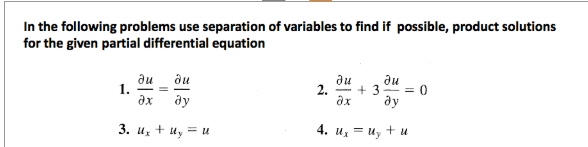 nthe following problems use separation of variables to ind if possible, product solutions
for the given partial differential equation
ws
LE 2, My
ax ay a Yay
Bu bu =u dow tu
This is AI generated Response.
Asked by: gvr
Created at: 2025-06-19 13:25:34
Asked by: gvr
Created at: 2025-06-19 13:25:34
Final Answer:
Rendered
Raw Text
Did you like this answer?
Let's solve each PDE **using separation of variables** and find product solutions where possible.
### **1.** \(\frac{\partial u}{\partial x} = \frac{\partial u}{\partial y}\)
#### **Step 1: Assume a product solution**
Let \(u(x, y) = X(x)Y(y)\).
#### **Step 2: Substitute into the equation**
\[
\frac{\partial u}{\partial x} = Y(y) X'(x)
\]
\[
\frac{\partial u}{\partial y} = X(x) Y'(y)
\]
Given,
\[
Y(y) X'(x) = X(x) Y'(y)
\]
#### **Step 3: Separate variables**
\[
\frac{X'(x)}{X(x)} = \frac{Y'(y)}{Y(y)}
\]
Set both sides equal to a constant, say \(\lambda\):
\[
\frac{X'(x)}{X(x)} = \lambda \implies X'(x) = \lambda X(x)
\]
\[
\frac{Y'(y)}{Y(y)} = \lambda \implies Y'(y) = \lambda Y(y)
\]
#### **Step 4: Solve the ODEs**
\[
X(x) = A e^{\lambda x}
\]
\[
Y(y) = B e^{\lambda y}
\]
#### **Step 5: Write the general solution**
\[
u(x, y) = X(x) Y(y) = C e^{\lambda (x+y)}
\]
where \(C = AB\), and \(\lambda\) is any constant.
**Final Answer:**
\[
\boxed{u(x, y) = C e^{\lambda(x + y)}}
\]
---
Would you like to proceed to the next problem (#2) or do you want all four solved here?
Question:
yes please
This is AI generated Response.
Asked by: gvr
Created at: 2025-06-19 13:26:21
Asked by: gvr
Created at: 2025-06-19 13:26:21
Final Answer:
Rendered
Raw Text
Did you like this answer?
Certainly! Let's proceed to solve the second PDE step-by-step.
---
### **2.** \(\frac{\partial u}{\partial x} + \frac{\partial u}{\partial y} = 0\)
#### **Step 1: Assume a product solution**
Let \(u(x, y) = X(x)Y(y)\).
#### **Step 2: Substitute into the PDE**
\[
\frac{\partial u}{\partial x} = X'(x) Y(y)
\]
\[
\frac{\partial u}{\partial y} = X(x) Y'(y)
\]
The PDE becomes:
\[
X'(x) Y(y) + X(x) Y'(y) = 0
\]
#### **Step 3: Divide through by \(X(x) Y(y)\) (assuming they are non-zero)**
\[
\frac{X'(x)}{X(x)} + \frac{Y'(y)}{Y(y)} = 0
\]
Set:
\[
\frac{X'(x)}{X(x)} = - \frac{Y'(y)}{Y(y)} = \lambda
\]
where \(\lambda\) is a separation constant.
---
### **Step 4: Solve the ODEs**
- For \(X(x)\):
\[
X'(x) = \lambda X(x) \Rightarrow X(x) = A e^{\lambda x}
\]
- For \(Y(y)\):
\[
Y'(y) = -\lambda Y(y) \Rightarrow Y(y) = B e^{-\lambda y}
\]
---
### **Step 5: Write the general solution**
\[
u(x, y) = X(x) Y(y) = A B e^{\lambda x} e^{-\lambda y} = C e^{\lambda (x - y)}
\]
where \(C = AB\) is an arbitrary constant, and \(\lambda\) is any real number.
---
### **Final Answer:**
\[
\boxed{
u(x, y) = C e^{\lambda (x - y)}
}
\]
---
Would you like to continue with the next PDE?
Question:
u rtaken wrong equation for question 2 the correct equation is \frac{\partial u}{\partial x} + 3\frac{\partial u}{\partial y} = 0
This is AI generated Response.
Asked by: gvr
Created at: 2025-06-19 13:27:37
Asked by: gvr
Created at: 2025-06-19 13:27:37
Final Answer:
Rendered
Raw Text
Did you like this answer?
Thank you for the clarification. The correct PDE for question 2 is:
\[
\frac{\partial u}{\partial x} + 3 \frac{\partial u}{\partial y} = 0
\]
Let's solve this step-by-step using separation of variables and product solutions.
---
### **2.** \(\frac{\partial u}{\partial x} + 3 \frac{\partial u}{\partial y} = 0\)
---
#### **Step 1: Assume a product solution**
Let:
\[
u(x, y) = X(x) Y(y)
\]
---
#### **Step 2: Compute partial derivatives**
\[
\frac{\partial u}{\partial x} = X'(x) Y(y)
\]
\[
\frac{\partial u}{\partial y} = X(x) Y'(y)
\]
Substitute into the PDE:
\[
X'(x) Y(y) + 3 X(x) Y'(y) = 0
\]
---
#### **Step 3: Divide through by \(X(x) Y(y)\) (assuming non-zero functions)**
\[
\frac{X'(x)}{X(x)} + 3 \frac{Y'(y)}{Y(y)} = 0
\]
Set both sides equal to a separation constant \(\lambda\):
\[
\frac{X'(x)}{X(x)} = -3 \frac{Y'(y)}{Y(y)} = \lambda
\]
---
#### **Step 4: Solve the ODEs**
- For \(X(x)\):
\[
X'(x) = \lambda X(x) \Rightarrow X(x) = A e^{\lambda x}
\]
- For \(Y(y)\):
\[
Y'(y) = -\frac{\lambda}{3} Y(y) \Rightarrow Y(y) = B e^{-\frac{\lambda}{3} y}
\]
---
#### **Step 5: Write the general product solution**
\[
u(x, y) = X(x) Y(y) = A B e^{\lambda x} e^{-\frac{\lambda}{3} y} = C e^{\lambda \left(x - \frac{y}{3}\right)}
\]
where \(C = AB\) and \(\lambda\) is an arbitrary real constant.
---
### **Final answer:**
\[
\boxed{
u(x, y) = C e^{\lambda \left( x - \frac{y}{3} \right)}
}
\]
---
Would you like to proceed to the third or fourth problem?
Question:
yes please
This is AI generated Response.
Asked by: gvr
Created at: 2025-06-19 13:28:05
Asked by: gvr
Created at: 2025-06-19 13:28:05
Final Answer:
Rendered
Raw Text
Did you like this answer?
Certainly! Let's proceed to solve the third PDE step-by-step.
---
### **3.** \(\frac{\partial u}{\partial x} = y \frac{\partial u}{\partial y}\)
---
#### **Step 1: Assume a product solution**
Let:
\[
u(x, y) = X(x) Y(y)
\]
---
#### **Step 2: Compute partial derivatives**
\[
\frac{\partial u}{\partial x} = X'(x) Y(y)
\]
\[
\frac{\partial u}{\partial y} = X(x) Y'(y)
\]
Substitute into the PDE:
\[
X'(x) Y(y) = y \cdot X(x) Y'(y)
\]
---
#### **Step 3: Divide both sides by \(X(x) Y(y)\) (assuming non-zero functions)**
\[
\frac{X'(x)}{X(x)} = y \frac{Y'(y)}{Y(y)}
\]
Note that the left side depends only on \(x\), and the right side depends only on \(y\). For equality to hold for all \(x, y\), both sides must equal a constant, say \(\lambda\).
Set:
\[
\frac{X'(x)}{X(x)} = \lambda
\]
and
\[
y \frac{Y'(y)}{Y(y)} = \lambda
\]
---
### **Step 4: Solve the ODEs**
- For \(X(x)\):
\[
X'(x) = \lambda X(x) \Rightarrow X(x) = A e^{\lambda x}
\]
- For \(Y(y)\):
\[
y \frac{Y'(y)}{Y(y)} = \lambda \Rightarrow \frac{Y'(y)}{Y(y)} = \frac{\lambda}{y}
\]
This is a separable ODE:
\[
\frac{Y'(y)}{Y(y)} = \frac{\lambda}{y}
\]
Integrate both sides:
\[
\int \frac{Y'(y)}{Y(y)} dy = \int \frac{\lambda}{y} dy
\]
\[
\ln |Y(y)| = \lambda \ln |y| + C
\]
Exponentiate:
\[
Y(y) = D y^{\lambda}
\]
where \(D = e^{C}\) is an arbitrary constant.
---
### **Step 5: Write the general solution**
\[
u(x, y) = X(x) Y(y) = A e^{\lambda x} \cdot D y^{\lambda} = C e^{\lambda x} y^{\lambda}
\]
where \(C = AD\).
### **Final answer:**
\[
\boxed{
u(x, y) = C e^{\lambda x} y^{\lambda}
}
\]
with \(\lambda\) an arbitrary constant.
---
Would you like to proceed to the fourth PDE?
Question:
the correct equation of equation is u_x+u_y=u
This is AI generated Response.
Asked by: gvr
Created at: 2025-06-19 13:29:57
Asked by: gvr
Created at: 2025-06-19 13:29:57
Final Answer:
Rendered
Raw Text
Did you like this answer?
Thank you for the clarification. The correct PDE for question 4 is:
\[
u_x + u_y = u
\]
Let's solve this PDE step-by-step using separation of variables and product solutions.
---
### **4.** \(u_x + u_y = u\)
---
#### **Step 1: Assume a product solution**
Let:
\[
u(x, y) = X(x) Y(y)
\]
---
#### **Step 2: Compute partial derivatives**
\[
u_x = X'(x) Y(y)
\]
\[
u_y = X(x) Y'(y)
\]
Substitute into the PDE:
\[
X'(x) Y(y) + X(x) Y'(y) = X(x) Y(y)
\]
---
#### **Step 3: Divide through by \(X(x) Y(y)\) (assuming non-zero functions)**
\[
\frac{X'(x)}{X(x)} + \frac{Y'(y)}{Y(y)} = 1
\]
Note that the left side is a sum of functions of \(x\) and \(y\). To separate variables, set:
\[
\frac{X'(x)}{X(x)} = \alpha
\]
\[
\frac{Y'(y)}{Y(y)} = 1 - \alpha
\]
where \(\alpha\) is a separation constant.
---
### **Step 4: Solve the ODEs**
- For \(X(x)\):
\[
X'(x) = \alpha X(x) \Rightarrow X(x) = A e^{\alpha x}
\]
- For \(Y(y)\):
\[
Y'(y) = (1 - \alpha) Y(y) \Rightarrow Y(y) = B e^{(1 - \alpha) y}
\]
---
### **Step 5: Write the general solution**
\[
u(x, y) = X(x) Y(y) = A B e^{\alpha x} e^{(1 - \alpha) y} = C e^{\alpha x + (1 - \alpha) y}
\]
where \(C = AB\), and \(\alpha\) is an arbitrary constant.
Alternatively, since \(\alpha\) is arbitrary, we can write the general solution as a superposition (integral over all \(\alpha\)):
\[
u(x, y) = \int_{-\infty}^\infty c(\alpha) e^{\alpha x + (1 - \alpha) y} d\alpha
\]
But often, the solution in the separated form:
\[
\boxed{
u(x, y) = C e^{\alpha x + (1 - \alpha) y}
}
\]
with arbitrary constant \(\alpha\), suffices.
---
### **Final answer:**
\[
\boxed{
u(x, y) = C e^{\alpha x + (1 - \alpha) y}
}
\]
where \(\alpha\) is an arbitrary constant.
---
**Summary of all solutions:**
1. \(u = C e^{\lambda (x + y)}\)
2. \(u = C e^{\lambda (x - y/3)}\)
3. \(u = C e^{\lambda x} y^{\lambda}\)
4. \(u = C e^{\alpha x + (1 - \alpha) y}\)
Would you like further explanations or help with boundary conditions?
Question:
u_x=u_y+u This is correct equation
This is AI generated Response.
Asked by: gvr
Created at: 2025-06-19 13:31:07
Asked by: gvr
Created at: 2025-06-19 13:31:07
Final Answer:
Rendered
Raw Text
Did you like this answer?
Thank you for the clarification. The correct PDE for question 4 is:
\[
u_x + u = u_y
\]
Let's proceed to solve this PDE step-by-step using separation of variables and product solutions.
---
### **4.** \(u_x + u = u_y\)
---
#### **Step 1: Rewrite the PDE**
Rewrite the PDE to bring all derivatives to one side:
\[
u_x - u_y = -u
\]
Alternatively, keep it as:
\[
u_x + u = u_y
\]
---
#### **Step 2: Assume a product solution**
Let:
\[
u(x, y) = X(x) Y(y)
\]
---
#### **Step 3: Compute partial derivatives**
\[
u_x = X'(x) Y(y)
\]
\[
u_y = X(x) Y'(y)
\]
Substitute into the PDE:
\[
X'(x) Y(y) + X(x) Y(y) = X(x) Y'(y)
\]
---
#### **Step 4: Divide through by \(X(x) Y(y)\) (assuming non-zero functions)**
\[
\frac{X'(x)}{X(x)} + 1 = \frac{Y'(y)}{Y(y)}
\]
The left side depends only on \(x\), and the right side only on \(y\). For equality to hold for all \(x, y\), both sides must be equal to a constant, say \(\lambda\):
\[
\frac{X'(x)}{X(x)} + 1 = \lambda
\]
\[
\frac{Y'(y)}{Y(y)} = \lambda
\]
---
### **Step 5: Solve the ODEs**
- For \(X(x)\):
\[
X'(x) = (\lambda - 1) X(x)
\]
\[
X(x) = A e^{(\lambda - 1) x}
\]
- For \(Y(y)\):
\[
Y'(y) = \lambda Y(y) \Rightarrow Y(y) = B e^{\lambda y}
\]
---
### **Step 6: Write the general solution**
\[
u(x, y) = X(x) Y(y) = A e^{(\lambda - 1) x} \cdot B e^{\lambda y} = C e^{(\lambda - 1) x + \lambda y}
\]
where \(C = AB\) is an arbitrary constant, and \(\lambda\) is an arbitrary parameter.
---
### **Final answer:**
\[
\boxed{
u(x, y) = C e^{(\lambda - 1) x + \lambda y}
}
\]
---
### **Summary:**
The general solution to the PDE \(u_x + u = u_y\) is:
\[
u(x, y) = C e^{(\lambda - 1) x + \lambda y}
\]
where \(\lambda\) is an arbitrary constant, and \(C\) is an arbitrary constant.
---
Would you like further clarification or assistance with boundary conditions?
Question:
u_x=u_y+u this is the correct given equation of 4 why r u ownly generating please take
This is AI generated Response.
Asked by: gvr
Created at: 2025-06-19 13:32:11
Asked by: gvr
Created at: 2025-06-19 13:32:11
Final Answer:
Rendered
Raw Text
Did you like this answer?
Certainly! Let's carefully solve the PDE:
\[
u_x = u_y + u
\]
using separation of variables and product solutions.
---
### Step 1: Rewrite the PDE
The PDE is:
\[
u_x = u_y + u
\]
which can be rearranged as:
\[
u_x - u_y = u
\]
---
### Step 2: Assume a product solution
Let:
\[
u(x, y) = X(x) Y(y)
\]
---
### Step 3: Compute derivatives
\[
u_x = X'(x) Y(y)
\]
\[
u_y = X(x) Y'(y)
\]
Substitute into the PDE:
\[
X'(x) Y(y) = X(x) Y'(y) + X(x) Y(y)
\]
or
\[
X'(x) Y(y) = X(x) Y'(y) + X(x) Y(y)
\]
---
### Step 4: Divide both sides by \(X(x) Y(y)\)
\[
\frac{X'(x)}{X(x)} = \frac{Y'(y)}{Y(y)} + 1
\]
Note that the left depends only on \(x\), and the right depends only on \(y\). Therefore, both sides equal a constant, say \(\lambda\):
\[
\frac{X'(x)}{X(x)} = \lambda
\]
\[
\frac{Y'(y)}{Y(y)} + 1 = \lambda
\]
which implies:
\[
\frac{Y'(y)}{Y(y)} = \lambda - 1
\]
---
### Step 5: Solve the ODEs
- For \(X(x)\):
\[
X'(x) = \lambda X(x) \Rightarrow X(x) = A e^{\lambda x}
\]
- For \(Y(y)\):
\[
Y'(y) = (\lambda - 1) Y(y) \Rightarrow Y(y) = B e^{(\lambda - 1) y}
\]
---
### **Step 6: Write the general solution**
\[
u(x, y) = X(x) Y(y) = A e^{\lambda x} \cdot B e^{(\lambda - 1) y} = C e^{\lambda x + (\lambda - 1) y}
\]
where \(C = AB\).
Alternatively, since \(\lambda\) is arbitrary, the general solution is a superposition of such solutions:
\[
u(x, y) = \int c(\lambda) e^{\lambda x + (\lambda - 1) y} d\lambda
\]
or, in the simplified form, the family of solutions:
\[
\boxed{
u(x, y) = C e^{\lambda x + (\lambda - 1) y}
}
\]
where \(\lambda\) is an arbitrary parameter.
---
### **Summary:**
The product solutions for the PDE \(u_x = u_y + u\) are of the form:
\[
\boxed{
u(x, y) = C e^{\lambda x + (\lambda - 1) y}
}
\]
with \(\lambda\) arbitrary.
---
If you'd like, I can help with specific boundary conditions or further interpretations!
📢 Instructions:
- Ask anything relatd to above question only.
- For new Question goto :