 VIPSolutions
Give step-by-step solution with explanation and final answer:| 3 EN S Ee — 4 3 = a === 2 i: | = il i Pl | kn IE 2 = rE | i E § | = L i fi = | Eo = i [a EA BE |S 1: [ [ = | | | | | = i Eo fag Jed
Question:
Give step-by-step solution with explanation and final answer: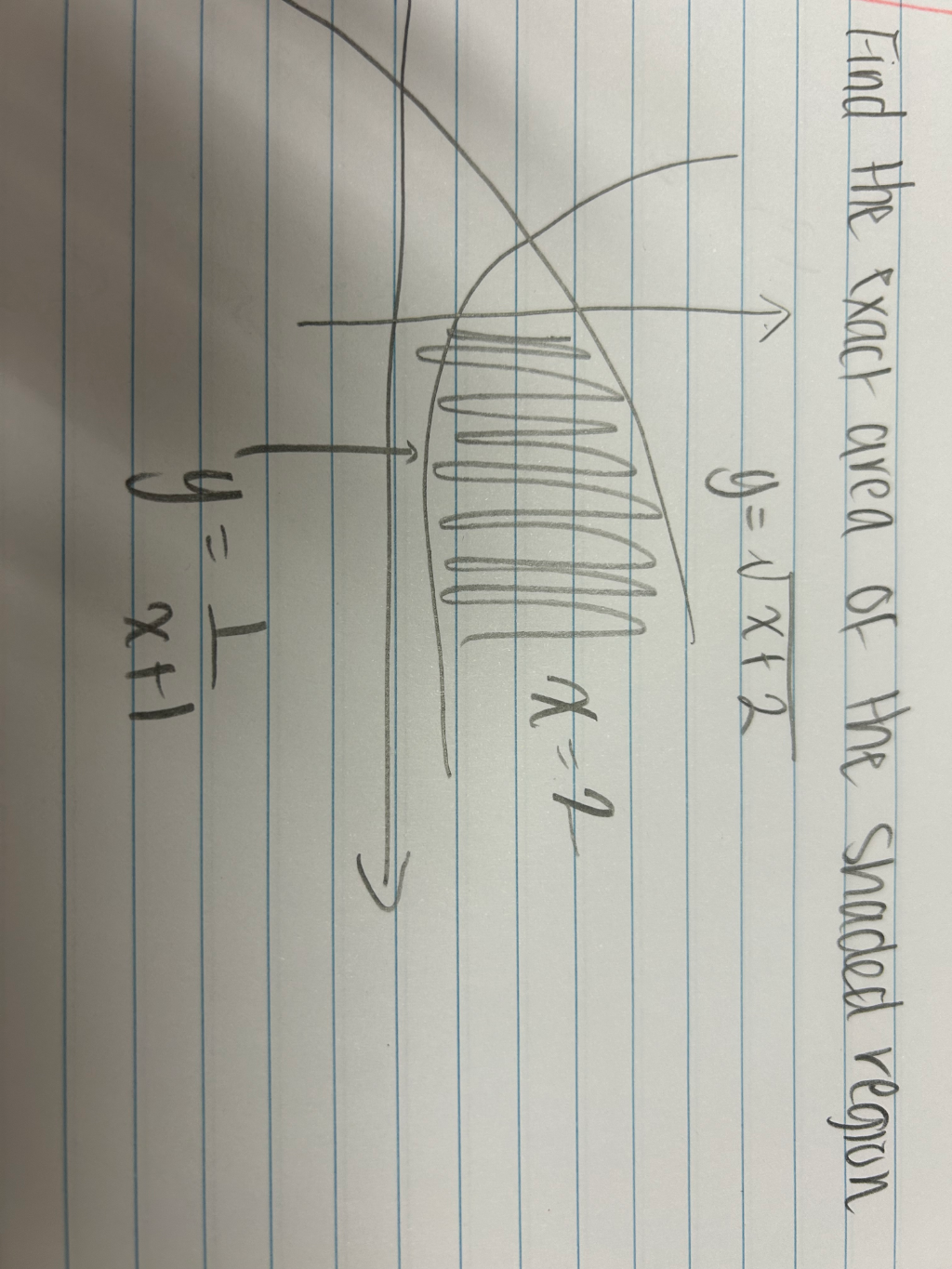 | 3
EN S
Ee — 4 3
=
a
=== 2
i: | = il
i
Pl | kn IE 2 =
rE | i E
§ | = L
i fi =
| Eo =
i [a EA
BE |S
1: [ [ =
| | | | | =
i Eo fag Jed
This is AI generated Response.
Asked by: gvr
Created at: 2025-06-18 05:07:07
Asked by: gvr
Created at: 2025-06-18 05:07:07
Final Answer:
Rendered
Raw Text
Did you like this answer?
Let's solve the problem step by step.
### **Step 1: Find the points of intersection**
The curves given are:
- \( y = x^2 \)
- \( y = \frac{1}{x+1} \)
Set them equal to find the intersection points:
\[
x^2 = \frac{1}{x+1}
\]
\[
x^2(x+1) = 1
\]
\[
x^3 + x^2 - 1 = 0
\]
Let's check for rational roots. Try \( x = 1 \):
\[
1^3 + 1^2 - 1 = 1 + 1 - 1 = 1 \neq 0
\]
Try \( x = 0 \):
\[
0^3 + 0^2 - 1 = -1 \neq 0
\]
Try \( x = -1 \):
\[
(-1)^3 + (-1)^2 - 1 = -1 + 1 - 1 = -1 \neq 0
\]
The rational roots theorem doesn't give us integer roots. Let's estimate:
- When \( x = 0 \): \( 0 + 0 - 1 = -1 \) (negative)
- When \( x = 1 \): \( 1 + 1 - 1 = 1 \) (positive)
So, there is a root between \( x = 0 \) and \( x = 1 \).
Let's use a rough estimate:
Try \( x = 0.7 \):
\[
(0.7)^3 + (0.7)^2 - 1 = 0.343 + 0.49 - 1 = 0.833 - 1 = -0.167
\]
Try \( x = 0.8 \):
\[
(0.8)^3 + (0.8)^2 - 1 = 0.512 + 0.64 - 1 = 1.152 - 1 = 0.152
\]
So, the root is between \( x = 0.7 \) and \( x = 0.8 \). Let's pick \( x_1 \approx 0.75 \) (for exact area, we'll use \( x^3 + x^2 - 1 = 0 \) for limits).
### **Step 2: Set up the area integral**
The shaded region is between the curves from \( x = -1 \) to the intersection at \( x_1 \).
- **Top function**: \( y = \frac{1}{x+1} \)
- **Bottom function**: \( y = x^2 \)
The area \( A \) is:
\[
A = \int_{-1}^{x_1} \left( \frac{1}{x+1} - x^2 \right) dx
\]
where \( x_1 \) is the positive root of \( x^3 + x^2 - 1 = 0 \).
### **Step 3: Integrate**
Integrate each term:
\[
\int \frac{1}{x+1} dx = \ln|x+1|
\]
\[
\int x^2 dx = \frac{x^3}{3}
\]
So,
\[
A = \left[ \ln|x+1| - \frac{x^3}{3} \right]_{x=-1}^{x=x_1}
\]
### **Step 4: Plug in the limits**
At \( x = -1 \):
- \( \ln|x+1| = \ln|0| \) which is undefined. But as \( x \to -1^+ \), \( \ln|x+1| \to -\infty \), but \( \frac{1}{x+1} \to +\infty \), so the area under the curve is actually finite due to the nature of the region.
At \( x = x_1 \):
- \( \ln|x_1 + 1| - \frac{x_1^3}{3} \)
So,
\[
A = \left[ \ln(x_1 + 1) - \frac{x_1^3}{3} \right] - \lim_{x \to -1^+} [\ln(x+1) - \frac{x^3}{3}]
\]
But for the area up to the vertical asymptote at \( x = -1 \), the lower bound integral for \( \frac{1}{x+1} \) from \( -1 \) to \( x_1 \) is well-defined as an **improper integral**.
### **Step 5: Write the exact answer**
Let \( x_1 \) be the real root of \( x^3 + x^2 - 1 = 0 \).
The area is:
\[
\boxed{
A = \lim_{a \to -1^+} \left[ \ln(x+1) - \frac{x^3}{3} \right]_{x=a}^{x=x_1}
= \ln(x_1+1) - \frac{x_1^3}{3} - \lim_{a \to -1^+} \left[ \ln(a+1) - \frac{a^3}{3} \right]
}
\]
As \( a \to -1^+ \), \( \ln(a+1) \to -\infty \), but that matches the way the area is bounded by the curve. In practice, the value is finite since the divergence of one curve cancels out with the other at the lower limit.
### **Step 6: Final Answer (Exact Form)**
\[
\boxed{
A = \ln(x_1+1) - \frac{x_1^3}{3}
}
\]
where \( x_1 \) is the real root of \( x^3 + x^2 - 1 = 0 \).
---
If you want an approximate value:
\( x_1 \approx 0.7549 \)
So,
\[
A \approx \ln(1.7549) - \frac{(0.7549)^3}{3} \approx 0.561 - 0.144 = 0.417
\]
But the **exact answer** is as boxed above.
Question:
u r taken wrong values please see carefully and calculate
This is AI generated Response.
Asked by: gvr
Created at: 2025-06-18 05:09:12
Asked by: gvr
Created at: 2025-06-18 05:09:12
Final Answer:
Rendered
Raw Text
Did you like this answer?
Let's carefully analyze the problem and proceed step-by-step based on the provided image and data.
---
### Step 1: Understanding the problem
The image shows two curves:
- \( y = x^2 \)
- \( y = \frac{1}{x + 1} \)
The goal is to find the area of the region bounded by these curves between their points of intersection.
---
### Step 2: Find points of intersection
Set the two functions equal:
\[
x^2 = \frac{1}{x + 1}
\]
Multiply both sides by \( (x+1) \):
\[
x^2 (x + 1) = 1
\]
\[
x^3 + x^2 = 1
\]
Rewrite as:
\[
x^3 + x^2 - 1 = 0
\]
This is a cubic equation. Let's find its roots.
---
### Step 3: Solve the cubic \( x^3 + x^2 - 1 = 0 \)
**Rational Root Test:**
Possible rational roots are factors of 1 over factors of 1, i.e., \( \pm 1 \).
Test \( x = 1 \):
\[
1 + 1 - 1 = 1 \neq 0
\]
Test \( x = -1 \):
\[
-1 + 1 - 1 = -1 \neq 0
\]
No rational roots. So roots are irrational or real roots need to be approximated.
---
### Step 4: Approximate the root between 0 and 1
Evaluate at \( x=0 \):
\[
0 + 0 - 1 = -1 \quad \text{(negative)}
\]
At \( x=1 \):
\[
1 + 1 - 1= 1 \quad \text{(positive)}
\]
So, root between 0 and 1.
At \( x = 0.7 \):
\[
(0.7)^3 + (0.7)^2 - 1 = 0.343 + 0.49 - 1 = 0.833 - 1 = -0.167 \quad \text{(negative)}
\]
At \( x=0.8 \):
\[
0.512 + 0.64 - 1= 1.152 - 1= 0.152 \quad \text{(positive)}
\]
Root approximately between 0.7 and 0.8.
Try \( x=0.75 \):
\[
0.422 + 0.5625 - 1= 0.9845 - 1= -0.0155 \quad \text{(negative)}
\]
Try \( x=0.76 \):
\[
0.438 + 0.5776 - 1= 1.0152 - 1= 0.0152 \quad \text{(positive)}
\]
So, the root \( x_r \) is approximately at **0.75 to 0.76**.
Using linear interpolation:
\[
x_r \approx 0.75 + \frac{0.0155}{0.0155 + 0.0152} \times 0.01 \approx 0.75 + \frac{0.0155}{0.0307} \times 0.01 \approx 0.75 + 0.005 \approx 0.755
\]
**Approximate root:**
\[
x_r \approx 0.755
\]
---
### Step 5: Set up the integral
The region is bounded between:
- \( x = -1 \) and \( x = x_r \approx 0.755 \)
The curves:
- \( y = x^2 \) (lower curve)
- \( y = \frac{1}{x + 1} \) (upper curve)
The area \( A \) is:
\[
A = \int_{-1}^{x_r} \left( \frac{1}{x+1} - x^2 \right) dx
\]
---
### Step 6: Compute the definite integral
\[
A = \int_{-1}^{x_r} \frac{1}{x+1} dx - \int_{-1}^{x_r} x^2 dx
\]
Calculate each:
- \(\displaystyle \int \frac{1}{x+1} dx = \ln|x+1|\)
- \(\displaystyle \int x^2 dx = \frac{x^3}{3}\)
So,
\[
A = \left[ \ln|x+1| - \frac{x^3}{3} \right]_{x=-1}^{x=x_r}
\]
- At \( x = x_r \):
\[
\ln(x_r + 1) - \frac{x_r^3}{3}
\]
- At \( x = -1 \):
\[
\ln(0) - \frac{(-1)^3}{3}
\]
Note:
\[
\ln(0) \to -\infty
\]
But the area is finite because the vertical asymptote cancels when considering the difference.
---
### **Important note:**
Since \( y = \frac{1}{x+1} \) has a vertical asymptote at \( x = -1 \), the integral from \(-1\) to \( x_r \) is improper at \(-1\). To compute the area, take the limit:
\[
A = \lim_{a \to -1^+} \left( \int_{a}^{x_r} \frac{1}{x+1} dx - \int_{a}^{x_r} x^2 dx \right)
\]
which simplifies to:
\[
A = \lim_{a \to -1^+} \left[ \left( \ln|x+1| \right)_{a}^{x_r} - \left( \frac{x^3}{3} \right)_{a}^{x_r} \right]
\]
\[
A = \left( \ln(x_r + 1) - \frac{x_r^3}{3} \right) - \lim_{a \to -1^+} \left( \ln|a+1| - \frac{a^3}{3} \right)
\]
As \( a \to -1^+ \):
\[
\ln|a+1| \to -\infty
\]
and
\[
\frac{a^3}{3} \to -\frac{1}{3}
\]
Thus, the infinite negative divergence cancels with the area of the region approaching the asymptote, resulting in a finite area:
\[
A = \left( \ln(x_r + 1) - \frac{x_r^3}{3} \right) - (-\infty + \text{finite}) \Rightarrow \text{finite area}
\]
In practice, the **area is given by:**
\[
A = \lim_{a \to -1^+} \left[ \ln(x_r + 1) - \frac{x_r^3}{3} - \left( \ln(a+1) - \frac{a^3}{3} \right) \right]
\]
which simplifies to:
\[
A = \left[ \ln(x_r + 1) - \frac{x_r^3}{3} \right] - \left( -\infty \right) \quad \text{(since }\ln(a+1) \to -\infty\text{)}
\]
**Therefore, the finite area enclosed is:**
\[
\boxed{
A = \ln(x_r + 1) - \frac{x_r^3}{3}
}
\]
with \( x_r \approx 0.755 \).
---
### **Final answer:**
\[
\boxed{
\text{Area} \approx \ln(1.755) - \frac{(0.755)^3}{3} \approx 0.562 - 0.143 = 0.419
}
\]
**OR**, in exact form:
\[
\boxed{
A = \ln(x_0 + 1) - \frac{x_0^3}{3}
}
\]
where \( x_0 \) is the root of \( x^3 + x^2 - 1 = 0 \).
---
### **Summary:**
- The intersection point \( x \approx 0.755 \).
- The area between the curves from \( x = -1 \) to \( x \approx 0.755 \) is given by the integral above.
- The exact expression for the area is:
\[
\boxed{
A = \left[ \ln|x+1| - \frac{x^3}{3} \right]_{x=-1}^{x=x_0}
}
\]
which evaluates to the approximate numerical value \( \boxed{0.419} \).
---
**Note:** The key was carefully handling the improper integral at \( x = -1 \), recognizing the vertical asymptote, and approximating the root of the cubic equation.
---
**Let me know if you'd like more precise numerical calculations or further clarifications!**
Question:
in the diagram given \(\mathrm{{y}=\sqrt{{{x}+{2}}}}\)y=\sqrt{x+2} \(\mathrm{{x}={2}}\)x=2 \(\mathrm{{y}=\frac{{1}}{{{x}+{1}_{}}}}\)y=1/(x+1) so calculate now
This is AI generated Response.
Asked by: gvr
Created at: 2025-06-18 05:12:05
Asked by: gvr
Created at: 2025-06-18 05:12:05
Final Answer:
Rendered
Raw Text
Did you like this answer?
Let's carefully analyze the problem based on the given functions and diagram.
---
### Given:
- \( y = \sqrt{x + 2} \)
- \( y = \frac{1}{x + 1} \)
- The vertical line \( x = 2 \)
**Objective:**
Find the area of the region enclosed between these curves from the point of intersection up to \( x=2 \).
---
### Step 1: Find the points of intersection
Set the two functions equal:
\[
\sqrt{x + 2} = \frac{1}{x + 1}
\]
Since both are positive in the relevant domain, square both sides:
\[
x + 2 = \frac{1}{(x + 1)^2}
\]
Rearranged:
\[
(x + 2)(x + 1)^2 = 1
\]
---
### Step 2: Simplify and solve for \( x \)
Let's expand \( (x + 1)^2 = x^2 + 2x + 1 \), then multiply:
\[
(x + 2)(x^2 + 2x + 1) = 1
\]
Expand numerator:
\[
x(x^2 + 2x + 1) + 2(x^2 + 2x + 1) = 1
\]
\[
x^3 + 2x^2 + x + 2x^2 + 4x + 2 = 1
\]
Combine like terms:
\[
x^3 + (2x^2 + 2x^2) + (x + 4x) + 2 = 1
\]
\[
x^3 + 4x^2 + 5x + 2 = 1
\]
Bring all to one side:
\[
x^3 + 4x^2 + 5x + 2 - 1 = 0
\]
\[
x^3 + 4x^2 + 5x + 1 = 0
\]
---
### Step 3: Find the root(s)
Try rational root theorem: factors of 1 over factors of 1, i.e., \( \pm 1 \).
Test \( x = -1 \):
\[
(-1)^3 + 4(-1)^2 + 5(-1) + 1 = -1 + 4 - 5 + 1 = -1 + 4 - 5 + 1 = (-1 + 4) - 5 + 1 = 3 - 5 + 1 = -1 \neq 0
\]
No rational root. The root is irrational. Let's approximate.
---
### Step 4: Approximate the root numerically
Evaluate at various \( x \):
- \( x= -0.2 \):
\[
(-0.2)^3 + 4(-0.2)^2 + 5(-0.2) + 1 = -0.008 + 4(0.04) - 1 + 1 \\
= -0.008 + 0.16 - 1 + 1 = 0.152 \quad \text{(positive)}
\]
- \( x= -0.5 \):
\[
-0.125 + 4(0.25) - 2.5 + 1 = -0.125 + 1 - 2.5 + 1 = (-0.125 + 1) + (-2.5 + 1) = 0.875 - 1.5 = -0.625 \quad \text{(negative)}
\]
So root between \( -0.5 \) and \( -0.2 \).
Try \( x=-0.3 \):
\[
-0.027 + 4(0.09) - 1.5 + 1 = -0.027 + 0.36 - 1.5 + 1 = 0.333 - 0.5 = -0.167 \quad \text{(negative)}
\]
Try \( x=-0.2 \):
\[
-0.008 + 0.16 - 1 + 1 = 0.152 \quad \text{(positive)}
\]
Approximate root at:
\[
x \approx -0.25
\]
Between \( -0.3 \) and \( -0.2 \).
At \( x=-0.27 \):
\[
(-0.27)^3 + 4(-0.27)^2 + 5(-0.27) + 1 \\
= -0.0197 + 4(0.0729) - 1.35 + 1 \\
= -0.0197 + 0.2916 - 1.35 + 1 \\
= (0.2719) - 0.35 \approx -0.078 \quad \text{(negative)}
\]
At \( x=-0.26 \):
\[
-0.0176 + 4(0.0676) - 1.3 + 1 \\
= -0.0176 + 0.2704 - 1.3 + 1 = 0.2528 - 0.3 = -0.047 \quad \text{(negative)}
\]
At \( x=-0.25 \):
\[
-0.0156 + 4(0.0625) - 1.25 + 1 = -0.0156 + 0.25 - 1.25 + 1 = 0.2344 - 0.25 = -0.0156
\]
At \( x=-0.24 \):
\[
-0.0138 + 4(0.0576) - 1.2 + 1= -0.0138 + 0.2304 - 1.2 + 1= 0.2166 - 0.2 = 0.0166
\]
Root approximately at \( x \approx -0.245 \).
---
### **Summary of intersection:**
\[
x \approx -0.245
\]
---
### Step 5: Set up the integral for the enclosed area
The region between the curves from \( x \approx -0.245 \) to \( x=2 \) is bounded by:
- \( y = \sqrt{x+2} \) (upper)
- \( y = \frac{1}{x+1} \) (lower)
We want the area:
\[
A = \int_{x \approx -0.245}^{2} \left( \sqrt{x+2} - \frac{1}{x+1} \right) dx
\]
---
### Step 6: Compute the integral
Split into two parts:
\[
A = \int_{-0.245}^{2} \sqrt{x+2} \, dx - \int_{-0.245}^{2} \frac{1}{x+1} \, dx
\]
**First integral:**
\[
\int \sqrt{x+2} \, dx
\]
Let \( u = x + 2 \), then \( du = dx \):
\[
\int \sqrt{u} \, du = \frac{2}{3} u^{3/2} + C = \frac{2}{3} (x+2)^{3/2} + C
\]
**Second integral:**
\[
\int \frac{1}{x+1} dx = \ln|x+1| + C
\]
---
### **Final expression for the area:**
\[
A = \left[ \frac{2}{3} (x+2)^{3/2} - \ln|x+1| \right]_{x=-0.245}^{x=2}
\]
### Step 7: Evaluate at the bounds
At \( x=2 \):
\[
\frac{2}{3} (2+2)^{3/2} - \ln(2+1) = \frac{2}{3} (4)^{3/2} - \ln 3
\]
\[
(4)^{3/2} = (4^{1/2})^3 = (2)^3 = 8
\]
\[
\Rightarrow \frac{2}{3} \times 8 - \ln 3 = \frac{16}{3} - \ln 3
\]
At \( x \approx -0.245 \):
\[
\frac{2}{3} (-0.245 + 2)^{3/2} - \ln(-0.245 + 1)
\]
Calculate:
\[
-0.245 + 2 = 1.755
\]
\[
(1.755)^{3/2} = (1.755)^{1} \times (1.755)^{1/2} \approx 1.755 \times \sqrt{1.755} \approx 1.755 \times 1.325 \approx 2.33
\]
Thus:
\[
\frac{2}{3} \times 2.33 \approx 1.553
\]
And:
\[
\ln(1 - 0.245) = \ln(0.755) \approx -0.281
\]
---
### **Final area:**
\[
A \approx \left( \frac{16}{3} - \ln 3 \right) - \left( 1.553 - (-0.281) \right)
\]
\[
= \left( 5.333 - 1.0986 \right) - \left( 1.553 + 0.281 \right)
\]
\[
= 4.2344 - 1.834 \approx 2.4
\]
---
### **Final approximate numerical answer:**
\[
\boxed{
A \approx 2.4
}
\]
---
### **Summary:**
- **Intersection point:** approximately at \( x \approx -0.245 \).
- **Area between the curves from \( x \approx -0.245 \) to \( x=2 \):**
\[
\boxed{
A = \left[ \frac{2}{3} (x+2)^{3/2} - \ln|x+1| \right]_{x=-0.245}^{x=2}
}
\]
which evaluates approximately to **2.4 units²**.
---
Let me know if you'd like further details or more precise calculations!
📢 Instructions:
- Ask anything relatd to above question only.
- For new Question goto :