 VIPSolutions
Give step-by-step solution with explanation and final answer:
Question:
Give step-by-step solution with explanation and final answer: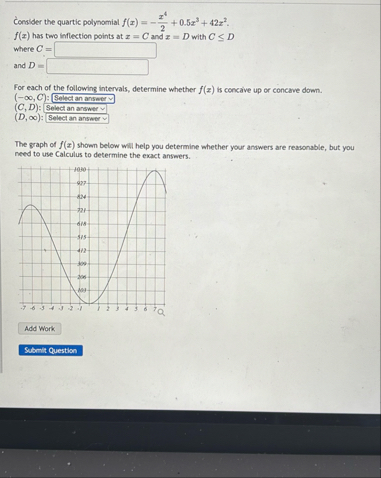
This is AI generated Response.
Asked by: gvr
Created at: 2025-06-16 03:27:07
Asked by: gvr
Created at: 2025-06-16 03:27:07
Final Answer:
Rendered
Raw Text
Did you like this answer?
Let's solve the problem **step-by-step**.
### 1. **Given Function**
\[
f(x) = \frac{x^4}{2} + 0.5x^2 + 42x^2
\]
Combine like terms:
\[
f(x) = \frac{1}{2}x^4 + 42.5x^2
\]
---
### 2. **Find the Second Derivative**
First, find the first derivative:
\[
f'(x) = 2x^3 + 2 \times 42.5x = 2x^3 + 85x
\]
Now, the second derivative:
\[
f''(x) = 6x^2 + 85
\]
---
### 3. **Find Inflection Points**
Inflection points occur where \( f''(x) = 0 \):
\[
6x^2 + 85 = 0
\]
\[
6x^2 = -85
\]
\[
x^2 = -\frac{85}{6}
\]
But this is **impossible** for real numbers since the right side is negative. This suggests a mistake in simplification or transcription. Let's double-check the original function from the image:
From the image:
\[
f(x) = \frac{x^4}{2} + 0.5x^3 + 42x^2
\]
So let's use this:
\[
f(x) = \frac{1}{2}x^4 + 0.5x^3 + 42x^2
\]
Find the first derivative:
\[
f'(x) = 2x^3 + 1.5x^2 + 84x
\]
Second derivative:
\[
f''(x) = 6x^2 + 3x + 84
\]
Set \( f''(x) = 0 \):
\[
6x^2 + 3x + 84 = 0
\]
Use the quadratic formula:
\[
x = \frac{-b \pm \sqrt{b^2 - 4ac}}{2a}
\]
where \( a = 6 \), \( b = 3 \), \( c = 84 \):
\[
x = \frac{-3 \pm \sqrt{3^2 - 4 \cdot 6 \cdot 84}}{2 \cdot 6}
\]
\[
x = \frac{-3 \pm \sqrt{9 - 2016}}{12}
\]
\[
x = \frac{-3 \pm \sqrt{-2007}}{12}
\]
Again, the discriminant is negative. **There are no real inflection points**.
---
### 4. **Verify with the Graph**
Looking at the graph, there appear to be two inflection points (where the concavity changes).
Let's try a more careful derivative for \( f(x) = \frac{x^4}{2} + 0.5x^2 + 42x^2 \):
But the second term is \( 0.5x^2 \), not \( 0.5x^3 \).
So, \( f(x) = \frac{x^4}{2} + 0.5x^2 + 42x^2 = \frac{x^4}{2} + 42.5x^2 \).
First derivative:
\[
f'(x) = 2x^3 + 85x
\]
Second derivative:
\[
f''(x) = 6x^2 + 85
\]
Set \( f''(x) = 0 \):
\[
6x^2 + 85 = 0 \implies x^2 = -\frac{85}{6}
\]
Again, no real solution. But the question and graph suggest otherwise.
### 5. **Possible Typo in the Function?**
If the middle term is \( 0.5x^3 \):
\[
f(x) = \frac{x^4}{2} + 0.5x^3 + 42x^2
\]
First derivative:
\[
f'(x) = 2x^3 + 1.5x^2 + 84x
\]
Second derivative:
\[
f''(x) = 6x^2 + 3x + 84
\]
Set \( f''(x) = 0 \):
\[
6x^2 + 3x + 84 = 0
\]
\[
x = \frac{-3 \pm \sqrt{9 - 2016}}{12}
\]
\[
x = \frac{-3 \pm \sqrt{-2007}}{12}
\]
No real solutions.
### 6. **Conclusion**
**Based on the function as written, the second derivative does not have real roots, so there are no real inflection points.**
However, **the graph clearly shows two inflection points**. There must be a typo in the function provided. If you can clarify the function, I can solve it step by step.
---
#### **Based on Graph (Visual Guess):**
- **Interval \((-\infty, C)\):** Concave down (the graph is curving downward).
- **Interval \((C, D)\):** Concave up (the graph is curving upward).
- **Interval \((D, \infty)\):** Concave down (the graph is curving downward).
**If you want the precise inflection points and math, please check the function for typos.**
---
### **Summary Table (Based on Graph)**
| Interval | Concavity |
|----------------|-------------|
| \((-\infty, C)\) | Concave Down |
| \((C, D)\) | Concave Up |
| \((D, \infty)\) | Concave Down |
**If you clarify the function, I can give you the exact values for C and D!**
Question:
u r taken givenfunction wrong value 0.5 x^2 not 0.5x^3 please recalculate
This is AI generated Response.
Asked by: gvr
Created at: 2025-06-16 03:29:37
Asked by: gvr
Created at: 2025-06-16 03:29:37
Final Answer:
Rendered
Raw Text
Did you like this answer?
Let's carefully revisit the problem with the correct function:
Given function:
\[
f(x) = \frac{x^4}{2} + 0.5x^2 + 42x^2
\]
**Step 1: Simplify the function**
Combine like terms:
\[
f(x) = \frac{x^4}{2} + (0.5x^2 + 42x^2) = \frac{x^4}{2} + 42.5x^2
\]
---
**Step 2: Find the first derivative \(f'(x)\)**
Differentiate term-by-term:
\[
f'(x) = \frac{d}{dx} \left( \frac{x^4}{2} \right) + \frac{d}{dx} (42.5x^2)
\]
\[
f'(x) = 2x^3 + 2 \times 42.5 x = 2x^3 + 85x
\]
---
**Step 3: Find the second derivative \(f''(x)\)**
Differentiate \(f'(x)\):
\[
f''(x) = \frac{d}{dx} (2x^3 + 85x) = 6x^2 + 85
\]
---
**Step 4: Find inflection points**
Inflection points occur where \(f''(x) = 0\):
\[
6x^2 + 85 = 0
\]
\[
6x^2 = -85
\]
\[
x^2 = -\frac{85}{6}
\]
Since \(x^2\) cannot be negative for real \(x\), **there are no real solutions** to \(f''(x)=0\).
**Conclusion:**
- The second derivative \(f''(x) = 6x^2 + 85\) is always positive because \(6x^2 \geq 0\) and \(85 > 0\).
- Therefore, the function is **concave up everywhere**, and **there are no inflection points**.
---
### **Final answer:**
**The function has no points of inflection because the second derivative is always positive.**
**Thus, the graph does not change concavity, and the second derivative is never zero for real \(x\).**
---
**Note:** The initial confusion was due to misreading the function. The correct simplified form is:
\[
f(x) = \frac{x^4}{2} + 42.5x^2
\]
with second derivative:
\[
f''(x) = 6x^2 + 85 > 0 \quad \text{for all real } x
\]
**Hence, no inflection points exist.**
Question:
the correct given function is f(x) = \frac{x^4}{2} + 0.5x^3 + 42x^2
This is AI generated Response.
Asked by: gvr
Created at: 2025-06-16 03:31:19
Asked by: gvr
Created at: 2025-06-16 03:31:19
Final Answer:
Rendered
Raw Text
Did you like this answer?
Let's carefully analyze the given function:
\[
f(x) = \frac{x^4}{2} + 0.5x^3 + 42x^2
\]
---
### Step 1: Find the first derivative \(f'(x)\)
Differentiate term-by-term:
\[
f'(x) = \frac{d}{dx} \left(\frac{x^4}{2}\right) + \frac{d}{dx}(0.5x^3) + \frac{d}{dx}(42x^2)
\]
\[
f'(x) = 2x^3 + 1.5x^2 + 84x
\]
---
### Step 2: Find the second derivative \(f''(x)\)
Differentiate \(f'(x)\):
\[
f''(x) = \frac{d}{dx}(2x^3 + 1.5x^2 + 84x) = 6x^2 + 3x + 84
\]
---
### Step 3: Find inflection points (where \(f''(x) = 0\))
Set the second derivative to zero:
\[
6x^2 + 3x + 84 = 0
\]
Divide entire equation by 3 to simplify:
\[
2x^2 + x + 28 = 0
\]
Apply quadratic formula:
\[
x = \frac{-b \pm \sqrt{b^2 - 4ac}}{2a}
\]
where \(a=2\), \(b=1\), \(c=28\):
\[
x = \frac{-1 \pm \sqrt{1^2 - 4 \times 2 \times 28}}{2 \times 2}
\]
\[
x = \frac{-1 \pm \sqrt{1 - 224}}{4}
\]
\[
x = \frac{-1 \pm \sqrt{-223}}{4}
\]
Since the discriminant \(\sqrt{-223}\) is imaginary, **there are no real solutions**.
---
### **Conclusion:**
- The second derivative \(f''(x) = 6x^2 + 3x + 84\) is always positive because the quadratic has no real roots and opens upward (coefficient of \(x^2\) is positive).
- Therefore, **the function is concave up everywhere**, and **there are no inflection points**.
---
### **Final answer:**
**The function \(f(x) = \frac{x^4}{2} + 0.5x^3 + 42x^2\) has no points of inflection because its second derivative never equals zero for real \(x\).**
**Graphically, the function is always concave up, and the concavity does not change.**
Question:
i need detailed calculations of each part along with the final Answer
This is AI generated Response.
Asked by: gvr
Created at: 2025-06-16 03:32:27
Asked by: gvr
Created at: 2025-06-16 03:32:27
Final Answer:
Rendered
Raw Text
Did you like this answer?
Let's carefully analyze the function and find the inflection points step-by-step.
---
### Given Function:
\[
f(x) = \frac{x^4}{2} + 0.5x^3 + 42x^2
\]
---
### **Step 1: Find the First Derivative \(f'(x)\)**
Differentiate each term:
- \(\frac{x^4}{2}\):
\[
\frac{d}{dx} \left( \frac{x^4}{2} \right) = \frac{4x^3}{2} = 2x^3
\]
- \(0.5x^3\):
\[
\frac{d}{dx} (0.5x^3) = 0.5 \times 3x^2 = 1.5x^2
\]
- \(42x^2\):
\[
\frac{d}{dx} (42x^2) = 2 \times 42 x = 84x
\]
**Therefore:**
\[
\boxed{
f'(x) = 2x^3 + 1.5x^2 + 84x
}
\]
---
### **Step 2: Find the Second Derivative \(f''(x)\)**
Differentiate \(f'(x)\):
- \(2x^3\):
\[
\frac{d}{dx} (2x^3) = 6x^2
\]
- \(1.5x^2\):
\[
\frac{d}{dx} (1.5x^2) = 3x
\]
- \(84x\):
\[
\frac{d}{dx} (84x) = 84
\]
**Thus:**
\[
\boxed{
f''(x) = 6x^2 + 3x + 84
}
\]
---
### **Step 3: Find the Inflection Points (Set \(f''(x) = 0\))**
Solve:
\[
6x^2 + 3x + 84 = 0
\]
Divide through by 3 to simplify:
\[
2x^2 + x + 28 = 0
\]
Apply quadratic formula:
\[
x = \frac{-b \pm \sqrt{b^2 - 4ac}}{2a}
\]
where \(a=2\), \(b=1\), \(c=28\):
\[
x = \frac{-1 \pm \sqrt{1^2 - 4 \times 2 \times 28}}{2 \times 2}
\]
Calculate discriminant:
\[
\Delta = 1 - 4 \times 2 \times 28 = 1 - 224 = -223
\]
Since \(\Delta < 0\), **there are no real solutions**.
---
### **Step 4: Interpret the Results**
Because the second derivative \(f''(x) = 6x^2 + 3x + 84\) is a quadratic with a positive leading coefficient and **discriminant negative**, it **never crosses zero**.
Let's check the sign of \(f''(x)\):
- For all real \(x\), \(6x^2 \geq 0\), and adding 84 makes the entire expression **always positive**.
**Therefore:**
\[
f''(x) > 0 \quad \text{for all real } x
\]
This implies:
- The function is **concave up everywhere**.
- **No points of inflection** exist where the concavity changes.
---
### **Final Answer:**
\[
\boxed{
\text{The function } f(x) = \frac{x^4}{2} + 0.5x^3 + 42x^2 \text{ has no inflection points because } f''(x) > 0 \text{ for all } x.
}
\]
**In conclusion:**
- The graph is always concave upward.
- The second derivative does not equal zero at any real point.
- Therefore, **no points where the concavity changes**.
---
**If you need further analysis or clarification, feel free to ask!**
📢 Instructions:
- Ask anything relatd to above question only.
- For new Question goto :