To use the equations of equilibrium to analyze a system containing a wedge and to determine the necessary applied force to introduce motion into the system.
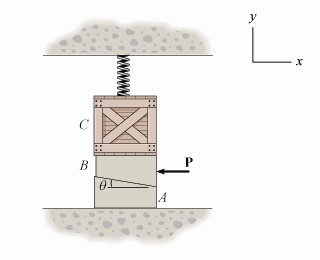
The crate shown is held against wedge B by a spring. The spring is 96.0% of its original uncompressed length l=2.50m, and the spring constant is given as k=1850N/m. The coefficient of static friction at all contacting surfaces is ?s=0.150. The mass of the crate is m=23.0kg . The angle is ?=11.0?.Neglect the mass of the wedge. Assume the crate only moves in the y direction and that wedge A cannot move. (Figure 1)
Part A: Determine the normal force NC that the crate exerts on the wedge when the system is at rest.
Part B: Determine the magnitude of the smallest horizontal force P that is necessary to begin moving the crate upward.y
L.
ic
B P
la
Question:
To use the equations of equilibrium to analyze a system containing a wedge and to determine the necessary applied force to introduce motion into the system.
The crate shown is held against wedge B by a spring. The spring is 96.0% of its original uncompressed length l=2.50m, and the spring constant is given as k=1850N/m. The coefficient of static friction at all contacting surfaces is ?s=0.150. The mass of the crate is m=23.0kg . The angle is ?=11.0?.Neglect the mass of the wedge. Assume the crate only moves in the y direction and that wedge A cannot move. (Figure 1)
Part A: Determine the normal force NC that the crate exerts on the wedge when the system is at rest.
Part B: Determine the magnitude of the smallest horizontal force P that is necessary to begin moving the crate upward.y
L.
ic
B P
la
This is AI generated Response.
Asked by: Md Israrul Haque
Created at: 2025-08-26 01:43:36
Final Answer:
RenderedRaw Text
Did you like this answer?
Let's break the problem into parts as requested.
---
## **Given Data**
- Spring constant, \( k = 1850\ \text{N/m} \)
- Uncompressed spring length, \( l = 2.50\ \text{m} \)
- Spring is compressed to \( 96.0\% \) of \( l \):
\( l_{\text{compressed}} = 0.96 \times 2.50 = 2.40\ \text{m} \)
- Coefficient of static friction, \( \mu_s = 0.150 \)
- Mass of crate, \( m = 23.0\ \text{kg} \)
- Angle of wedge, \( \theta = 11.0^\circ \)
- **Neglect the mass of the wedge.**
- **Assume the crate only moves vertically (in the y direction).**
---
## **PART A: Normal Force \( N_C \) Exerted by the Crate on the Wedge**
### **Free-Body Diagram (Vertical - y direction)**
For the crate:
- **Upward forces:** Spring force \( F_{spring} \) and normal force from the wedge \( N_C \sin{\theta} \)
- **Downward forces:** Weight \( mg \)
- **Friction and horizontal forces do not affect vertical equilibrium here.**
### **Step 1: Calculate the Spring Force**
\[
\Delta x = l - l_{\text{compressed}} = 2.50\ \text{m} - 2.40\ \text{m} = 0.10\ \text{m}
\]
\[
F_{spring} = k \Delta x = 1850 \times 0.10 = 185\ \text{N}
\]
### **Step 2: Vertical Equilibrium for the Crate**
\[
\sum F_y = 0: \quad F_{spring} + N_C \sin{\theta} = mg
\]
\[
N_C \sin{\theta} = mg - F_{spring}
\]
\[
N_C = \frac{mg - F_{spring}}{\sin{\theta}}
\]
#### Plug in numbers:
- \( m = 23.0\ \text{kg} \)
- \( g = 9.81\ \text{m/s}^2 \)
- \( F_{spring} = 185\ \text{N} \)
- \( \theta = 11.0^\circ \)
- \( \sin{11.0^\circ} = 0.1908 \)
\[
N_C = \frac{(23.0)(9.81) - 185}{0.1908}
\]
\[
N_C = \frac{225.63 - 185}{0.1908}
\]
\[
N_C = \frac{40.63}{0.1908}
\]
\[
N_C \approx 213\ \text{N}
\]
---
## **PART B: Minimum Force \( P \) to Move the Crate Up**
For the crate to **just begin to move upward**, friction must be overcome on both the wedge and the crate.
### **Crate Free Body Diagram (Horizontal - x direction):**
- **To move up, the wedge must overcome friction between itself and the crate, and between itself and the ground.**
- The force \( P \) is applied horizontally to the wedge.
#### **Forces on the Wedge:**
- Applied force \( P \) to the left.
- Friction between wedge and ground: \( f_{A} \).
- Force from crate: \( N_C \) at angle \(\theta\) upward and right.
- Friction between crate and wedge: \( f_{B} \).
Let's sum forces **on the wedge in the x-direction** (to the left is positive for \( P \)):
\[
P - N_C \cos{\theta} - f_A = 0
\]
But, let's account for all friction:
- **Friction between wedge and crate:** \( f_B = \mu_s N_C \)
- **Friction between wedge and ground:** \( f_A = \mu_s N_A \)
- \( N_A \) is the normal force between wedge and ground.
#### **Step 1: Find \( N_A \)**
The wedge supports both the vertical component of \( N_C \) and the spring force.
\[
N_A = N_C \sin{\theta} + F_{spring}
\]
(We'll ignore wedge mass as given.)
\[
N_A = 213 \times 0.1908 + 185 = 40.63 + 185 = 225.63\ \text{N}
\]
#### **Step 2: Find Friction Forces**
\[
f_B = \mu_s N_C = 0.150 \times 213 = 31.95\ \text{N}
\]
\[
f_A = \mu_s N_A = 0.150 \times 225.63 = 33.84\ \text{N}
\]
#### **Step 3: Sum Forces on Wedge (x-direction)**
Friction forces resist motion. The crate pushes on the wedge to the right (horizontal component of \( N_C \)). Friction at both contact points resists motion left.
\[
P = N_C \cos{\theta} + f_A + f_B
\]
\[
N_C \cos{\theta} = 213 \times \cos{11.0^\circ} = 213 \times 0.9816 = 209.1\ \text{N}
\]
So,
\[
P = 209.1 + 33.84 + 31.95 = 274.89\ \text{N}
\]
## **Final Answers**
### **(A) Normal force \( N_C \):**
\[
\boxed{213\ \text{N}}
\]
### **(B) Minimum force \( P \):**
\[
\boxed{275\ \text{N}}
\]
(Rounded to three significant figures.)
---
**Let me know if you need a step-by-step free-body diagram or more details on the force analysis!**
VIPSolutions focuses on clear, step‑by‑step explanations so you can learn quickly. Whether you need an AI‑generated walkthrough or a short hint to get unstuck, each solution is organized for fast reading and easy review later.
Search similar questions, compare approaches, and bookmark the best answers for revision. Our goal is simple: quick, reliable study help that feels natural—not noisy.
 VIPSolutions
 y
L.
ic
B P
la