This is AI generated Response.
Asked by: MD ISRARUL HAQUE
Created at: 2025-09-09 10:20:38
Final Answer:
RenderedRaw Text
Did you like this answer?
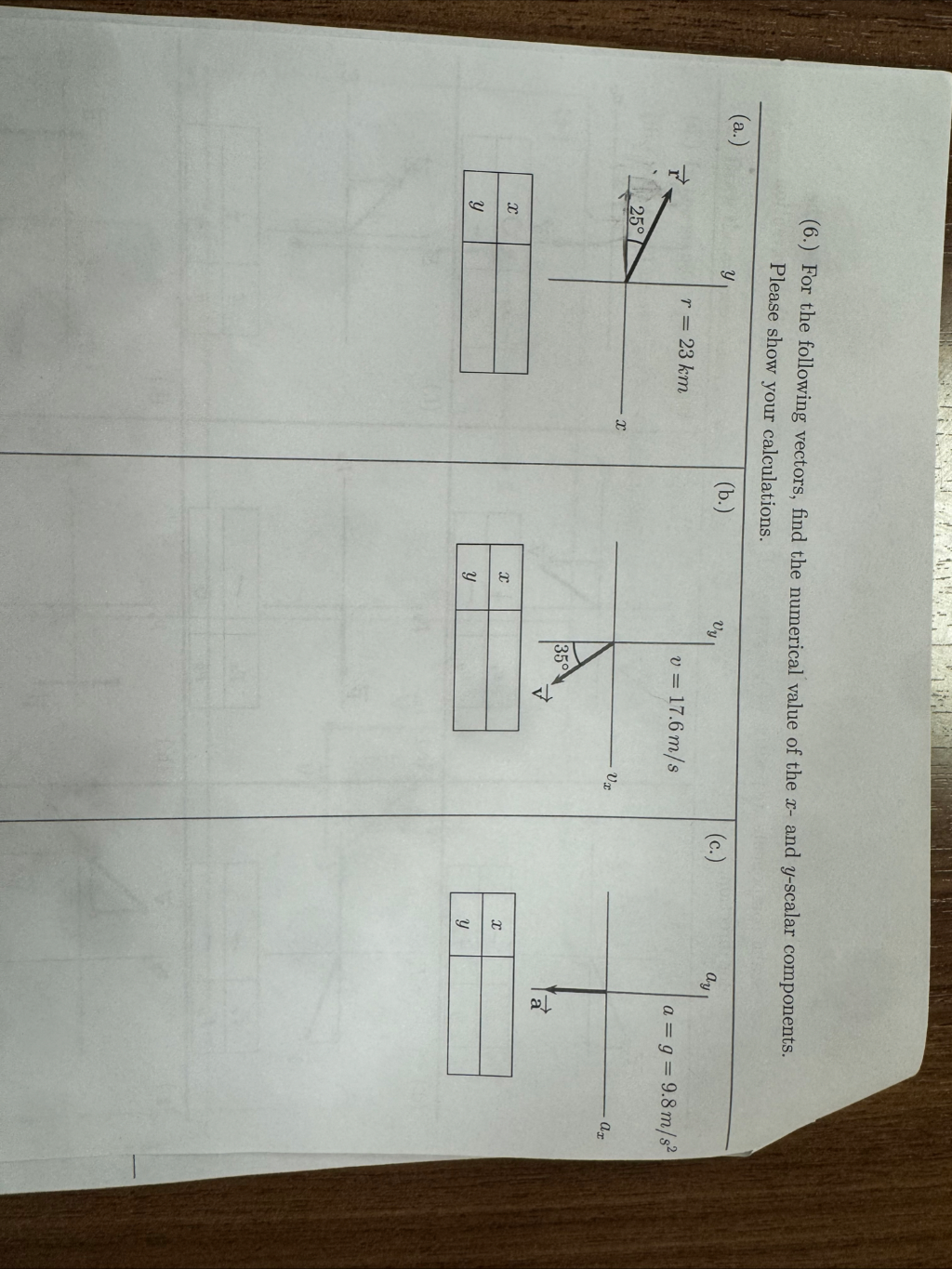
Let's solve each part step-by-step, finding the **x** and **y** components of each vector.
### (a)
Given:
- Vector \( r = 23 \) km
- Angle from x-axis = \( 25^\circ \) (above x-axis)
The components are:
- \( r_x = r \cos(25^\circ) \)
- \( r_y = r \sin(25^\circ) \)
**Calculations:**
- \( r_x = 23 \times \cos(25^\circ) \)
- \( r_y = 23 \times \sin(25^\circ) \)
Now, using a calculator:
- \( \cos(25^\circ) \approx 0.9063 \)
- \( \sin(25^\circ) \approx 0.4226 \)
So,
- \( r_x = 23 \times 0.9063 \)
- \( r_x \approx 20.85 \) km
- \( r_y = 23 \times 0.4226 \)
- \( r_y \approx 9.72 \) km
**Final answers (a):**
| | x | y |
|---|-------|-------|
| | 20.85 | 9.72 |
---
### (b)
Given:
- Vector \( v = 17.6 \) m/s
- Angle below x-axis = \( 35^\circ \) (below the x-axis, so y-component is negative)
The components are:
- \( v_x = v \cos(35^\circ) \)
- \( v_y = -v \sin(35^\circ) \) (negative because it is below the axis)
**Calculations:**
- \( v_x = 17.6 \times \cos(35^\circ) \)
- \( v_y = -17.6 \times \sin(35^\circ) \)
Now, using a calculator:
- \( \cos(35^\circ) \approx 0.8192 \)
- \( \sin(35^\circ) \approx 0.5736 \)
So,
- \( v_x = 17.6 \times 0.8192 \)
- \( v_x \approx 14.42 \) m/s
- \( v_y = -17.6 \times 0.5736 \)
- \( v_y \approx -10.10 \) m/s
**Final answers (b):**
| | x | y |
|---|-------|--------|
| | 14.42 | -10.10 |
---
### (c)
Given:
- \( a = g = 9.8 \) m/s²
- The vector is straight down (negative y-axis)
So:
- \( a_x = 0 \)
- \( a_y = -9.8 \) m/s²
**Final answers (c):**
| | x | y |
|---|---|--------|
| | 0 | -9.8 |
---
### **Summary Table**
#### (a)
| | x (km) | y (km) |
|---|---------|--------|
| | 20.85 | 9.72 |
#### (b)
| | x (m/s) | y (m/s) |
|---|----------|---------|
| | 14.42 | -10.10 |
#### (c)
| | x (m/s²) | y (m/s²) |
|---|----------|----------|
| | 0 | -9.8 |
Let me know if you need a further breakdown or explanation!
Question:
While warming up for a game, two basketball players shoot balls in parabolic paths. The path of the first player's ball can be represented by the function g(x) = - 2x ^ 2 + 13x + 7 where x represents the distance from the coach. The path of the second player's ball can be represented by the function h(x)= - x ^ 2 + 4x + 21.
Part A: Find the distances in which the two basketball paths will cross. Show all necessary calculations. (4 points)
Part B: Let f (x) = f(x)=(x) Solve for f (x) in simplest form and determine all discontinuities. (6 points)
This is AI generated Response.
Asked by: MD ISRARUL HAQUE
Created at: 2025-09-09 20:46:58
Final Answer:
RenderedRaw Text
Did you like this answer?
# Basketball Players' Parabolic Paths
## Part A: Finding Intersection Points
Given the functions for the paths of the basketballs:
- \( g(x) = -2x^2 + 13x + 7 \) (First player)
- \( h(x) = -x^2 + 4x + 21 \) (Second player)
### Step 1: Set the equations equal to each other
To find the distances where the two paths cross, we set \( g(x) = h(x) \):
\[
-2x^2 + 13x + 7 = -x^2 + 4x + 21
\]
### Step 2: Rearrange the equation
Move all terms to one side:
\[
-2x^2 + 13x + 7 + x^2 - 4x - 21 = 0
\]
Combine like terms:
\[
-x^2 + 9x - 14 = 0
\]
### Step 3: Multiply by -1 for simplicity
\[
x^2 - 9x + 14 = 0
\]
### Step 4: Factor the quadratic
\[
(x - 7)(x - 2) = 0
\]
### Step 5: Solve for \( x \)
Setting each factor to zero gives:
\[
x - 7 = 0 \quad \Rightarrow \quad x = 7
\]
\[
x - 2 = 0 \quad \Rightarrow \quad x = 2
\]
### Final Answer for Part A
The distances where the two basketball paths cross are:
- \( x = 2 \)
- \( x = 7 \)
---
## Part B: Solving for \( f(x) \)
Given the function:
\[
f(x) = \frac{1}{x}
\]
### Step 1: Simplify \( f(x) \)
The function is already in its simplest form.
### Step 2: Determine discontinuities
A function is discontinuous where its denominator is zero. For \( f(x) \):
\[
x = 0
\]
### Final Answer for Part B
The function \( f(x) = \frac{1}{x} \) has a discontinuity at:
- \( x = 0 \)
This means \( f(x) \) is undefined at this point.
Question:
While warming up for a game, two basketball players shoot balls in parabolic paths. The path of the first player's ball can be represented by the function g(x) = - 2x ^ 2 + 13x + 7 where x represents the distance from the coach. The path of the second player's ball can be represented by the function h(x)= - x ^ 2 + 4x + 21.
Part A: Find the distances in which the two basketball paths will cross. Show all necessary calculations. (4 points)
Part B: Let f (x) = g(x)/h(x) Solve for f (x) in simplest form and determine all discontinuities. (6 points)
This is AI generated Response.
Asked by: MD ISRARUL HAQUE
Created at: 2025-09-09 20:48:31
Final Answer:
RenderedRaw Text
Did you like this answer?
# Basketball Players' Parabolic Paths
## Part A: Finding Intersection Points
Given the functions for the paths of the basketballs:
- \( g(x) = -2x^2 + 13x + 7 \) (First player)
- \( h(x) = -x^2 + 4x + 21 \) (Second player)
### Step 1: Set the equations equal to each other
To find the distances where the two paths cross, we set \( g(x) = h(x) \):
\[
-2x^2 + 13x + 7 = -x^2 + 4x + 21
\]
### Step 2: Rearrange the equation
Move all terms to one side:
\[
-2x^2 + 13x + 7 + x^2 - 4x - 21 = 0
\]
Combine like terms:
\[
-x^2 + 9x - 14 = 0
\]
### Step 3: Multiply by -1 for simplicity
\[
x^2 - 9x + 14 = 0
\]
### Step 4: Factor the quadratic
\[
(x - 7)(x - 2) = 0
\]
### Step 5: Solve for \( x \)
Setting each factor to zero gives:
\[
x - 7 = 0 \quad \Rightarrow \quad x = 7
\]
\[
x - 2 = 0 \quad \Rightarrow \quad x = 2
\]
### Final Answer for Part A
The distances where the two basketball paths cross are:
- \( x = 2 \)
- \( x = 7 \)
---
## Part B: Solving for \( f(x) \)
Given the function:
\[
f(x) = \frac{g(x)}{h(x)} = \frac{-2x^2 + 13x + 7}{-x^2 + 4x + 21}
\]
### Step 1: Simplify \( f(x) \)
To simplify, we will factor both \( g(x) \) and \( h(x) \).
**Factoring \( g(x) \)**:
- We already have \( g(x) = -2(x - 7)(x - 2) \).
**Factoring \( h(x) \)**:
- We need to factor \( -x^2 + 4x + 21 \):
Using the quadratic formula or factoring method:
\[
h(x) = - (x^2 - 4x - 21)
\]
Now, we need to find factors of \( -21 \) that sum to \( -4 \), which are \( -7 \) and \( 3 \):
\[
h(x) = - (x - 7)(x + 3)
\]
### Step 2: Combine into \( f(x) \)
Now substituting back into \( f(x) \):
\[
f(x) = \frac{-2(x - 7)(x - 2)}{-(x - 7)(x + 3)}
\]
Cancelling the common factor \( -(x - 7) \) (valid for \( x \neq 7 \)):
\[
f(x) = \frac{2(x - 2)}{x + 3}
\]
### Step 3: Determine discontinuities
A function is discontinuous where its denominator is zero. For \( f(x) \):
Set the denominator equal to zero:
\[
x + 3 = 0 \quad \Rightarrow \quad x = -3
\]
### Final Answer for Part B
The simplified form of \( f(x) \) is:
\[
f(x) = \frac{2(x - 2)}{x + 3} \quad (x \neq 7)
\]
The function \( f(x) \) has a discontinuity at:
- \( x = -3 \)
Additionally, \( f(x) \) is undefined at \( x = 7 \) due to cancellation. Thus, the discontinuities are:
- \( x = -3 \)
- \( x = 7 \)
Question:
To help pay for new costumes for a
play, a theater invests
$
1
6
0
0
in an
1
8
-
month CD paying
3
.
5
%
interest compounded monthly. Determine the amount the theater will receive when it cashes in the CD after
1
8
months. Question content area bottom Part
1
The theater will receive
$enter your response here when it cashes in the CD
.
(
Round to the nearest cent as
needed.
)
This is AI generated Response.
Asked by: MD ISRARUL HAQUE
Created at: 2025-09-10 02:47:23
Final Answer:
RenderedRaw Text
Did you like this answer?
# Calculation of CD Maturity Value
To calculate the amount the theater will receive when cashing in the Certificate of Deposit (CD), we will use the formula for compound interest:
\[
A = P \left(1 + \frac{r}{n}\right)^{nt}
\]
Where:
- \( A \) = the amount of money accumulated after n years, including interest.
- \( P \) = the principal amount (the initial amount of money).
- \( r \) = annual interest rate (decimal).
- \( n \) = number of times that interest is compounded per unit \( t \).
- \( t \) = the time the money is invested for in years.
### Given Values
- \( P = 1600 \) (the initial investment)
- \( r = 3.5\% = 0.035 \) (annual interest rate)
- \( n = 12 \) (compounded monthly)
- \( t = \frac{18}{12} = 1.5 \) years (18 months)
### Step 1: Plug Values into the Formula
Substituting the values into the formula:
\[
A = 1600 \left(1 + \frac{0.035}{12}\right)^{12 \times 1.5}
\]
### Step 2: Calculate the values
1. Calculate \( \frac{r}{n} \):
\[
\frac{0.035}{12} \approx 0.00291667
\]
2. Calculate \( nt \):
\[
12 \times 1.5 = 18
\]
3. Now substitute back into the formula:
\[
A = 1600 \left(1 + 0.00291667\right)^{18}
\]
\[
A = 1600 \left(1.00291667\right)^{18}
\]
4. Calculate \( (1.00291667)^{18} \):
Using a calculator, \( (1.00291667)^{18} \approx 1.055273 \).
5. Finally, calculate \( A \):
\[
A \approx 1600 \times 1.055273 \approx 1688.43
\]
### Final Answer
The theater will receive **$1688.43** when it cashes in the CD.
Question:
1. Solve the system of linear equations below by the method of Gaussian-Jordan elimination
4x + y + z = 5; - 2x - 2y + z = 5; 2x + 3y - z = - 7
This is AI generated Response.
Asked by: MD ISRARUL HAQUE
Created at: 2025-09-10 03:54:47
Final Answer:
RenderedRaw Text
Did you like this answer?
# Solution Using Gaussian-Jordan Elimination
We will solve the following system of linear equations:
\[
\begin{align*}
1. & \quad 4x + y + z = 5 \\
2. & \quad -2x - 2y + z = 5 \\
3. & \quad 2x + 3y - z = -7
\end{align*}
\]
### Step 1: Write in Augmented Matrix Form
The augmented matrix corresponding to the system is:
\[
\begin{bmatrix}
4 & 1 & 1 & | & 5 \\
-2 & -2 & 1 & | & 5 \\
2 & 3 & -1 & | & -7
\end{bmatrix}
\]
### Step 2: Row Reduction
**Step 2.1: Make the leading coefficient of the first row to be 1**
We can divide the first row by 4:
\[
R_1 = \frac{1}{4}R_1 \Rightarrow \begin{bmatrix}
1 & \frac{1}{4} & \frac{1}{4} & | & \frac{5}{4} \\
-2 & -2 & 1 & | & 5 \\
2 & 3 & -1 & | & -7
\end{bmatrix}
\]
**Step 2.2: Eliminate the x-term from the second and third rows**
\[
R_2 = R_2 + 2R_1 \quad \text{and} \quad R_3 = R_3 - 2R_1
\]
Calculating these:
\[
R_2: -2 + 2(1) = 0, \quad -2 + 2\left(\frac{1}{4}\right) = -2 + \frac{1}{2} = -\frac{3}{2}, \quad 1 + 2\left(\frac{1}{4}\right) = 1 + \frac{1}{2} = \frac{3}{2}, \quad 5 + 2\left(\frac{5}{4}\right) = 5 + \frac{10}{4} = \frac{20}{4} + \frac{10}{4} = \frac{30}{4} = \frac{15}{2}
\]
\[
R_3: 2 - 2(1) = 0, \quad 3 - 2\left(\frac{1}{4}\right) = 3 - \frac{1}{2} = \frac{6}{2} - \frac{1}{2} = \frac{5}{2}, \quad -1 - 2\left(\frac{1}{4}\right) = -1 - \frac{1}{2} = -\frac{3}{2}, \quad -7 - 2\left(\frac{5}{4}\right) = -7 - \frac{10}{4} = -\frac{28}{4} - \frac{10}{4} = -\frac{38}{4} = -\frac{19}{2}
\]
The augmented matrix now looks like:
\[
\begin{bmatrix}
1 & \frac{1}{4} & \frac{1}{4} & | & \frac{5}{4} \\
0 & -\frac{3}{2} & \frac{3}{2} & | & \frac{15}{2} \\
0 & \frac{5}{2} & -\frac{3}{2} & | & -\frac{19}{2}
\end{bmatrix}
\]
**Step 2.3: Make the leading coefficient of the second row to be 1**
Multiply the second row by \(-\frac{2}{3}\):
\[
R_2 = -\frac{2}{3}R_2 \Rightarrow \begin{bmatrix}
1 & \frac{1}{4} & \frac{1}{4} & | & \frac{5}{4} \\
0 & 1 & -1 & | & -5 \\
0 & \frac{5}{2} & -\frac{3}{2} & | & -\frac{19}{2}
\end{bmatrix}
\]
**Step 2.4: Eliminate the y-term from the third row**
\[
R_3 = R_3 - \frac{5}{2}R_2
\]
Calculating this:
For \(R_3\):
- \( 0 \) remains \( 0 \)
- \( \frac{5}{2} - \frac{5}{2}(1) = 0 \)
- \(-\frac{3}{2} + \frac{5}{2}(1) = -\frac{3}{2} + \frac{5}{2} = 1\)
- \(-\frac{19}{2} - \frac{5}{2}(-5) = -\frac{19}{2} + \frac{25}{2} = 3\)
The augmented matrix now looks like:
\[
\begin{bmatrix}
1 & \frac{1}{4} & \frac{1}{4} & | & \frac{5}{4} \\
0 & 1 & -1 & | & -5 \\
0 & 0 & 1 & | & 3
\end{bmatrix}
\]
### Step 3: Back Substitution
**From \( R_3 \)**:
\[
z = 3
\]
**Substituting into \( R_2 \)**:
\[
y - z = -5 \Rightarrow y - 3 = -5 \Rightarrow y = -2
\]
**Substituting into \( R_1 \)**:
\[
4x + y + z = 5 \Rightarrow 4x - 2 + 3 = 5 \Rightarrow 4x + 1 = 5 \Rightarrow 4x = 4 \Rightarrow x = 1
\]
### Final Solution
The solution to the system of equations is:
\[
\begin{align*}
x &= 1 \\
y &= -2 \\
z &= 3
\end{align*}
\]
Question:
Please use proper rendering tools so that i can copy it, rendering error occurs in the above solution.
This is AI generated Response.
Asked by: MD ISRARUL HAQUE
Created at: 2025-09-10 03:57:46
Final Answer:
RenderedRaw Text
Did you like this answer?
# Solution Using Gaussian-Jordan Elimination
We will solve the following system of linear equations:
\[
\begin{align*}
1. & \quad 4x + y + z = 5 \\
2. & \quad -2x - 2y + z = 5 \\
3. & \quad 2x + 3y - z = -7
\end{align*}
\]
## Step 1: Write in Augmented Matrix Form
The augmented matrix corresponding to the system is:
\[
\begin{bmatrix}
4 & 1 & 1 & | & 5 \\
-2 & -2 & 1 & | & 5 \\
2 & 3 & -1 & | & -7
\end{bmatrix}
\]
## Step 2: Row Reduction
### Step 2.1: Make the leading coefficient of the first row to be 1
We can divide the first row by 4:
\[
R_1 = \frac{1}{4}R_1 \Rightarrow \begin{bmatrix}
1 & \frac{1}{4} & \frac{1}{4} & | & \frac{5}{4} \\
-2 & -2 & 1 & | & 5 \\
2 & 3 & -1 & | & -7
\end{bmatrix}
\]
### Step 2.2: Eliminate the x-term from the second and third rows
\[
R_2 = R_2 + 2R_1 \quad \text{and} \quad R_3 = R_3 - 2R_1
\]
Calculating these:
- For \( R_2 \):
\[
R_2: -2 + 2(1) = 0, \quad -2 + 2\left(\frac{1}{4}\right) = -2 + \frac{1}{2} = -\frac{3}{2}, \quad 1 + 2\left(\frac{1}{4}\right) = 1 + \frac{1}{2} = \frac{3}{2}, \quad 5 + 2\left(\frac{5}{4}\right) = 5 + \frac{10}{4} = \frac{30}{4} = \frac{15}{2}
\]
- For \( R_3 \):
\[
R_3: 2 - 2(1) = 0, \quad 3 - 2\left(\frac{1}{4}\right) = 3 - \frac{1}{2} = \frac{5}{2}, \quad -1 - 2\left(\frac{1}{4}\right) = -1 - \frac{1}{2} = -\frac{3}{2}, \quad -7 - 2\left(\frac{5}{4}\right) = -7 - \frac{10}{4} = -\frac{38}{4} = -\frac{19}{2}
\]
The augmented matrix now looks like:
\[
\begin{bmatrix}
1 & \frac{1}{4} & \frac{1}{4} & | & \frac{5}{4} \\
0 & -\frac{3}{2} & \frac{3}{2} & | & \frac{15}{2} \\
0 & \frac{5}{2} & -\frac{3}{2} & | & -\frac{19}{2}
\end{bmatrix}
\]
### Step 2.3: Make the leading coefficient of the second row to be 1
Multiply the second row by \(-\frac{2}{3}\):
\[
R_2 = -\frac{2}{3}R_2 \Rightarrow \begin{bmatrix}
1 & \frac{1}{4} & \frac{1}{4} & | & \frac{5}{4} \\
0 & 1 & -1 & | & -5 \\
0 & \frac{5}{2} & -\frac{3}{2} & | & -\frac{19}{2}
\end{bmatrix}
\]
### Step 2.4: Eliminate the y-term from the third row
\[
R_3 = R_3 - \frac{5}{2}R_2
\]
Calculating this:
- For \( R_3 \):
- \( 0 \) remains \( 0 \)
- \( \frac{5}{2} - \frac{5}{2}(1) = 0 \)
- \(-\frac{3}{2} + \frac{5}{2}(1) = -\frac{3}{2} + \frac{5}{2} = 1\)
- \(-\frac{19}{2} - \frac{5}{2}(-5) = -\frac{19}{2} + \frac{25}{2} = 3\)
The augmented matrix now looks like:
\[
\begin{bmatrix}
1 & \frac{1}{4} & \frac{1}{4} & | & \frac{5}{4} \\
0 & 1 & -1 & | & -5 \\
0 & 0 & 1 & | & 3
\end{bmatrix}
\]
## Step 3: Back Substitution
**From \( R_3 \)**:
\[
z = 3
\]
**Substituting into \( R_2 \)**:
\[
y - z = -5 \Rightarrow y - 3 = -5 \Rightarrow y = -2
\]
**Substituting into \( R_1 \)**:
\[
4x + y + z = 5 \Rightarrow 4x - 2 + 3 = 5 \Rightarrow 4x + 1 = 5 \Rightarrow 4x = 4 \Rightarrow x = 1
\]
## Final Solution
The solution to the system of equations is:
\[
\begin{align*}
x &= 1 \\
y &= -2 \\
z &= 3
\end{align*}
\]
VIPSolutions focuses on clear, step‑by‑step explanations so you can learn quickly. Whether you need an AI‑generated walkthrough or a short hint to get unstuck, each solution is organized for fast reading and easy review later.
Search similar questions, compare approaches, and bookmark the best answers for revision. Our goal is simple: quick, reliable study help that feels natural—not noisy.
 VIPSolutions
 ®
Ii
4 =
< 2)
Co
S
=, a
I 2s
@
2 g
8 gg I
sir
EE :
2 :
a ’
g 3
5
Eg
CR
8B
Loa
=:
5
< |g @
E
ES © 8 g
Il
< = g =
= =] =
[