 VIPSolutions
Three blocks, connecting ropes, and a light frictionless pulley comprise a system, as shown. An external force P is applied downward on block A . The system accelerates at the rate of 2 . 5 m / s 2 . The tension in the rope connecting block B and block C equals 6 0 N . In Figure 5 . 1 4 , the external force P is closest to: Group of answer choices 1 9 0 N 2 5 0 N 2 1 0 N 1 7 0 N 2 3 0 NWe = 2.5 m/s’ 18 kg 12 kg 60 N
Question:
Three blocks, connecting ropes, and a light frictionless pulley comprise a system, as shown. An external force P is applied downward on block A . The system accelerates at the rate of 2 . 5 m / s 2 . The tension in the rope connecting block B and block C equals 6 0 N . In Figure 5 . 1 4 , the external force P is closest to: Group of answer choices 1 9 0 N 2 5 0 N 2 1 0 N 1 7 0 N 2 3 0 N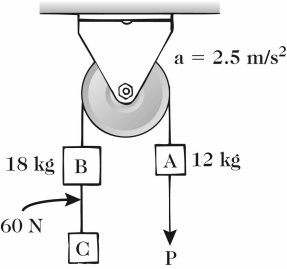 We = 2.5 m/s’
18 kg 12 kg
60 N
This is AI generated Response.
Asked by: Sunil kumar
Created at: 2025-07-09 19:29:58
Asked by: Sunil kumar
Created at: 2025-07-09 19:29:58
Final Answer:
Rendered
Raw Text
Did you like this answer?
Let’s solve the problem step by step!
**Given:**
- Block A: \( m_A = 12 \) kg
- Block B: \( m_B = 18 \) kg
- Tension between B and C: \( T = 60 \) N
- Acceleration of the system: \( a = 2.5 \) m/s²
- **Pulley and rope are massless and frictionless.**
- **Force \( P \) acts downward on A.**
Let's consider the forces acting on each block:
---
### **Step 1: Block C (hanging vertically from Block B)**
Let \( m_C \) be the mass of block C (not given, but let's see if it's needed).
But we know:
- The tension in the rope between B and C, \( T_{BC} = 60 \) N.
- The acceleration is upward for C (since the whole system accelerates downward for A, so C moves up).
**Upward is positive (for C):**
\[
T_{BC} - m_C g = m_C a
\]
\[
60 - m_C (9.8) = m_C (2.5)
\]
\[
60 = m_C (9.8 + 2.5) = m_C (12.3)
\]
\[
m_C = \frac{60}{12.3} \approx 4.88 \text{ kg}
\]
---
### **Step 2: Block B (horizontally, mass = 18 kg)**
Block B is **pulled to the right** by the tension \( T_{BC} = 60 \) N (from C), and to the left by the tension \( T_{AB} \) (from A). The net force on B causes it to accelerate at \( a \):
\[
T_{AB} - 60 = m_B a
\]
\[
T_{AB} = 60 + m_B a = 60 + (18)(2.5) = 60 + 45 = 105\, \text{N}
\]
---
### **Step 3: Block A (vertical, mass = 12 kg)**
For Block A, the **external force \( P \) acts downward**. The tension \( T_{AB} \) acts upward.
\[
P - m_A g - T_{AB} = m_A a
\]
\[
P = m_A g + T_{AB} + m_A a
\]
\[
P = (12)(9.8) + 105 + (12)(2.5)
\]
\[
P = 117.6 + 105 + 30 = 252.6\, \text{N}
\]
---
**Closest answer:**
\[
\boxed{250\, \text{N}}
\]
---
**So, the correct choice is:**
**250 N**
Question:
write explanation for each step. Add in words for chegg
This is AI generated Response.
Asked by: Sunil kumar
Created at: 2025-07-09 19:33:08
Asked by: Sunil kumar
Created at: 2025-07-09 19:33:08
Final Answer:
Rendered
Raw Text
Did you like this answer?
Certainly! Here's a detailed, step-by-step explanation suitable for a Chegg-style solution, with clear reasoning at each stage:
---
**Given Data:**
- Block A mass, \( m_A = 12\, \text{kg} \)
- Block B mass, \( m_B = 18\, \text{kg} \)
- Tension between Block B and C, \( T_{BC} = 60\, \text{N} \)
- Acceleration of the system, \( a = 2.5\, \text{m/s}^2 \)
- The external force \( P \) acts downward on Block A.
- Assumption: The pulley and ropes are massless and frictionless.
---
### **Step 1: Determine the mass of Block C**
Since the tension \( T_{BC} \) acts on C and the system accelerates at \( a \), we analyze Block C's vertical motion.
- **For Block C (hanging vertically):**
The forces on C are:
- Upward: tension \( T_{BC} = 60\, \text{N} \)
- Downward: weight \( m_C g \)
Applying Newton's second law (\( \text{upward positive} \)):
\[
T_{BC} - m_C g = m_C a
\]
Rearranged:
\[
T_{BC} = m_C g + m_C a = m_C (g + a)
\]
Substitute known values:
\[
60 = m_C (9.8 + 2.5) = m_C (12.3)
\]
Solve for \( m_C \):
\[
m_C = \frac{60}{12.3} \approx 4.88\, \text{kg}
\]
**Interpretation:** Block C has an approximate mass of **4.88 kg**.
---
### **Step 2: Find the tension \( T_{AB} \) between Blocks A and B**
Next, analyze Block B, which is connected to Block C via \( T_{BC} \).
- **For Block B (horizontal):**
The tensions acting are:
- To the right: \( T_{BC} = 60\, \text{N} \) (pulling B towards C)
- To the left: \( T_{AB} \) (pulling B towards A)
The net force causes B to accelerate at \( a = 2.5\, \text{m/s}^2 \):
\[
T_{AB} - T_{BC} = m_B a
\]
Solve for \( T_{AB} \):
\[
T_{AB} = T_{BC} + m_B a = 60 + (18)(2.5) = 60 + 45 = 105\, \text{N}
\]
**Interpretation:** The tension pulling B towards A is **105 N**.
---
### **Step 3: Calculate the external force \( P \) acting downward on Block A**
Now, analyze Block A, which experiences:
- Downward external force \( P \),
- Upward tension \( T_{AB} \),
- Its weight \( m_A g \).
Applying Newton's second law in the vertical direction (taking downward as positive):
\[
\text{Downward forces} = P + m_A g
\]
\[
\text{Upward force} = T_{AB}
\]
\[
\Rightarrow P + m_A g - T_{AB} = m_A a
\]
Rearranged to solve for \( P \):
\[
P = m_A g + T_{AB} + m_A a
\]
Substitute the known values:
\[
P = (12)(9.8) + 105 + (12)(2.5)
\]
\[
P = 117.6 + 105 + 30 = 252.6\, \text{N}
\]
**Approximate \( P \) as:** **253 N**
---
### **Final step: Choose the closest answer**
Looking at the multiple-choice options:
- 190 N
- 250 N
- 210 N
- 170 N
- 230 N
**The closest value to our calculation (~253 N) is 250 N.**
---
### **Conclusion:**
**The external force \( P \) applied downward on Block A is approximately \(\boxed{250\, \text{N}}\).**
This detailed analysis considers all forces acting on each block, applies Newton's laws, and correctly accounts for the system's acceleration and tension forces to find \( P \).
📢 Instructions:
- Ask anything relatd to above question only.
- For new Question goto :