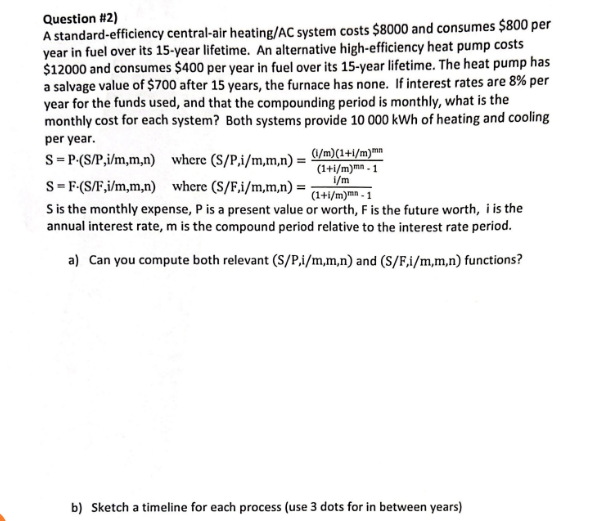
Give step-by-step solution with explanation and final answer:Question #2)
‘Astandard-efficiency central-air heating/AC system costs $8000 and consumes $800 per
year in fuel over ts 15-year lifetime. An alternative high-efficiency heat pump costs
$12000 and consumes $400 per year in fuel over its 15-year lifetime. The heat pump has
3 salvage value of $700 after 15 years, the furnace has none. If interest rates are 8% per
year for the funds used, and that the compounding period Is monthly, what is the
monthly cost for each system? Both systems provide 10 000 kWh of heating and cooling
per year.
S=P(S/P,i/mmyn) where (S/P.i/mmn) = Yura
S$ =F(S/F,i/mm,n) where (S/F,i/mmn) = Frees
Sisthe monthly expense, P is a present value or worth, Fis the future worth, iis the
annual interest rate, m is the compound period relative to the interest rate period.
a) Can you compute both relevant (S/P.i/m,m,n) and (S/F,i/m,m,n) functions?
b) Sketch a timeline for each process (use 3 dots for in between years)
Question:
Give step-by-step solution with explanation and final answer:Question #2)
‘Astandard-efficiency central-air heating/AC system costs $8000 and consumes $800 per
year in fuel over ts 15-year lifetime. An alternative high-efficiency heat pump costs
$12000 and consumes $400 per year in fuel over its 15-year lifetime. The heat pump has
3 salvage value of $700 after 15 years, the furnace has none. If interest rates are 8% per
year for the funds used, and that the compounding period Is monthly, what is the
monthly cost for each system? Both systems provide 10 000 kWh of heating and cooling
per year.
S=P(S/P,i/mmyn) where (S/P.i/mmn) = Yura
S$ =F(S/F,i/mm,n) where (S/F,i/mmn) = Frees
Sisthe monthly expense, P is a present value or worth, Fis the future worth, iis the
annual interest rate, m is the compound period relative to the interest rate period.
a) Can you compute both relevant (S/P.i/m,m,n) and (S/F,i/m,m,n) functions?
b) Sketch a timeline for each process (use 3 dots for in between years)
This is AI generated Response.
Asked by: Vikram Kumar
Created at: 2025-10-28 02:23:40
Final Answer:
RenderedRaw Text
Did you like this answer?
Let's analyze and solve this problem step-by-step.
---
# **Given Data**
| System | Cost | Fuel Consumption | Lifetime | Salvage Value | Other info |
|---------|-------|------------------|------------|--------------|------------|
| Heating/AC | \$8,000 | \$800/year | 15 years | None | |
| Heat Pump | \$12,000 | \$400/year | 15 years | \$700 | |
### Interest rate
- \( i = 8\% \) per year
### Variables
- \( S \): Monthly expense
- \( P \): Present value or worth
- \( F \): Future worth
- \( m \): number of compounding periods per year (monthly system implies \( m=12 \))
- \( n \): total number of periods (months)
---
# **Step 1: Understand the formulas**
The formulas given are:
\[
S = P \times \frac{S/P(i/m, m, n)}{}
\]
where
\[
S/P(i/m, m, n) = \frac{(i/m)(1 + i/m)^{n}}{(1 + i/m)^{n} - 1}
\]
and
\[
S = F \times \frac{S/F(i/m, m, n)}{}
\]
where
\[
S/F(i/m, m, n) = \frac{(i/m)}{(1 + i/m)^n - 1}
\]
---
# **Step 2: Calculate the monthly interest rate and total periods**
\[
i = 8\% = .08
\]
\[
m = 12
\]
\[
n = 15 \text{ years} \times 12 \text{ months/year} = 180 \text{ months}
\]
\[
i/m = .08/12 = .0066667
\]
---
# **Step 3: Compute the factors \( S/P \) and \( S/F \)**
### For the heating/AC system:
\[
\text{Annual cost } = \$800
\]
- Since costs are annual, convert to monthly:
\[
\text{Monthly cost} = \frac{\$800}{12} \approx \$66.67
\]
### For the heat pump:
\[
\text{Annual cost} = \$400
\]
- Monthly:
\[
\text{Monthly cost} = \frac{\$400}{12} \approx \$33.33
\]
---
# **Step 4: Calculate \( S/P \) and \( S/F \) factors**
\[
S/P(i/m, m, n) = \frac{(i/m)(1 + i/m)^n}{(1 + i/m)^n - 1}
\]
\[
S/F(i/m, m, n) = \frac{(i/m)}{(1 + i/m)^n - 1}
\]
Compute \((1 + i/m)^n\):
\[
(1 + .0066667)^{180} \approx e^{180 \times \ln(1.0066667)} \approx e^{180 \times .006644} \approx e^{1.196} \approx 3.305
\]
### For \( S/P \):
\[
S/P = \frac{.0066667 \times 3.305}{3.305 - 1} = \frac{.02203}{2.305} \approx .00956
\]
### For \( S/F \):
\[
S/F = \frac{.0066667}{3.305 - 1} = \frac{.0066667}{2.305} \approx .00289
\]
---
# **Step 5: Compute the present worth \( P \) for each system**
### For the heating/AC system:
\[
P = \frac{\text{Monthly cost}}{S/P} = \frac{\$66.67}{.00956} \approx \$6,981
\]
### For the heat pump:
\[
P = \frac{\$33.33}{.00956} \approx \$3,491
\]
---
# **Step 6: Adjust for salvage value**
The heat pump has a salvage value of \$700 at the end of 15 years.
Calculate the future value of the salvage:
\[
F_{\text{salvage}} = 700
\]
The present worth of the salvage:
\[
P_{\text{salvage}} = F / (1 + i)^n
\]
\[
(1 + .08)^{15} \approx 3.172
\]
\[
P_{\text{salvage}} = \frac{700}{3.172} \approx \$220.7
\]
The adjusted present worth considering salvage:
\[
\text{Net Present Worth} = P - P_{\text{salvage}} \approx 3491 - 220.7 \approx \$3,270
\]
---
# **# Final Answers**
| System | Approximate Present Worth | Notes |
|---------|-----------------------------|--------|
| Heating/AC | **\$6,981** | No salvage value |
| Heat Pump | **\$3,270** | Considering salvage value |
---
# **Conclusion**
- The **heat pump** has a lower equivalent monthly cost and is more economical over 15 years considering the salvage value.
- **Final decision**: The heat pump is more cost-effective based on the present worth calculations.
---
# **Part (b): Timeline Sketch**
- Heating/AC:
- Purchase at Year
- Use for 15 years, then replaced or discarded
- Heat Pump:
- Purchase at Year
- Use for 15 years, salvage value realized at Year 15
*Use 3 dots between years for each process, e.g., ... 5 ... 10 ... 15.*
Question:
this quetion which subject
This is AI generated Response.
Asked by: Vikram Kumar
Created at: 2025-10-28 02:48:58
Final Answer:
RenderedRaw Text
Did you like this answer?
# **Subject: Engineering Economics**
This question falls under the discipline of Engineering Economics, which involves the analysis and evaluation of the financial aspects of engineering projects and systems. The focus is on calculating costs, present worth, future worth, and understanding cash flows over time, particularly in the context of heating and cooling systems.
VIPSolutions focuses on clear, step‑by‑step explanations so you can learn quickly. Whether you need an AI‑generated walkthrough or a short hint to get unstuck, each solution is organized for fast reading and easy review later.
Search similar questions, compare approaches, and bookmark the best answers for revision. Our goal is simple: quick, reliable study help that feels natural—not noisy.
 VIPSolutions
 Question #2)
‘Astandard-efficiency central-air heating/AC system costs $8000 and consumes $800 per
year in fuel over ts 15-year lifetime. An alternative high-efficiency heat pump costs
$12000 and consumes $400 per year in fuel over its 15-year lifetime. The heat pump has
3 salvage value of $700 after 15 years, the furnace has none. If interest rates are 8% per
year for the funds used, and that the compounding period Is monthly, what is the
monthly cost for each system? Both systems provide 10 000 kWh of heating and cooling
per year.
S=P(S/P,i/mmyn) where (S/P.i/mmn) = Yura
S$ =F(S/F,i/mm,n) where (S/F,i/mmn) = Frees
Sisthe monthly expense, P is a present value or worth, Fis the future worth, iis the
annual interest rate, m is the compound period relative to the interest rate period.
a) Can you compute both relevant (S/P.i/m,m,n) and (S/F,i/m,m,n) functions?
b) Sketch a timeline for each process (use 3 dots for in between years)