 VIPSolutions
Think like a real problem solver and explain me logic for:& cB 3% 22 org . 0. — a Ss 2s SE p> 5 3 a 8%9 3 SEE gE = IE oa 25 SEES i oi Sol Wr 588 SEEE OE Ea it £500 & High $58 32S | cI Saag fa = S =
Question:
Think like a real problem solver and explain me logic for: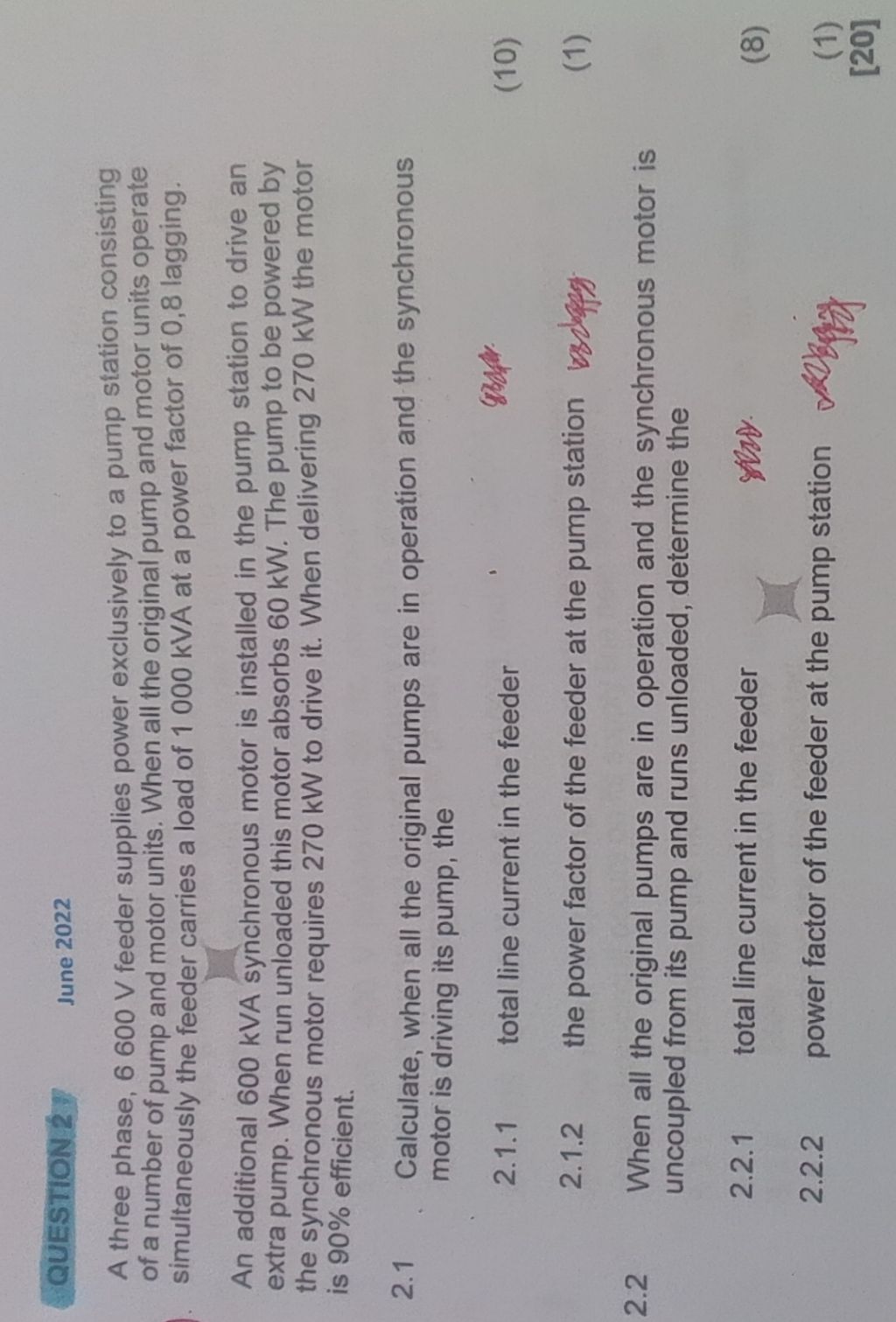 & cB 3% 22 org .
0. —
a Ss 2s SE p> 5 3 a
8%9 3 SEE gE = IE oa
25 SEES i oi Sol Wr
588 SEEE OE Ea
it £500
& High
$58 32S |
cI Saag
fa = S =
This is AI generated Response.
Asked by: Aman
Created at: 2025-09-25 07:31:13
Asked by: Aman
Created at: 2025-09-25 07:31:13
Final Answer:
Rendered
Raw Text
Did you like this answer?
To solve this problem, we need to apply the concepts of electrical power, efficiency, power factor, and the relationships between them in a three-phase system. Here's a step-by-step approach:
### Given Data:
1. **Original Load:**
- Feeder load: 100 kVA
- Power factor: .8 lagging
2. **Synchronous Motor:**
- Apparent power rating: 600 kVA
- Power required: 270 kW
- Efficiency: 90%
### Problem Breakdown:
#### 2.1 When all the original pumps are in operation and the synchronous motor is driving its pump:
##### 2.1.1 Total Line Current in the Feeder
- **Calculate the Real Power (P) of Original Load:**
\[
P = \text{Apparent Power} \times \text{Power Factor} = 100 \, \text{kVA} \times .8 = 800 \, \text{kW}
\]
- **Calculate the Real Power of the Synchronous Motor:**
- Given output power is 270 kW.
- Input power = \(\frac{270 \, \text{kW}}{.9} = 300 \, \text{kW}\)
- **Total Real Power:**
\[
P_{\text{total}} = 800 \, \text{kW} + 300 \, \text{kW} = 110 \, \text{kW}
\]
- **Calculate Total Apparent Power (S):**
- \(S = \sqrt{P_{\text{total}}^2 + Q_{\text{total}}^2}\)
- \(Q_{\text{original}} = 100 \times \sin(\cos^{-1}(.8))\)
- \(Q_{\text{original}} = 100 \times .6 = 600 \, \text{kVAR}\)
- **Calculate Total Reactive Power (Q):**
- Since the synchronous motor is driving, its reactive power can be adjusted to improve power factor.
- Assume initially it operates at unity power factor, so:
\[
Q_{\text{total}} = Q_{\text{original}} = 600 \, \text{kVAR}
\]
- **Total Apparent Power (S):**
\[
S_{\text{total}} = \sqrt{110^2 + 600^2} \, \text{kVA}
\]
- **Calculate Total Line Current (I):**
\[
I = \frac{S_{\text{total}}}{\sqrt{3} \times V} = \frac{S_{\text{total}}}{\sqrt{3} \times 660}
\]
##### 2.1.2 Power Factor of the Feeder
- \[
\text{Power Factor} = \frac{P_{\text{total}}}{S_{\text{total}}}
\]
#### 2.2 When all the original pumps are in operation and the synchronous motor is uncoupled from its pump and runs unloaded:
##### 2.2.1 Total Line Current in the Feeder
- When the synchronous motor is unloaded, it will draw less real power but might still draw reactive power depending on its power factor in this mode.
- Assume the unloaded motor's power factor and recalculate using the same steps as above.
##### 2.2.2 Power Factor of the Feeder
- Determine the power factor using the real and apparent power as before, with the synchronous motor unloaded.
### Conclusion:
- Calculating line currents and power factors involves determining real and reactive power contributions from all loads and using them to find total apparent power and current. Adjustments based on motor loading and power factor are crucial in these calculations.
📢 Instructions:
- Ask anything relatd to above question only.
- For new Question goto :