 VIPSolutions
give answer in 2 step with explanation at the end of each step and final answer at the end:Find which of the following maps are linear transformations. If F is a linear transformation then find its kernel and image. a. F:R? — R? given by F(z,y, 2) = (2,9). b. F:R* — R* given by F(v) = —v, where v € R*. ¢. F:R® B® given by F(v) = v + (0,-1,0). d. F:R? - R? given by F(z,y) = (2¢ + y,y)- e. F:R? 5 R? given by F(z,y) = (y,2). f. F:R? 5 R given by F(z,y,2) = zy.
Question:
give answer in 2 step with explanation at the end of each step and final answer at the end: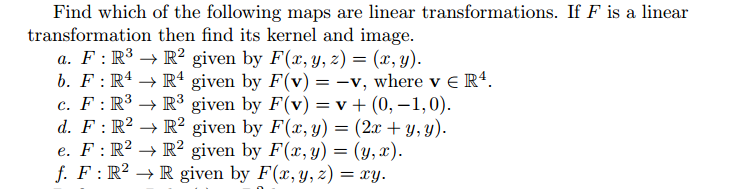 Find which of the following maps are linear transformations. If F is a linear
transformation then find its kernel and image.
a. F:R? — R? given by F(z,y, 2) = (2,9).
b. F:R* — R* given by F(v) = —v, where v € R*.
¢. F:R® B® given by F(v) = v + (0,-1,0).
d. F:R? - R? given by F(z,y) = (2¢ + y,y)-
e. F:R? 5 R? given by F(z,y) = (y,2).
f. F:R? 5 R given by F(z,y,2) = zy.
This is AI generated Response.
Asked by: Firdos
Created at: 2025-12-08 05:04:19
Asked by: Firdos
Created at: 2025-12-08 05:04:19
Final Answer:
Rendered
Raw Text
Did you like this answer?
Let's analyze each map step by step.
---
### **(a) \( F : \mathbb{R}^3 \to \mathbb{R}^2 \) given by \( F(x, y, z) = (x, y) \)**
#### **Step 1: Check if it's a linear transformation**
- **Additivity:**
\( F((x_1, y_1, z_1) + (x_2, y_2, z_2)) = F(x_1 + x_2, y_1 + y_2, z_1 + z_2) = (x_1 + x_2, y_1 + y_2) \)
\( F(x_1, y_1, z_1) + F(x_2, y_2, z_2) = (x_1, y_1) + (x_2, y_2) = (x_1 + x_2, y_1 + y_2) \)
- **Homogeneity:**
\( F(\alpha(x, y, z)) = F(\alpha x, \alpha y, \alpha z) = (\alpha x, \alpha y) = \alpha (x, y) = \alpha F(x, y, z) \)
**Conclusion:**
Yes, \( F \) is linear.
#### **Step 2: Find kernel and image**
- **Kernel:**
\( F(x, y, z) = (, ) \implies x = , y = \)
So, \( \ker F = \{(, , z) \mid z \in \mathbb{R}\} \)
- **Image:**
Any \((x, y) \in \mathbb{R}^2\) can be written as \( F(x, y, ) \).
So, \( \mathrm{Im} F = \mathbb{R}^2 \)
---
### **(b) \( F : \mathbb{R}^4 \to \mathbb{R}^4 \) given by \( F(\mathbf{v}) = -\mathbf{v} \)**
#### **Step 1: Check if it's linear**
- **Additivity:**
\( F(\mathbf{u} + \mathbf{v}) = -(\mathbf{u} + \mathbf{v}) = -\mathbf{u} - \mathbf{v} = F(\mathbf{u}) + F(\mathbf{v}) \)
- **Homogeneity:**
\( F(\alpha \mathbf{v}) = -(\alpha \mathbf{v}) = \alpha (-\mathbf{v}) = \alpha F(\mathbf{v}) \)
**Conclusion:**
Yes, \( F \) is linear.
#### **Step 2: Kernel and image**
- **Kernel:**
\( F(\mathbf{v}) = \mathbf{} \implies -\mathbf{v} = \mathbf{} \implies \mathbf{v} = \mathbf{} \).
So, \( \ker F = \{ \mathbf{} \} \)
- **Image:**
For any \( \mathbf{w} \in \mathbb{R}^4 \), \( F(-\mathbf{w}) = \mathbf{w} \).
So, \( \mathrm{Im} F = \mathbb{R}^4 \)
---
### **(c) \( F : \mathbb{R}^3 \to \mathbb{R}^3 \) given by \( F(\mathbf{v}) = \mathbf{v} + (, -1, ) \)**
#### **Step 1: Check if it's linear**
- **Additivity:**
\( F(\mathbf{u} + \mathbf{v}) = \mathbf{u} + \mathbf{v} + (, -1, ) \neq (\mathbf{u} + (, -1, )) + (\mathbf{v} + (, -1, )) \)
(since the constant is added twice)
- **Homogeneity:**
\( F(, , ) = (, -1, ) \neq \)
**Conclusion:**
Not linear.
---
### **(d) \( F : \mathbb{R}^2 \to \mathbb{R}^2 \) given by \( F(x, y) = (2x + y, y) \)**
#### **Step 1: Check if it's linear**
- **Additivity:**
\( F((x_1, y_1) + (x_2, y_2)) = (2(x_1 + x_2) + (y_1 + y_2), y_1 + y_2) \)
\( = (2x_1 + 2x_2 + y_1 + y_2, y_1 + y_2) \)
\( F(x_1, y_1) + F(x_2, y_2) = (2x_1 + y_1, y_1) + (2x_2 + y_2, y_2) = (2x_1 + y_1 + 2x_2 + y_2, y_1 + y_2) \)
They are equal.
- **Homogeneity:**
\( F(\alpha x, \alpha y) = (2\alpha x + \alpha y, \alpha y) = \alpha(2x + y, y) = \alpha F(x, y) \)
**Conclusion:**
Yes, \( F \) is linear.
#### **Step 2: Kernel and image**
- **Kernel:**
\( F(x, y) = (, ) \implies 2x + y = , y = \implies x = , y = \)
So, \( \ker F = \{(, )\} \)
- **Image:**
For any \((a, b) \in \mathbb{R}^2\), let \( y = b \), \( x = \frac{a-b}{2} \):
\( F\left(\frac{a-b}{2}, b\right) = (a, b) \)
So, \( \mathrm{Im} F = \mathbb{R}^2 \)
---
### **(e) \( F : \mathbb{R}^2 \to \mathbb{R}^2 \) given by \( F(x, y) = (y, x) \)**
#### **Step 1: Check if it's linear**
- **Additivity:**
\( F((x_1, y_1) + (x_2, y_2)) = (y_1 + y_2, x_1 + x_2) \)
\( F(x_1, y_1) + F(x_2, y_2) = (y_1, x_1) + (y_2, x_2) = (y_1 + y_2, x_1 + x_2) \)
- **Homogeneity:**
\( F(\alpha x, \alpha y) = (\alpha y, \alpha x) = \alpha (y, x) = \alpha F(x, y) \)
**Conclusion:**
Yes, \( F \) is linear.
#### **Step 2: Kernel and image**
- **Kernel:**
\( F(x, y) = (, ) \implies y = , x = \implies (x, y) = (, ) \)
So, \( \ker F = \{(, )\} \)
- **Image:**
For any \((a, b) \in \mathbb{R}^2\), \( F(b, a) = (a, b) \), so \( \mathrm{Im} F = \mathbb{R}^2 \)
---
### **(f) \( F : \mathbb{R}^2 \to \mathbb{R} \) given by \( F(x, y) = xy \)**
#### **Step 1: Check if it's linear**
- **Additivity:**
\( F((x_1, y_1) + (x_2, y_2)) = (x_1 + x_2)(y_1 + y_2) = x_1y_1 + x_1y_2 + x_2y_1 + x_2y_2 \)
\( F(x_1, y_1) + F(x_2, y_2) = x_1y_1 + x_2y_2 \)
Not equal in general.
**Conclusion:**
Not linear.
---
## **Final Answers**
The following are **linear transformations** (with their kernels and images):
| Map | Linear? | Kernel | Image |
|-----|---------|--------|-------|
| a | Yes | \( \{(,,z) | z \in \mathbb{R} \} \) | \( \mathbb{R}^2 \) |
| b | Yes | \( \{ \mathbf{} \} \) | \( \mathbb{R}^4 \) |
| c | No | - | - |
| d | Yes | \( \{(,)\} \) | \( \mathbb{R}^2 \) |
| e | Yes | \( \{(,)\} \) | \( \mathbb{R}^2 \) |
| f | No | - | - |
Question:
Then sorry correct answer
This is AI generated Response.
Asked by: Firdos
Created at: 2025-12-08 05:06:15
Asked by: Firdos
Created at: 2025-12-08 05:06:15
Final Answer:
Rendered
Raw Text
Did you like this answer?
Let's analyze each map step by step, determining whether they are linear transformations, and if so, identifying their kernels and images.
---
### **(a) \( F : \mathbb{R}^3 \to \mathbb{R}^2 \) given by \( F(x, y, z) = (2, 9) \)**
#### **Step 1: Check if it's a linear transformation**
- **Additivity:**
\( F((x_1, y_1, z_1) + (x_2, y_2, z_2)) = F(x_1 + x_2, y_1 + y_2, z_1 + z_2) = (2, 9) \)
\( F(x_1, y_1, z_1) + F(x_2, y_2, z_2) = (2, 9) + (2, 9) \neq (2, 9) \)
- **Homogeneity:**
\( F(\alpha(x, y, z)) = F(\alpha x, \alpha y, \alpha z) = (2, 9) \neq \alpha (2, 9) \)
**Conclusion:**
Not a linear transformation.
---
### **(b) \( F : \mathbb{R}^4 \to \mathbb{R}^4 \) given by \( F(\mathbf{v}) = -\mathbf{v} \)**
#### **Step 1: Check if it's linear**
- **Additivity:**
\( F(\mathbf{u} + \mathbf{v}) = -(\mathbf{u} + \mathbf{v}) = -\mathbf{u} - \mathbf{v} = F(\mathbf{u}) + F(\mathbf{v}) \)
- **Homogeneity:**
\( F(\alpha \mathbf{v}) = -(\alpha \mathbf{v}) = \alpha (-\mathbf{v}) = \alpha F(\mathbf{v}) \)
**Conclusion:**
Yes, \( F \) is linear.
#### **Step 2: Find kernel and image**
- **Kernel:**
\( F(\mathbf{v}) = \mathbf{0} \implies -\mathbf{v} = \mathbf{0} \implies \mathbf{v} = \mathbf{0} \).
So, \( \ker F = \{ \mathbf{0} \} \)
- **Image:**
Every vector \( \mathbf{w} \in \mathbb{R}^4 \) can be expressed as \( F(-\mathbf{w}) = \mathbf{w} \).
So, \( \mathrm{Im} F = \mathbb{R}^4 \)
---
### **(c) \( F : \mathbb{R}^3 \to \mathbb{R}^3 \) given by \( F(\mathbf{v}) = \mathbf{v} + (0, -1, 0) \)**
#### **Step 1: Check if it's linear**
- **Additivity:**
\( F(\mathbf{u} + \mathbf{v}) = (\mathbf{u} + \mathbf{v}) + (0, -1, 0) \neq F(\mathbf{u}) + F(\mathbf{v}) \)
- **Homogeneity:**
\( F(\alpha \mathbf{v}) = \alpha \mathbf{v} + (0, -1, 0) \neq \alpha F(\mathbf{v}) \)
**Conclusion:**
Not a linear transformation.
---
### **(d) \( F : \mathbb{R}^2 \to \mathbb{R}^2 \) given by \( F(x, y) = (2x + y, y) \)**
#### **Step 1: Check if it's linear**
- **Additivity:**
\( F((x_1, y_1) + (x_2, y_2)) = (2(x_1 + x_2) + (y_1 + y_2), y_1 + y_2) = (2x_1 + y_1 + 2x_2 + y_2, y_1 + y_2) \)
\( F(x_1, y_1) + F(x_2, y_2) = (2x_1 + y_1, y_1) + (2x_2 + y_2, y_2) = (2x_1 + y_1 + 2x_2 + y_2, y_1 + y_2) \). They are equal.
- **Homogeneity:**
\( F(\alpha x, \alpha y) = (2\alpha x + \alpha y, \alpha y) = \alpha(2x + y, y) = \alpha F(x, y) \)
**Conclusion:**
Yes, \( F \) is linear.
#### **Step 2: Find kernel and image**
- **Kernel:**
\( F(x, y) = (0, 0) \implies 2x + y = 0, y = 0 \).
Thus, \( x = 0 \) leads to \( \ker F = \{(0, 0)\} \).
- **Image:**
Any \((a, b) \in \mathbb{R}^2\) can be achieved by choosing \( y = b \) and \( x = \frac{a - b}{2} \), hence \( \mathrm{Im} F = \mathbb{R}^2 \).
---
### **(e) \( F : \mathbb{R}^2 \to \mathbb{R}^2 \) given by \( F(x, y) = (y, x) \)**
#### **Step 1: Check if it's linear**
- **Additivity:**
\( F((x_1, y_1) + (x_2, y_2)) = (y_1 + y_2, x_1 + x_2) = F(x_1, y_1) + F(x_2, y_2) \)
- **Homogeneity:**
\( F(\alpha x, \alpha y) = (\alpha y, \alpha x) = \alpha (y, x) = \alpha F(x, y) \)
**Conclusion:**
Yes, \( F \) is linear.
#### **Step 2: Find kernel and image**
- **Kernel:**
\( F(x, y) = (0, 0) \implies y = 0, x = 0 \).
Thus, \( \ker F = \{(0, 0)\} \).
- **Image:**
For any \((a, b) \in \mathbb{R}^2\), choosing \( (b, a) \) yields \( F(b, a) = (a, b) \), hence \( \mathrm{Im} F = \mathbb{R}^2 \).
---
### **(f) \( F : \mathbb{R}^2 \to \mathbb{R} \) given by \( F(x, y) = xy \)**
#### **Step 1: Check if it's linear**
- **Additivity:**
\( F((x_1, y_1) + (x_2, y_2)) = (x_1 + x_2)(y_1 + y_2) = x_1y_1 + x_1y_2 + x_2y_1 + x_2y_2 \)
This is not equal to \( F(x_1, y_1) + F(x_2, y_2) \).
**Conclusion:**
Not a linear transformation.
---
## **Final Answers**
The following are **linear transformations** (with their kernels and images):
| Map | Linear? | Kernel | Image |
|-----|---------|--------|-------|
| a | No | - | - |
| b | Yes | \( \{ \mathbf{0} \} \) | \( \mathbb{R}^4 \) |
| c | No | - | - |
| d | Yes | \( \{(0, 0)\} \) | \( \mathbb{R}^2 \) |
| e | Yes | \( \{(0, 0)\} \) | \( \mathbb{R}^2 \) |
| f | No | - | - |
📢 Instructions:
- Ask anything relatd to above question only.
- For new Question goto :