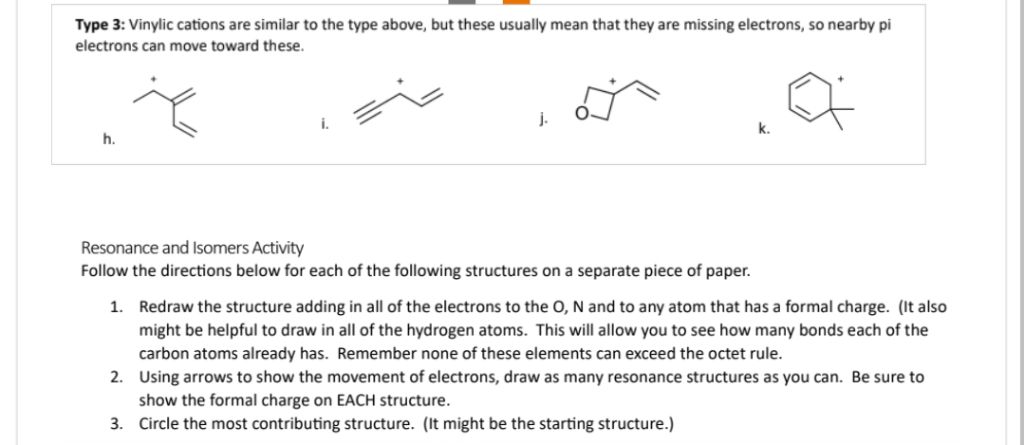
Give step-by-step solution with explanation and final answer:Type 3: Vinylic cations are similar to the type above, but these usually mean that they are missing electrons, so nearby pi
electrons can move toward these.
xX ad , dT gH
Xx i : k.
h.
Resonance and Isomers Activity
Follow the directions below for each of the following structures on a separate piece of paper.
1. Redraw the structure adding in all of the electrons to the O, N and to any atom that has a formal charge. (It also
might be helpful to draw in all of the hydrogen atoms. This will allow you to see how many bonds each of the
carbon atoms already has. Remember none of these elements can exceed the octet rule.
2. Using arrows to show the movement of electrons, draw as many resonance structures as you can. Be sure to
show the formal charge on EACH structure.
3. Circle the most contributing structure. (It might be the starting structure.)
Question:
Give step-by-step solution with explanation and final answer:Type 3: Vinylic cations are similar to the type above, but these usually mean that they are missing electrons, so nearby pi
electrons can move toward these.
xX ad , dT gH
Xx i : k.
h.
Resonance and Isomers Activity
Follow the directions below for each of the following structures on a separate piece of paper.
1. Redraw the structure adding in all of the electrons to the O, N and to any atom that has a formal charge. (It also
might be helpful to draw in all of the hydrogen atoms. This will allow you to see how many bonds each of the
carbon atoms already has. Remember none of these elements can exceed the octet rule.
2. Using arrows to show the movement of electrons, draw as many resonance structures as you can. Be sure to
show the formal charge on EACH structure.
3. Circle the most contributing structure. (It might be the starting structure.)
This is AI generated Response.
Asked by: Rahul
Created at: 2026-01-28 04:13:21
Final Answer:
RenderedRaw Text
Did you like this answer?
Let's solve the resonance structures for each given cation, step by step.
---
## **Structure h**
### **Structure:**
A carbocation with the positive charge on a secondary carbon, adjacent to a double bond (allylic carbocation).
### **Step 1: Draw the Structure**
Let's label the carbon atoms for clarity:
```
CH2=CH-CH+-CH3
```
- The positive charge is on the carbon next to the double bond.
### **Step 2: Resonance Arrow Pushing**
Move electrons from the double bond towards the carbocation:
- The double bond shifts so the positive charge moves:
```
CH2-CH=CH-CH3
+
```
Now, the positive charge is on the terminal carbon of the double bond.
### **Step 3: Resonance Structures**
1. **Original:**

2. **After Arrow Pushing:**

### **Step 4: Most Contributing Structure**
Both structures contribute, but generally, the more substituted carbocation is more stable. In this case, the positive charge on the secondary carbon is more stable than on the primary carbon.
---
## **Structure i**
### **Structure:**
A cation with a positive charge on an sp2-hybridized carbon adjacent to a double bond.
### **Step 1: Draw the Structure**
```
CH2=CH-C+=CH2
```
- The positive charge is on the central carbon.
### **Step 2: Resonance Arrow Pushing**
Move electrons from the double bond towards the carbocation:
- The double bond shifts, moving the positive charge:
```
CH2+-CH=CH-CH2
```
But this makes a positive charge on a primary carbon, which is less stable.
### **Step 3: Resonance Structures**
1. **Original:**

2. **After Arrow Pushing:**

### **Step 4: Most Contributing Structure**
The original structure is more stable, as the positive charge is on a more substituted carbon.
---
## **Structure j**
### **Structure:**
A five-membered ring with an oxygen and a carbocation at the 2-position.
### **Step 1: Draw the Structure**
```
O
/ \
| |
\ /
C+
```
### **Step 2: Resonance Arrow Pushing**
Move a lone pair from oxygen to form a double bond with the carbocation:
- Oxygen gets a positive charge after donating a lone pair.
```
O+
// \
| |
\ /
```
### **Step 3: Resonance Structures**
1. **Original:**

2. **After Arrow Pushing:**

### **Step 4: Most Contributing Structure**
The structure with positive charge on oxygen is less stable, so the original is more contributing.
---
## **Structure k**
### **Structure:**
A benzene ring with a methyl group and a positive charge (benzylic carbocation).
### **Step 1: Draw the Structure**
```
+
|
/ \
| |
\ /
|
CH3
```
### **Step 2: Resonance Arrow Pushing**
The positive charge can delocalize into the aromatic ring:
- Move a pair of pi electrons from the ring towards the carbocation, moving the positive charge around the ring.
### **Step 3: Resonance Structures**
There are three main resonance structures, with the positive charge at the ortho and para positions relative to the methyl group.
### **Step 4: Most Contributing Structure**
All resonance forms contribute, but the most stable is often the one where the charge is most delocalized.
---
# **Summary Table**
| Structure | Resonance Structures | Most Contributing |
|-----------|---------------------|-------------------|
| h | 2 | Original (sec. cation) |
| i | 2 | Original (central cation) |
| j | 2 | Original (O not charged) |
| k | 3+ | All equally (delocalized) |
Let me know if you'd like these structures hand-drawn or further step-by-step resonance arrows for each one!
Question:
Then solved Structure:hata do only question solve karo
This is AI generated Response.
Asked by: Rahul
Created at: 2026-01-28 04:15:17
Final Answer:
RenderedRaw Text
Did you like this answer?
# Resonance Structures for Structure h
## **Step 1: Draw the Structure**
We start with a secondary carbocation adjacent to a double bond. The structural formula can be represented as follows:
```
CH2=CH-CH+-CH3
```
- The positive charge is located on the secondary carbon (C+) adjacent to the double bond.
## **Step 2: Draw in All Electrons**
To clarify the bonding and electron distribution, we add all electrons, including lone pairs and hydrogen atoms:
```
H H H
| | |
C = C - C⁺ - C
| |
H H
```
## **Step 3: Resonance Arrow Pushing**
We can show the movement of electrons from the double bond towards the carbocation. This results in the following resonance structure:
1. Original Structure:
```
H H H
| | |
C = C - C⁺ - C
| |
H H
```
2. After Arrow Pushing:
```
H H
| |
C - C = C - C
|
H
```
## **Step 4: Resonance Structures**
The resonance structures can be summarized as follows:
1. **Original Structure:** Positive charge on C+.
2. **Resonance Structure:** Positive charge shifts to the terminal carbon of the double bond.
### **Visual Representation of Structures**
1. **Original Structure:**

2. **After Arrow Pushing:**

## **Step 5: Most Contributing Structure**
- The original structure is often more stable since the positive charge is on a more substituted carbon (secondary carbocation).
- The resonance structure with the positive charge on the end carbon is less stable due to it being a primary carbocation.
## **Conclusion**
The most contributing resonance structure for the given carbocation is the original structure where the positive charge is on the secondary carbon adjacent to the double bond.
VIPSolutions focuses on clear, step‑by‑step explanations so you can learn quickly. Whether you need an AI‑generated walkthrough or a short hint to get unstuck, each solution is organized for fast reading and easy review later.
Search similar questions, compare approaches, and bookmark the best answers for revision. Our goal is simple: quick, reliable study help that feels natural—not noisy.
 VIPSolutions
 Type 3: Vinylic cations are similar to the type above, but these usually mean that they are missing electrons, so nearby pi
electrons can move toward these.
xX ad , dT gH
Xx i : k.
h.
Resonance and Isomers Activity
Follow the directions below for each of the following structures on a separate piece of paper.
1. Redraw the structure adding in all of the electrons to the O, N and to any atom that has a formal charge. (It also
might be helpful to draw in all of the hydrogen atoms. This will allow you to see how many bonds each of the
carbon atoms already has. Remember none of these elements can exceed the octet rule.
2. Using arrows to show the movement of electrons, draw as many resonance structures as you can. Be sure to
show the formal charge on EACH structure.
3. Circle the most contributing structure. (It might be the starting structure.)