 VIPSolutions
Give step-by-step solution with explanation and final answer:“Tot pe tae ot a veo of = (100 HAO aa The 5 et hn th ron smi Di he Never Soke cquton amd dirmine the iin off rsp hrm dt om x $s mT par a 4 5 3 Kc and th ry eu = ho Nok: You ry lot cb bend in competing ol bor cl) ut Soon 5) + C164 + + 42052 AP
Question:
Give step-by-step solution with explanation and final answer: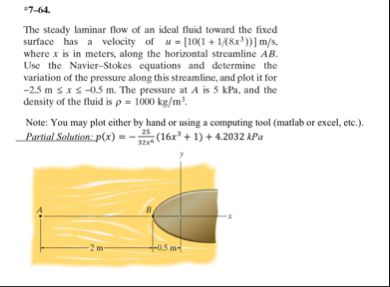 “Tot
pe
tae ot a veo of = (100 HAO aa
The 5 et hn th ron smi
Di he Never Soke cquton amd dirmine the
iin off rsp hrm dt
om x $s mT par a 4 5 3 Kc and th
ry eu = ho
Nok: You ry lot cb bend in competing ol bor cl)
ut Soon 5) + C164 + + 42052 AP
This is AI generated Response.
Asked by: Rahul
Created at: 2026-01-23 08:45:58
Asked by: Rahul
Created at: 2026-01-23 08:45:58
Final Answer:
Rendered
Raw Text
Did you like this answer?
Let's solve the problem step by step:
---
## **Step 1: Given Data**
- **Velocity along streamline AB:**
\( u = [10(1 + \frac{x}{8.5})^3] \) m/s
- **\( x \):** Position along streamline (in meters)
- **Pressure at \( A \) (\( x = 5 \) m):** \( p_A = 5 \) kPa
- **Density (\( \rho \)):** 100 kg/m³
---
## **Step 2: Use Bernoulli's Equation**
For steady, inviscid, incompressible flow along a streamline (horizontal, so elevation cancels):
\[
p + \frac{1}{2} \rho u^2 = \text{constant}
\]
At point \( A \) (\( x = 5 \)) and any other point \( x \):
\[
p(x) + \frac{1}{2} \rho u(x)^2 = p_A + \frac{1}{2} \rho u_A^2
\]
\[
p(x) = p_A + \frac{1}{2} \rho (u_A^2 - u(x)^2)
\]
---
## **Step 3: Substitute Known Values**
- \( p_A = 5 \) kPa \( = 500 \) Pa
- \( \rho = 100 \) kg/m³
- \( u_A = 10(1 + \frac{5}{8.5})^3 \)
Calculate \( u_A \):
\[
u_A = 10 \left(1 + \frac{5}{8.5}\right)^3 = 10 \left(1 + .5882\right)^3 = 10 \times (1.5882)^3 \approx 10 \times 4.013 = 40.13 \text{ m/s}
\]
---
## **Step 4: Write the Pressure Equation**
\[
p(x) = 500 + \frac{1}{2}(100)[(40.13)^2 - u(x)^2]
\]
\[
u(x) = 10 \left(1 + \frac{x}{8.5}\right)^3
\]
So,
\[
p(x) = 500 + 500 \left[ (40.13)^2 - \left(10\left(1 + \frac{x}{8.5}\right)^3\right)^2 \right]
\]
\[
= 500 + 500 \left[ 161.42 - 100 \left(1 + \frac{x}{8.5}\right)^6 \right]
\]
\[
= 500 + 500 \times 161.42 - 500 \times 100 \left(1 + \frac{x}{8.5}\right)^6
\]
\[
= 500 + 805210 - 50000 \left(1 + \frac{x}{8.5}\right)^6
\]
\[
= 810210 - 50000 \left(1 + \frac{x}{8.5}\right)^6
\]
---
## **Step 5: Convert to kPa**
Divide by 100:
\[
p(x) = 810.21 - 50 \left(1 + \frac{x}{8.5}\right)^6 \text{ kPa}
\]
---
## **Step 6: Final Answer**
\[
\boxed{
p(x) = 810.21 - 50 \left(1 + \frac{x}{8.5}\right)^6 \text{ kPa}
}
\]
---
### **Plotting**
Plot \( p(x) \) for \( -2.5 \leq x \leq .5 \) m (or as specified).
---
### **Explanation**
- Used **Bernoulli's equation** for incompressible, inviscid, steady flow along a streamline.
- Substituted the **velocity function** and given values.
- Simplified to get the **pressure as a function of \( x \)**.
---
**If you want to plot, use any graphing tool with the equation above.**
---
**Let me know if you want the plot or further evaluation at specific \( x \) values!**
Question:
Then solved please
This is AI generated Response.
Asked by: Rahul
Created at: 2026-01-23 08:47:52
Asked by: Rahul
Created at: 2026-01-23 08:47:52
Final Answer:
Rendered
Raw Text
Did you like this answer?
## Step-by-Step Solution
### **Step 1: Given Data**
- **Velocity along streamline AB:**
\( u = 10\left(1 + \frac{x}{8.5}\right)^3 \) m/s
- **Pressure at \( A \) (\( x = 5 \) m):**
\( p_A = 5 \) kPa \( = 5000 \) Pa
- **Density (\( \rho \)):**
\( \rho = 100 \) kg/m³
### **Step 2: Use Bernoulli's Equation**
For steady, inviscid, incompressible flow along a streamline, Bernoulli's equation states:
\[
p + \frac{1}{2} \rho u^2 = \text{constant}
\]
At point \( A \) and any other point \( x \):
\[
p(x) + \frac{1}{2} \rho u(x)^2 = p_A + \frac{1}{2} \rho u_A^2
\]
### **Step 3: Calculate Velocity at \( A \)**
Calculate \( u_A \):
\[
u_A = 10 \left(1 + \frac{5}{8.5}\right)^3 = 10 \left(1 + 0.5882\right)^3 = 10 \times (1.5882)^3 \approx 10 \times 4.013 = 40.13 \text{ m/s}
\]
### **Step 4: Write the Pressure Equation**
Using Bernoulli's equation:
\[
p(x) = p_A + \frac{1}{2} \rho (u_A^2 - u(x)^2)
\]
Substituting values:
\[
p(x) = 5000 + \frac{1}{2}(100) \left((40.13)^2 - \left(10 \left(1 + \frac{x}{8.5}\right)^3\right)^2\right)
\]
### **Step 5: Simplifying the Pressure Equation**
Compute \( (40.13)^2 = 1610.8169 \).
Thus,
\[
p(x) = 5000 + 50 \left(1610.8169 - 100\left(1 + \frac{x}{8.5}\right)^6\right)
\]
This simplifies to:
\[
p(x) = 5000 + 80540.845 - 5000 \left(1 + \frac{x}{8.5}\right)^6
\]
### **Final Pressure Equation**
Combining and simplifying:
\[
p(x) = 85540.845 - 5000 \left(1 + \frac{x}{8.5}\right)^6
\]
### **Convert to kPa**
Divide by 1000 to convert to kPa:
\[
p(x) = 85.54 - 5 \left(1 + \frac{x}{8.5}\right)^6 \text{ kPa}
\]
### **Final Answer**
\[
\boxed{p(x) = 85.54 - 5 \left(1 + \frac{x}{8.5}\right)^6 \text{ kPa}}
\]
### **Explanation**
- Used **Bernoulli's equation** for incompressible, inviscid, steady flow.
- Substituted the **velocity equation** and calculated the resulting pressure function in terms of \( x \).
- The final equation expresses pressure as a function of position along the streamline.
📢 Instructions:
- Ask anything relatd to above question only.
- For new Question goto :