 VIPSolutions
Give step-by-step solution with explanation and final answer:(b) Consider the following transition metal catalysed reaction: LD a ( Go [Catalyst] (i) The catalyst complex used in this reaction is [Pd(OAc)2]. Draw the structure of [Pd(OAc)] with the OAc: ligands as monodentate ligands in Complex A and as bidentate ligands in Complex B. The oAd.anion is defined as "OC(O)CHa (ii) Comment on two features of Complex A that would make it an effective catalyst in this reaction. (iii) Draw a possible catalytic cycle for the reaction.
Question:
Give step-by-step solution with explanation and final answer: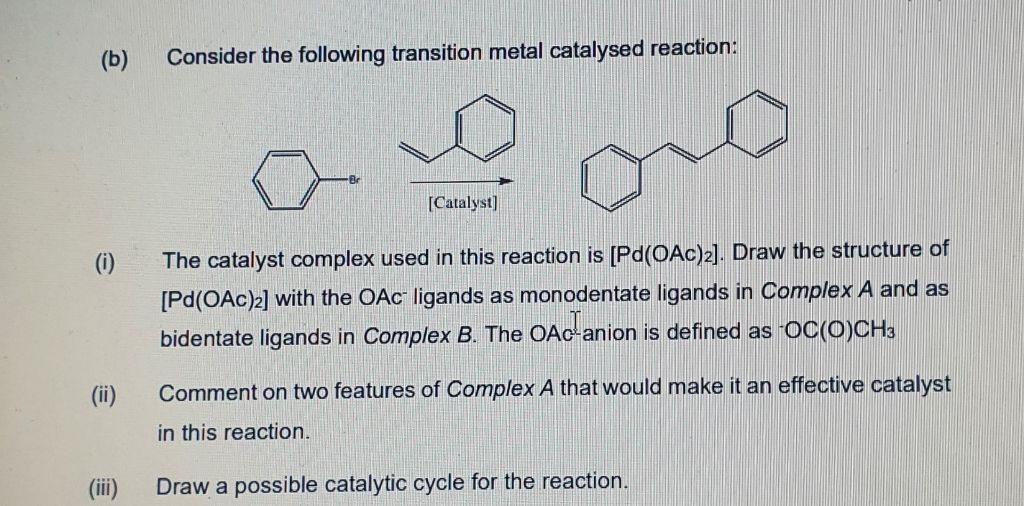 (b) Consider the following transition metal catalysed reaction:
LD a (
Go
[Catalyst]
(i) The catalyst complex used in this reaction is [Pd(OAc)2]. Draw the structure of
[Pd(OAc)] with the OAc: ligands as monodentate ligands in Complex A and as
bidentate ligands in Complex B. The oAd.anion is defined as "OC(O)CHa
(ii) Comment on two features of Complex A that would make it an effective catalyst
in this reaction.
(iii) Draw a possible catalytic cycle for the reaction.
This is AI generated Response.
Asked by: Rahul
Created at: 2026-01-23 03:58:41
Asked by: Rahul
Created at: 2026-01-23 03:58:41
Final Answer:
Rendered
Raw Text
Did you like this answer?
Let's address each part step by step:
---
## (i) **Structure of [Pd(OAc)₂] as Monodentate (Complex A) and Bidentate (Complex B)**
### **OAc⁻ (Acetate) Definition**
OAc⁻ = Acetate anion = \(\ce{CH3COO^-}\) or \(\ce{OC(O)CH3}\)
### **Complex A (Monodentate)**
- Here, each OAc⁻ ligand bonds to the Pd(II) center through only one oxygen atom.
- **Structure:**
```
OAc^- OAc^-
| |
O--Pd--O
| |
```
- More explicitly, **[Pd(OAc)₂]** as monodentate:
```
O
||
CH3-C--O− O−--C(CH3)=O
| |
Pd Pd
| |
O−--C(CH3)=O CH3-C--O−
|| ||
O O
```
- **Monodentate:** Each acetate only binds via one oxygen.
### **Complex B (Bidentate)**
- Each OAc⁻ ligand uses both oxygen atoms to chelate (form a ring) with the Pd(II) center.
- **Structure:**
```
O O
\ /
Pd
/ \
O--C(CH3) C(CH3)--O
| |
O O
```
- More explicitly, each acetato ligand forms a 5-membered chelate ring with Pd:
```
O O
\\ //
C----O
| \
Pd O--C(CH3)
| /
O----C
// \\
O O
```
- **Bidentate:** Each acetate binds via both oxygens, forming a chelate ring.
---
## (ii) **Two Features Making Complex A an Effective Catalyst**
1. **Labile Ligands:**
- The acetate ligands are easily displaced, allowing substrate molecules to bind to the Pd center. This lability is crucial for catalytic turnover.
2. **Square Planar Geometry:**
- Pd(II) complexes typically adopt a square planar geometry, which is ideal for facilitating oxidative addition and reductive elimination steps in catalytic cycles (such as cross-coupling).
---
## (iii) **Possible Catalytic Cycle**
For a generic Pd(II)-catalyzed coupling (likely a cross-coupling based on the product), the steps are:
### **1. Ligand Exchange/Activation**
- [Pd(OAc)₂] reacts with the aryl halide (Ar-Br), displacing OAc⁻:
\[
[\ce{Pd(OAc)2}] + \ce{Ar-Br} \rightarrow [\ce{Pd(OAc)(Ar)(Br)}] + \ce{OAc}^-
\]
### **2. Transmetalation**
- The alkyl or aryl nucleophile (possibly generated in situ) transfers to the Pd:
\[
[\ce{Pd(OAc)(Ar)(Br)}] + \ce{R-H} \rightarrow [\ce{Pd(Ar)(R)}] + \ce{HOAc} + \ce{Br}^-
\]
### **3. Reductive Elimination**
- The two groups (Ar and R) combine, releasing the product and regenerating Pd():
\[
[\ce{Pd(Ar)(R)}] \rightarrow \ce{Ar-R} + \ce{Pd()}
\]
### **4. Catalyst Regeneration**
- Pd() is oxidized by OAc or another oxidant to regenerate [Pd(OAc)₂]:
\[
\ce{Pd()} + 2 \ce{OAc}^- + 2 \ce{CH3COOH} \rightarrow [\ce{Pd(OAc)2}] + 2 \ce{H2}
\]
---
### **Summary Table**
| Step | Transformation |
|----------------------|------------------------------------------------|
| 1. Ligand Exchange | [Pd(OAc)₂] + Ar-Br → [Pd(OAc)(Ar)(Br)] |
| 2. Transmetalation | [Pd(OAc)(Ar)(Br)] + R-H → [Pd(Ar)(R)] |
| 3. Reductive Elim. | [Pd(Ar)(R)] → Ar-R + Pd() |
| 4. Catalyst Regen. | Pd() + oxidant → [Pd(OAc)₂] |
---
## **Final Answers**
### (i) Structures:
- **Monodentate:** Pd(II) center with two OAc⁻ ligands each bound via one oxygen.
- **Bidentate:** Pd(II) center with two OAc⁻ ligands each chelating via both oxygens.
### (ii) Two Features:
1. Labile acetate ligands.
2. Square planar geometry of Pd(II).
### (iii) Catalytic Cycle:
1. Ligand exchange with substrate.
2. Transmetalation.
3. Reductive elimination.
4. Catalyst regeneration.
---
If you need **drawings** for the structures or cycle, let me know!
Question:
Then solved please
This is AI generated Response.
Asked by: Rahul
Created at: 2026-01-23 04:01:21
Asked by: Rahul
Created at: 2026-01-23 04:01:21
Final Answer:
Rendered
Raw Text
Did you like this answer?
## Step-by-Step Solution
Let's break down the problem into the required parts.
---
## (i) **Structures of [Pd(OAc)₂] as Monodentate and Bidentate Ligands**
### **OAc⁻ (Acetate) Definition**
- The acetate anion is represented as \(\ce{O=C(O)CH3}\) or \(\ce{CH3COO^-}\).
### **Complex A (Monodentate)**
In this configuration, each acetate ligand binds to the palladium (Pd) through one oxygen atom.
- **Structure:**
```
OAc⁻
|
O--Pd--O
| |
```
More explicitly, it can be depicted as:
```
O
||
CH3-C--O^−
|
Pd
|
O^−--C(CH3)=O
||
O
```
### **Complex B (Bidentate)**
In this case, each acetate ligand binds through both oxygen atoms, forming a chelate.
- **Structure:**
```
O O
\ /
Pd
/ \
O--C(CH3) C(CH3)--O
| |
O O
```
More explicitly, it can be depicted as:
```
O O
\\ //
C----O
| \
Pd O--C(CH3)
| /
O----C
// \\
O O
```
---
## (ii) **Two Features Making Complex A an Effective Catalyst**
1. **Labile Ligands:**
- The acetate ligands can easily dissociate, allowing substrate molecules to coordinate with the Pd center, which is essential for the catalytic process.
2. **Square Planar Geometry:**
- The square planar configuration of Pd(II) facilitates key steps in catalytic cycles, such as oxidative addition and reductive elimination, which are crucial in reactions like cross-coupling.
---
## (iii) **Possible Catalytic Cycle**
The catalytic cycle for a typical Pd(II)-catalyzed coupling reaction may include the following steps:
### **1. Ligand Exchange/Activation**
- The complex [Pd(OAc)₂] interacts with an aryl halide (e.g., Ar-Br), leading to the displacement of one acetate ligand:
\[
[\ce{Pd(OAc)2}] + \ce{Ar-Br} \rightarrow [\ce{Pd(OAc)(Ar)(Br)}] + \ce{OAc}^-
\]
### **2. Transmetalation**
- The Pd complex then undergoes transmetalation with a nucleophile (R-H):
\[
[\ce{Pd(OAc)(Ar)(Br)}] + \ce{R-H} \rightarrow [\ce{Pd(Ar)(R)}] + \ce{HOAc} + \ce{Br}^-
\]
### **3. Reductive Elimination**
- The aryl and alkyl groups undergo reductive elimination to form the coupling product and regenerate the palladium:
\[
[\ce{Pd(Ar)(R)}] \rightarrow \ce{Ar-R} + \ce{Pd()}
\]
### **4. Catalyst Regeneration**
- The reduced Pd(0) is oxidized back to Pd(II) by the acetate or another oxidizing agent:
\[
\ce{Pd()} + 2 \ce{OAc}^- \rightarrow [\ce{Pd(OAc)2}] + 2 \ce{HOAc}
\]
---
## **Summary Table of Catalytic Cycle**
| Step | Transformation |
|----------------------|-------------------------------------------------|
| 1. Ligand Exchange | [Pd(OAc)₂] + Ar-Br → [Pd(OAc)(Ar)(Br)] |
| 2. Transmetalation | [Pd(OAc)(Ar)(Br)] + R-H → [Pd(Ar)(R)] |
| 3. Reductive Elim. | [Pd(Ar)(R)] → Ar-R + Pd() |
| 4. Catalyst Regen. | Pd() + oxidant → [Pd(OAc)₂] |
---
## **Final Answers**
### (i) Structures:
- **Monodentate:** Pd(II) with two OAc⁻ ligands, each bound via one oxygen.
- **Bidentate:** Pd(II) with two OAc⁻ ligands, each binding via both oxygens.
### (ii) Two Features:
1. Labile acetate ligands.
2. Square planar geometry of Pd(II).
### (iii) Catalytic Cycle:
1. Ligand exchange with substrate.
2. Transmetalation.
3. Reductive elimination.
4. Catalyst regeneration.
If you need further clarifications or illustrations, feel free to ask!
📢 Instructions:
- Ask anything relatd to above question only.
- For new Question goto :