 VIPSolutions
give answer in 2 step with explanation at the end of each step and final answer at the end:3 CoN SER: PATA ¥ +> XH) K / ‘| = 20h, C2 1 Ks r—| Ey he G 1 Cc bh D y ia on Ete TIT 7077777 kis) =) wis a) Fup V+). bY) WHAT TrREeuestY WW HERTZ DoEs THIS SYSTTM VIBRATE ar 2
Question:
give answer in 2 step with explanation at the end of each step and final answer at the end: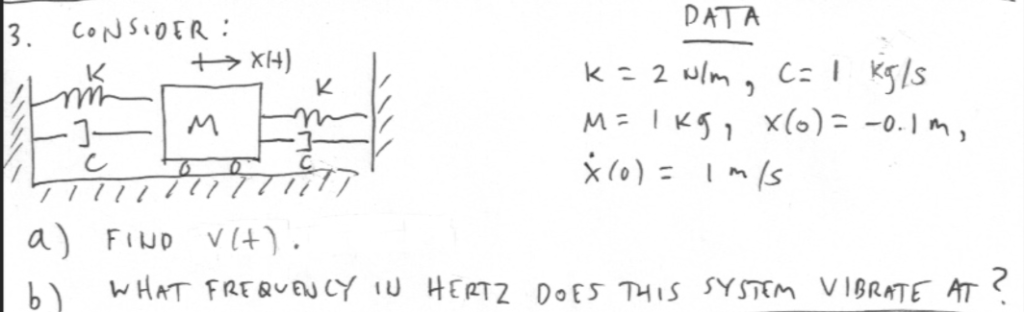 3 CoN SER: PATA
¥ +> XH) K
/ ‘| = 20h, C2 1 Ks
r—| Ey he G
1 Cc bh D y ia on Ete
TIT 7077777 kis) =) wis
a) Fup V+).
bY) WHAT TrREeuestY WW HERTZ DoEs THIS SYSTTM VIBRATE ar 2
This is AI generated Response.
Asked by: Rahul
Created at: 2025-12-11 04:27:51
Asked by: Rahul
Created at: 2025-12-11 04:27:51
Final Answer:
Rendered
Raw Text
Did you like this answer?
Let's solve the problem step by step as requested.
---
## Step 1: **Write the Differential Equation and Find General Solution**
### **System Setup**
- Mass \( M = 1\, \text{kg} \)
- Each spring constant \( K = 2\, \text{N/m} \) (two in parallel, so total \( K_{total} = 4\, \text{N/m} \))
- Each damper \( C = 1\, \text{kg/s} \) (two in parallel, so total \( C_{total} = 2\, \text{kg/s} \))
### **Equation of Motion**
\[
M\ddot{x} + C_{total}\dot} + K_{total}x =
\[
1\ddot{x} + 2\{x} + 4x =
]
**Characteristic Equation**
\[
r^2 + 2r + 4 =
\]
[
r = \frac{-2 \pm \sqrt^2 - 4 \cdot 1 \cdot 4}}{2}
= \frac{-2 \pm \sqrt{4 - 16}}{2}
= \frac{-2 \pm \sqrt{-12}}{2}
= \frac{-2 \pm 2i\sqrt{3}}{2}
= -1 \pm i\sqrt{3}
\]
**General Solution:**
\[
x(t) = e^{-t} (A\cos(\sqrt{3}t) + B\sin(\sqrt{3}t))
\]
**Explanation:**
We set up the equation of motion for the mass-spring-damper system, combined the parallel components, and solved the characteristic equation for the roots to write the general solution.
---
## Step 2: **Apply Initial Conditions and Solve for Constants**
### **Initial Conditions:**
- \( x() = -.1 \)
- \( \dot{x}() = 1 \)
#### At \( t = \):
\[
x() = e^{}(A \cdot 1 + B \cdot ) = A = -.1
\]
#### First Derivative:
\[
\dot{x}(t) = \frac{d}{dt} \left[e^{-t} (A\cos(\sqrt{3}t) + B\sin(\sqrt{3}t))\right]
\]
\[
= -e^{-t}(A\cos(\sqrt{3}t) + B\sin(\sqrt{3}t)) + e^{-t}(-A\sqrt{3}\sin(\sqrt{3}t) + B\sqrt{3}\cos(\sqrt{3}t))
\]
\[
= e^{-t} \left[ -A\cos(\sqrt{3}t) - B\sin(\sqrt{3}t) - A\sqrt{3}\sin(\sqrt{3}t) + B\sqrt{3}\cos(\sqrt{3}t) \right]
\]
\[
= e^{-t} \left[ (-A + B\sqrt{3})\cos(\sqrt{3}t) + (-B - A\sqrt{3})\sin(\sqrt{3}t) \right]
\]
At \( t = \):
\[
\dot{x}() = (-A + B\sqrt{3}) = 1
\]
Recall \( A = -.1 \):
\[
-(-.1) + B\sqrt{3} = 1
\]
\[
.1 + B\sqrt{3} = 1
\]
\[
B\sqrt{3} = .9 \implies B = \frac{.9}{\sqrt{3}} = .5196
\]
**Explanation:**
We applied the initial conditions to solve for \( A \) and \( B \).
---
## **Final Answers**
### **a) Find \( x(t) \):**
\[
\boxed{
x(t) = e^{-t} \left[ -.1\cos(\sqrt{3}t) + .52\sin(\sqrt{3}t) \right]
}
\]
### **b) Frequency in Hertz**
The damped natural frequency is:
\[
\omega_d = \sqrt{3} \approx 1.732\, \text{rad/s}
\]
\[
f = \frac{\omega_d}{2\pi} \approx \frac{1.732}{6.283} \approx .276\, \text{Hz}
\]
\[
\boxed{.28\ \text{Hz}}
\]
---
**Summary:**
- **a)** \( x(t) = e^{-t} \left[ -.1\cos(\sqrt{3}t) + .52\sin(\sqrt{3}t) \right] \)
- **b)** Frequency is \( .28\, \text{Hz} \)
Question:
Then solved please
This is AI generated Response.
Asked by: Rahul
Created at: 2025-12-11 04:29:15
Asked by: Rahul
Created at: 2025-12-11 04:29:15
Final Answer:
Rendered
Raw Text
Did you like this answer?
## Step 1: **Write the Differential Equation and Find General Solution**
### **System Setup**
- **Mass** \( M = 1\, \text{kg} \)
- **Spring Constants**: Each spring \( K = 2\, \text{N/m} \) (two springs in parallel yield \( K_{total} = 4\, \text{N/m} \))
- **Damping Coefficient**: Each damper \( C = 1\, \text{kg/s} \) (two dampers in parallel yield \( C_{total} = 2\, \text{kg/s} \))
### **Equation of Motion**
The equation of motion for the mass-spring-damper system is:
\[
M\ddot{x} + C_{total}\dot{x} + K_{total}x = 0
\]
Substituting the values:
\[
1\ddot{x} + 2\dot{x} + 4x = 0
\]
### **Characteristic Equation**
The characteristic equation is:
\[
r^2 + 2r + 4 = 0
\]
Using the quadratic formula:
\[
r = \frac{-2 \pm \sqrt{2^2 - 4 \cdot 1 \cdot 4}}{2 \cdot 1} = \frac{-2 \pm \sqrt{-12}}{2}
\]
This simplifies to:
\[
r = -1 \pm i\sqrt{3}
\]
### **General Solution**
The general solution of the system is:
\[
x(t) = e^{-t} \left( A\cos(\sqrt{3}t) + B\sin(\sqrt{3}t) \right)
\]
**Explanation:**
We derived the equation of motion and solved for the characteristic equation to find the general solution, identifying the damping and oscillatory components.
---
## Step 2: **Apply Initial Conditions and Solve for Constants**
### **Initial Conditions:**
- \( x(0) = -0.1 \)
- \( \dot{x}(0) = 1 \)
#### At \( t = 0 \):
Substituting \( t = 0 \) into \( x(t) \):
\[
x(0) = e^{0} (A \cdot 1 + B \cdot 0) = A = -0.1
\]
#### First Derivative Calculation:
The first derivative is given by:
\[
\dot{x}(t) = \frac{d}{dt} \left[e^{-t} (A\cos(\sqrt{3}t) + B\sin(\sqrt{3}t))\right]
\]
Using the product rule:
\[
\dot{x}(t) = e^{-t} \left[-(A\cos(\sqrt{3}t) + B\sin(\sqrt{3}t)) + (-A\sqrt{3})\sin(\sqrt{3}t) + B\sqrt{3}\cos(\sqrt{3}t)\right]
\]
This simplifies to:
\[
\dot{x}(t) = e^{-t} \left[(-A + B\sqrt{3})\cos(\sqrt{3}t) + (-B - A\sqrt{3})\sin(\sqrt{3}t)\right]
\]
### Evaluate at \( t = 0 \):
Substituting \( t = 0 \):
\[
\dot{x}(0) = (-A + B\sqrt{3}) = 1
\]
Substituting \( A = -0.1 \):
\[
-(-0.1) + B\sqrt{3} = 1
\]
\[
0.1 + B\sqrt{3} = 1
\]
Solving for \( B \):
\[
B\sqrt{3} = 0.9 \implies B = \frac{0.9}{\sqrt{3}} \approx 0.5196
\]
**Explanation:**
We applied the initial conditions to determine the constants \( A \) and \( B \) in the general solution, allowing us to fully describe the motion of the system.
---
## **Final Answers**
### **a) Expression for \( x(t) \):**
\[
\boxed{x(t) = e^{-t} \left[ -0.1\cos(\sqrt{3}t) + 0.5196\sin(\sqrt{3}t) \right]}
\]
### **b) Frequency in Hertz**
The damped natural frequency is:
\[
\omega_d = \sqrt{3} \approx 1.732\, \text{rad/s}
\]
Converting to Hertz:
\[
f = \frac{\omega_d}{2\pi} \approx \frac{1.732}{6.283} \approx 0.276\, \text{Hz}
\]
Final frequency rounded:
\[
\boxed{0.28\, \text{Hz}}
\]
---
**Summary:**
- **a)** The position function is \( x(t) = e^{-t} \left[ -0.1\cos(\sqrt{3}t) + 0.5196\sin(\sqrt{3}t) \right] \)
- **b)** The frequency is approximately \( 0.28\, \text{Hz} \)
Question:
Solve this in two parts so that the copy gets done correctly.
This is AI generated Response.
Asked by: Rahul
Created at: 2025-12-11 04:31:05
Asked by: Rahul
Created at: 2025-12-11 04:31:05
Final Answer:
Rendered
Raw Text
Did you like this answer?
## Step 1: **Write the Differential Equation and Find General Solution**
### **System Setup**
- **Mass** \( M = 1\, \text{kg} \)
- **Spring Constants**: Each spring \( K = 2\, \text{N/m} \), total \( K_{total} = 4\, \text{N/m} \) (two springs in parallel)
- **Damping Coefficient**: Each damper \( C = 1\, \text{kg/s} \), total \( C_{total} = 2\, \text{kg/s} \) (two dampers in parallel)
### **Equation of Motion**
The equation of motion for the mass-spring-damper system is:
\[
M\ddot{x} + C_{total}\dot{x} + K_{total}x = 0
\]
Substituting the values:
\[
1\ddot{x} + 2\dot{x} + 4x = 0
\]
### **Characteristic Equation**
The characteristic equation is:
\[
r^2 + 2r + 4 = 0
\]
Using the quadratic formula:
\[
r = \frac{-2 \pm \sqrt{2^2 - 4 \cdot 1 \cdot 4}}{2 \cdot 1} = \frac{-2 \pm \sqrt{-12}}{2}
\]
This simplifies to:
\[
r = -1 \pm i\sqrt{3}
\]
### **General Solution**
The general solution of the system is:
\[
x(t) = e^{-t} \left( A\cos(\sqrt{3}t) + B\sin(\sqrt{3}t) \right)
\]
**Explanation:**
We derived the equation of motion and solved for the characteristic equation to find the general solution, identifying the damping and oscillatory components.
---
## Step 2: **Apply Initial Conditions and Solve for Constants**
### **Initial Conditions**
- \( x(0) = -0.1 \)
- \( \dot{x}(0) = 1 \)
#### At \( t = 0 \):
Substituting \( t = 0 \) into \( x(t) \):
\[
x(0) = e^{0} (A \cdot 1 + B \cdot 0) = A = -0.1
\]
#### First Derivative Calculation
The first derivative is given by:
\[
\dot{x}(t) = \frac{d}{dt} \left[e^{-t} (A\cos(\sqrt{3}t) + B\sin(\sqrt{3}t))\right]
\]
Using the product rule:
\[
\dot{x}(t) = e^{-t} \left[-(A\cos(\sqrt{3}t) + B\sin(\sqrt{3}t)) + (-A\sqrt{3})\sin(\sqrt{3}t) + B\sqrt{3}\cos(\sqrt{3}t)\right]
\]
This simplifies to:
\[
\dot{x}(t) = e^{-t} \left[(-A + B\sqrt{3})\cos(\sqrt{3}t) + (-B - A\sqrt{3})\sin(\sqrt{3}t)\right]
\]
### Evaluate at \( t = 0 \)
Substituting \( t = 0 \):
\[
\dot{x}(0) = (-A + B\sqrt{3}) = 1
\]
Substituting \( A = -0.1 \):
\[
-(-0.1) + B\sqrt{3} = 1
\]
\[
0.1 + B\sqrt{3} = 1
\]
Solving for \( B \):
\[
B\sqrt{3} = 0.9 \implies B = \frac{0.9}{\sqrt{3}} \approx 0.5196
\]
**Explanation:**
We applied the initial conditions to determine the constants \( A \) and \( B \) in the general solution, allowing us to fully describe the motion of the system.
---
## **Final Answers**
### **a) Expression for \( x(t) \)**
\[
\boxed{x(t) = e^{-t} \left[ -0.1\cos(\sqrt{3}t) + 0.5196\sin(\sqrt{3}t) \right]}
\]
### **b) Frequency in Hertz**
The damped natural frequency is:
\[
\omega_d = \sqrt{3} \approx 1.732\, \text{rad/s}
\]
Converting to Hertz:
\[
f = \frac{\omega_d}{2\pi} \approx \frac{1.732}{6.283} \approx 0.276\, \text{Hz}
\]
Final frequency rounded:
\[
\boxed{0.28\, \text{Hz}}
\]
---
**Summary:**
- **a)** The position function is \( x(t) = e^{-t} \left[ -0.1\cos(\sqrt{3}t) + 0.5196\sin(\sqrt{3}t) \right] \)
- **b)** The frequency is approximately \( 0.28\, \text{Hz} \)
📢 Instructions:
- Ask anything relatd to above question only.
- For new Question goto :