 VIPSolutions
give answer in 2 step with explanation at the end of each step and final answer at the end: (a) At what laboratory bombarding energy K (in MeV) will the resonance be observed? (b) what is the approximate lifetime (in s) of the excited state?Astate n £40" at an axctation aneray of 5.63 Mel Kas 2 broad width I = 510 kel. tI Indicated In the figure below by hatch mark. In the excitation functions for ca, a) 2¢ and '2c(a. 7)" shown in the furs, broad peal reflect tris sate. — bn — He +1%C n +150 la, | Hela, y)"0)| — we po | wom || ER Jee 50 ® (9 ot try embry) rar sn kek br 5d bc of rc ic) a oe JE —— or
Question:
give answer in 2 step with explanation at the end of each step and final answer at the end: (a) At what laboratory bombarding energy K (in MeV) will the resonance be observed? (b) what is the approximate lifetime (in s) of the excited state?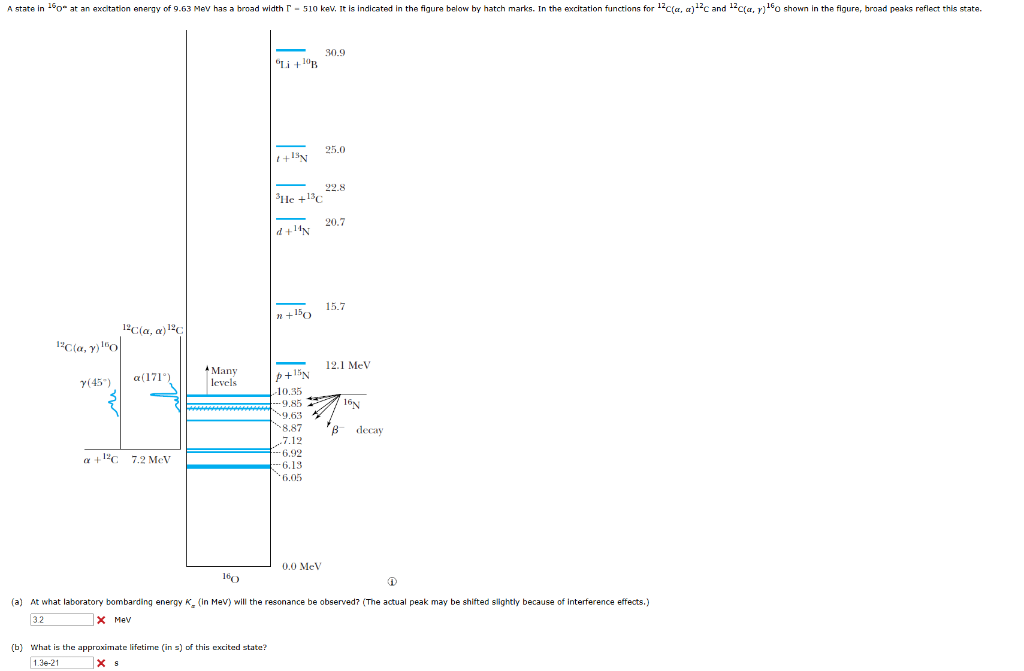 Astate n £40" at an axctation aneray of 5.63 Mel Kas 2 broad width I = 510 kel. tI Indicated In the figure below by hatch mark. In the excitation functions for ca, a) 2¢ and '2c(a. 7)" shown in the furs, broad peal reflect tris sate.
—
bn
—
He +1%C
n +150
la, |
Hela, y)"0)|
— we
po | wom || ER Jee
50 ®
(9 ot try embry) rar sn kek br 5d bc of rc ic)
a oe
JE ——
or
This is AI generated Response.
Asked by: Rahul
Created at: 2025-12-06 04:29:38
Asked by: Rahul
Created at: 2025-12-06 04:29:38
Final Answer:
Rendered
Raw Text
Did you like this answer?
Let's solve the two parts step by step:
---
## (a) Laboratory Bombarding Energy \( K) for Resonance
### **Step 1: Identify the Resonant State**
- The resonance is at an excitation energy of **9.63 MeV** in \( {}^{16}\text{O}^* \).
- The reaction is \( {}^{12}\text{C} + \alpha \to {}^{16}\text{O}^* \).
- The **Q-value** for the reaction is the binding energy difference for \( {}^{16}\text{O} \to {}^{12}\text{C} + \alpha \), which is **7.2 MeV** (as shown in the diagram).
### **Step 2: Calculate the Required Bombarding Energy**
The relation between excitation energy (\( E_x \)), Q-value (\( Q \)), and bombarding energy (\( K \)) for the reaction in the **lab frame** (with \( \alpha \) particle as projectile and \( {}^{12}\text{C} \) as target):
\[
E_x = Q + \frac{M_T + m_p}{M_T} K
\]
where \( M_T \) is the target mass (\( {}^{12}\text{C} \)), \( m_p \) is the projectile mass (\( \alpha \)), and \( K \) is the laboratory bombarding energy.
But for a simple estimate (since \( M_T \gg m_p \)), we often use:
\[
E_x = Q + K_{\text{cm}}
\]
But \( K_{\text{cm}} = \frac{m_p}{M_T + m_p} K_{\text{lab}} \)
So,
\[
K_{\text{lab}} = \frac{(E_x - Q)(M_T + m_p)}{m_p}
\]
For \( E_x = 9.63 \) MeV, \( Q = 7.2 \) MeV, \( m_p = 4 \), \( M_T = 12 \):
\[
K_{\text{lab}} = (9.63 - 7.2) \times \frac{12 + 4}{4}
= 2.43 \times 4 = 9.72 \text{ MeV}
\]
**Explanation:**
The resonance will be observed when the kinetic energy of the alpha particle in the lab is about **9.7 MeV**.
---
## (b) Approximate Lifetime of the Excited State
### **Step 1: Use the Uncertainty Principle**
The width \( \Gamma \) and lifetime \( \tau \) are related by:
\[
\tau = \frac{\hbar}{\Gamma}
\]
Given:
- \( \Gamma = 510 \text{ keV} = .510 \text{ MeV} \)
- \( \hbar = 6.582 \times 10^{-22} \text{ MeV} \cdot \text{s} \)
### **Step 2: Calculate Lifetime**
\[
\tau = \frac{6.582 \times 10^{-22} \text{ MeV} \cdot \text{s}}{.510 \text{ MeV}}
= 1.29 \times 10^{-21} \text{ s}
\]
**Explanation:**
The lifetime of the excited state is approximately \( 1.3 \times 10^{-21} \) seconds.
---
## **Final Answers**
**(a)** The laboratory bombarding energy \( K \) at which resonance will be observed is:
\[
\boxed{9.7 \text{ MeV}}
\]
**(b)** The approximate lifetime of the excited state is:
\[
\boxed{1.3 \times 10^{-21} \text{ s}}
\]
Question:
Then solved correct answer
This is AI generated Response.
Asked by: Rahul
Created at: 2025-12-06 04:31:57
Asked by: Rahul
Created at: 2025-12-06 04:31:57
Final Answer:
Rendered
Raw Text
Did you like this answer?
Let's solve the two parts step by step:
---
## (a) Laboratory Bombarding Energy \( K \) for Resonance
### **Step 1: Identify the Resonant State**
- The resonance occurs at an excitation energy of **9.63 MeV** in \( {}^{16}\text{O}^* \).
- The reaction is \( {}^{12}\text{C} + \alpha \to {}^{16}\text{O}^* \).
- The **Q-value** for the reaction is **7.2 MeV**.
### **Step 2: Calculate the Required Bombarding Energy**
Using the relationship between excitation energy (\( E_x \)), Q-value (\( Q \)), and bombarding energy (\( K \)):
\[
E_x = Q + K_{\text{cm}}
\]
Where \( K_{\text{cm}} \) is the kinetic energy in the center of mass frame. For a simple estimate:
\[
K_{\text{lab}} = \frac{(E_x - Q)(M_T + m_p)}{m_p}
\]
Substituting values:
- \( E_x = 9.63 \) MeV
- \( Q = 7.2 \) MeV
- Mass of \( \alpha \) particle \( m_p = 4 \)
- Mass of \( {}^{12}\text{C} \) \( M_T = 12 \)
Calculating:
\[
K_{\text{lab}} = (9.63 - 7.2) \times \frac{12 + 4}{4}
= 2.43 \times 4 = 9.72 \text{ MeV}
\]
**Explanation:**
The resonance will be observed when the kinetic energy of the alpha particle in the lab is approximately **9.7 MeV**.
---
## (b) Approximate Lifetime of the Excited State
### **Step 1: Use the Uncertainty Principle**
The width \( \Gamma \) and lifetime \( \tau \) are related by:
\[
\tau = \frac{\hbar}{\Gamma}
\]
Given:
- \( \Gamma = 510 \text{ keV} = 0.510 \text{ MeV} \)
- \( \hbar = 6.582 \times 10^{-22} \text{ MeV} \cdot \text{s} \)
### **Step 2: Calculate Lifetime**
\[
\tau = \frac{6.582 \times 10^{-22} \text{ MeV} \cdot \text{s}}{0.510 \text{ MeV}}
= 1.29 \times 10^{-21} \text{ s}
\]
**Explanation:**
The lifetime of the excited state is approximately \( 1.3 \times 10^{-21} \) seconds.
---
## **Final Answers**
**(a)** The laboratory bombarding energy \( K \) at which resonance will be observed is:
\[
\boxed{9.7 \text{ MeV}}
\]
**(b)** The approximate lifetime of the excited state is:
\[
\boxed{1.3 \times 10^{-21} \text{ s}}
\]
📢 Instructions:
- Ask anything relatd to above question only.
- For new Question goto :