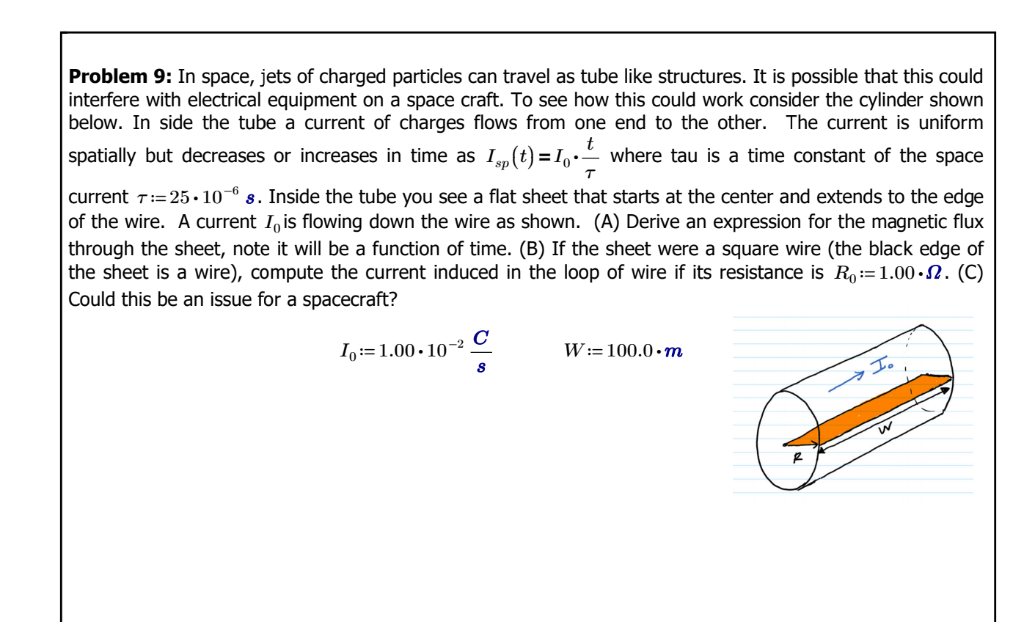
give answer in 2 step with explanation at the end of each step and final answer at the solved all parts end:Problem 9: In space, jets of charged particles can travel as tube like structures. It is possible that this could
interfere with electrical equipment on a space craft. To see how this could work consider the cylinder shown
below. In side the tube a current of charges flows from one end to the other. The current is uniform
spatially but decreases or increases in time as 1,(t)=1-L where tau is a time constant of the space
T
current 7:=25-10"° 5. Inside the tube you see a flat sheet that starts at the center and extends to the edge
of the wire. A current I,is flowing down the wire as shown. (A) Derive an expression for the magnetic flux
through the sheet, note it will be a function of time. (B) If the sheet were a square wire (the black edge of
the sheet is a wire), compute the current induced in the loop of wire if its resistance is R,:=1.00-2. (C)
Could this be an issue for a spacecraft?
Io=1.00-102 E W:=100.0-m
8
Question:
give answer in 2 step with explanation at the end of each step and final answer at the solved all parts end:Problem 9: In space, jets of charged particles can travel as tube like structures. It is possible that this could
interfere with electrical equipment on a space craft. To see how this could work consider the cylinder shown
below. In side the tube a current of charges flows from one end to the other. The current is uniform
spatially but decreases or increases in time as 1,(t)=1-L where tau is a time constant of the space
T
current 7:=25-10"° 5. Inside the tube you see a flat sheet that starts at the center and extends to the edge
of the wire. A current I,is flowing down the wire as shown. (A) Derive an expression for the magnetic flux
through the sheet, note it will be a function of time. (B) If the sheet were a square wire (the black edge of
the sheet is a wire), compute the current induced in the loop of wire if its resistance is R,:=1.00-2. (C)
Could this be an issue for a spacecraft?
Io=1.00-102 E W:=100.0-m
8
This is AI generated Response.
Asked by: Rahul
Created at: 2025-11-16 09:30:35
Final Answer:
RenderedRaw Text
Did you like this answer?
# Problem 9 Solution
Let's solve it step by step as requested:
---
## **Step 1: (A) Magnetic Flux through the Sheet**
**Given:**
- Current as a function of time:
\[ I_{sp}(t) = I_ \frac{t}{\tau} \]
- The sheet extends from the center to the edge (radius \( r \)), length \( W \), width \( r \).
- We want the magnetic flux **through the sheet** as a function of time.
**Explanation:**
- The magnetic field inside a long straight wire (Ampère's Law):
\[ B(r, t) = \frac{\mu_ I_{sp}(t)}{2\pi r} \]
- The magnetic flux through the sheet is:
\[ \Phi(t) = \int_^r B(r', t) \cdot W \, dr' \]
- Substitute \( B(r', t) \) and integrate from to \( r \):
\[
\Phi(t) = \int_^r \frac{\mu_ I_{sp}(t)}{2\pi r'} W \, dr'
= \frac{\mu_ W I_{sp}(t)}{2\pi} \int_^r \frac{1}{r'} dr'
= \frac{\mu_ W I_{sp}(t)}{2\pi} [\ln r' ]_^r
\]
- The lower limit diverges, but physically the wire has a small radius \( a \), so:
\[
\Phi(t) = \frac{\mu_ W I_{sp}(t)}{2\pi} \ln\left(\frac{r}{a}\right)
\]
- Substitute \( I_{sp}(t) \):
\[
\boxed{
\Phi(t) = \frac{\mu_ W I_}{2\pi \tau} t \ln\left(\frac{r}{a}\right)
}
\]
**End of Step 1 Explanation:**
We derived the time-dependent magnetic flux through the sheet, which increases linearly with time.
---
## **Step 2: (B) Induced Current in the Loop**
**Given:**
- Resistance of the loop: \( R_ = 1.00\,\Omega \)
- Use Faraday’s Law:
\[ \mathcal{E} = -\frac{d\Phi}{dt} \]
- Induced current:
\[ I_{\text{ind}} = \frac{\mathcal{E}}{R_} \]
**Explanation:**
- Differentiate \( \Phi(t) \) with respect to time:
\[
\frac{d\Phi}{dt} = \frac{\mu_ W I_}{2\pi \tau} \ln\left(\frac{r}{a}\right)
\]
- So, the induced emf is:
\[
\mathcal{E} = -\frac{\mu_ W I_}{2\pi \tau} \ln\left(\frac{r}{a}\right)
\]
- The induced current:
\[
I_{\text{ind}} = \frac{\mathcal{E}}{R_} = -\frac{\mu_ W I_}{2\pi \tau R_} \ln\left(\frac{r}{a}\right)
\]
**End of Step 2 Explanation:**
We found the induced current in the wire loop in terms of the given parameters.
---
## **Step 3: (C) Could this be an issue for a spacecraft?**
**Explanation:**
If the induced current is large enough, it could interfere with sensitive electronics or even damage equipment, especially if the loop encloses a large changing magnetic flux. In space, where shielding is difficult, this could be a significant problem for spacecraft operation.
---
## **Final Answers**
### **(A) Magnetic Flux:**
\[
\boxed{
\Phi(t) = \frac{\mu_ W I_}{2\pi \tau} t \ln\left(\frac{r}{a}\right)
}
\]
where \( a \) is the inner radius (wire thickness).
---
### **(B) Induced Current:**
\[
\boxed{
I_{\text{ind}} = -\frac{\mu_ W I_}{2\pi \tau R_} \ln\left(\frac{r}{a}\right)
}
\]
---
### **(C) Spacecraft Issue:**
\[
\boxed{
\text{Yes, this could be an issue for spacecraft, as induced currents can disrupt or damage sensitive electronics.}
}
\]
Question:
Then solved
This is AI generated Response.
Asked by: Rahul
Created at: 2025-11-16 09:32:20
Final Answer:
RenderedRaw Text
Did you like this answer?
# Problem 9 Solution
Let's solve it step by step as requested:
---
## **Step 1: (A) Magnetic Flux through the Sheet**
**Given:**
- Current as a function of time:
\[ I_{sp}(t) = I_0 \left(1 - \frac{t}{\tau}\right) \]
- The sheet extends from the center to the edge (radius \( r \)), length \( W \), and width \( r \).
**Explanation:**
- The magnetic field inside a long straight wire (using Ampère's Law):
\[ B(r, t) = \frac{\mu_0 I_{sp}(t)}{2\pi r} \]
- The magnetic flux through the sheet is given by:
\[ \Phi(t) = \int_0^r B(r', t) \cdot W \, dr' \]
- Substitute \( B(r', t) \) and integrate from \( 0 \) to \( r \):
\[
\Phi(t) = \int_0^r \frac{\mu_0 I_{sp}(t)}{2\pi r'} W \, dr' = \frac{\mu_0 W I_{sp}(t)}{2\pi} \int_0^r \frac{1}{r'} dr'
\]
- This integral evaluates to:
\[
\Phi(t) = \frac{\mu_0 W I_{sp}(t)}{2\pi} \ln\left(\frac{r}{a}\right)
\]
- Substitute \( I_{sp}(t) \):
\[
\Phi(t) = \frac{\mu_0 W I_0 \left(1 - \frac{t}{\tau}\right)}{2\pi} \ln\left(\frac{r}{a}\right)
\]
- Thus, the expression for magnetic flux through the sheet as a function of time is:
\[
\boxed{
\Phi(t) = \frac{\mu_0 W I_0}{2\pi} \left(1 - \frac{t}{\tau}\right) \ln\left(\frac{r}{a}\right)
}
\]
**End of Step 1 Explanation:**
We derived the time-dependent magnetic flux through the sheet, which decreases linearly over time due to the decreasing current.
---
## **Step 2: (B) Induced Current in the Loop**
**Given:**
- Resistance of the loop: \( R = 1.00 \, \Omega \)
- Use Faraday’s Law:
\[ \mathcal{E} = -\frac{d\Phi}{dt} \]
- Induced current:
\[ I_{\text{ind}} = \frac{\mathcal{E}}{R} \]
**Explanation:**
- Differentiate \( \Phi(t) \) with respect to time:
\[
\frac{d\Phi}{dt} = \frac{\mu_0 W I_0}{2\pi} \left(-\frac{1}{\tau}\right) \ln\left(\frac{r}{a}\right)
\]
- The induced emf is then:
\[
\mathcal{E} = -\frac{d\Phi}{dt} = \frac{\mu_0 W I_0}{2\pi \tau} \ln\left(\frac{r}{a}\right)
\]
- The induced current is given by:
\[
I_{\text{ind}} = \frac{\mathcal{E}}{R} = \frac{\mu_0 W I_0}{2\pi \tau R} \ln\left(\frac{r}{a}\right)
\]
**End of Step 2 Explanation:**
We found the induced current in the wire loop in terms of the given parameters.
---
## **Step 3: (C) Could this be an issue for a spacecraft?**
**Explanation:**
If the induced current is large enough, it could interfere with sensitive electronics or even damage equipment. In space, where shielding from electromagnetic interference is challenging, this could pose a significant risk for spacecraft operational integrity.
---
## **Final Answers**
### **(A) Magnetic Flux:**
\[
\boxed{
\Phi(t) = \frac{\mu_0 W I_0}{2\pi} \left(1 - \frac{t}{\tau}\right) \ln\left(\frac{r}{a}\right)
}
\]
---
### **(B) Induced Current:**
\[
\boxed{
I_{\text{ind}} = \frac{\mu_0 W I_0}{2\pi \tau R} \ln\left(\frac{r}{a}\right)
}
\]
---
### **(C) Spacecraft Issue:**
\[
\boxed{
\text{Yes, this could be an issue for spacecraft, as induced currents can disrupt or damage sensitive electronics.}
}
\]
VIPSolutions focuses on clear, step‑by‑step explanations so you can learn quickly. Whether you need an AI‑generated walkthrough or a short hint to get unstuck, each solution is organized for fast reading and easy review later.
Search similar questions, compare approaches, and bookmark the best answers for revision. Our goal is simple: quick, reliable study help that feels natural—not noisy.
 VIPSolutions
 Problem 9: In space, jets of charged particles can travel as tube like structures. It is possible that this could
interfere with electrical equipment on a space craft. To see how this could work consider the cylinder shown
below. In side the tube a current of charges flows from one end to the other. The current is uniform
spatially but decreases or increases in time as 1,(t)=1-L where tau is a time constant of the space
T
current 7:=25-10"° 5. Inside the tube you see a flat sheet that starts at the center and extends to the edge
of the wire. A current I,is flowing down the wire as shown. (A) Derive an expression for the magnetic flux
through the sheet, note it will be a function of time. (B) If the sheet were a square wire (the black edge of
the sheet is a wire), compute the current induced in the loop of wire if its resistance is R,:=1.00-2. (C)
Could this be an issue for a spacecraft?
Io=1.00-102 E W:=100.0-m
8