 VIPSolutions
Give step-by-step solution with explanation and final answer:! Required information An 8-02 package is projected upward with a velocity vo by a spring at 4; it moves around a frictionless loop and is deposited at C. Take 7 = 2.40 ft . In the second loop, the tube supports the package. B B r r c Bi c 1 751 1 7.51 Vo Vo A A — Determine for the second loop, the smallest velocity vq for which the package will reach Cand the corresponding force exerted by the package on the loop just before the package leaves the loop at C. The smallest velocity vq for which the package will reach Cis fils. The force exerted by the package on the loop[ 0] Ib. (Round the final answer to three decimal places.)
Question:
Give step-by-step solution with explanation and final answer: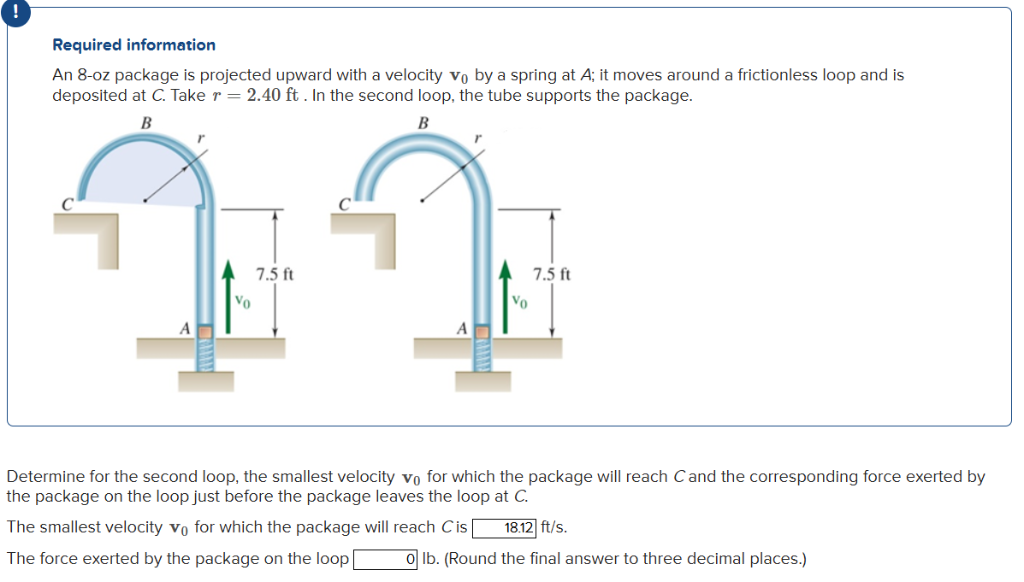 !
Required information
An 8-02 package is projected upward with a velocity vo by a spring at 4; it moves around a frictionless loop and is
deposited at C. Take 7 = 2.40 ft . In the second loop, the tube supports the package.
B B
r r
c Bi c
1 751 1 7.51
Vo Vo
A A
—
Determine for the second loop, the smallest velocity vq for which the package will reach Cand the corresponding force exerted by
the package on the loop just before the package leaves the loop at C.
The smallest velocity vq for which the package will reach Cis fils.
The force exerted by the package on the loop[ 0] Ib. (Round the final answer to three decimal places.)
This is AI generated Response.
Asked by: Rahul
Created at: 2026-02-24 09:01:50
Asked by: Rahul
Created at: 2026-02-24 09:01:50
Final Answer:
Rendered
Raw Text
Did you like this answer?
Let's solve the two required quantities step by step.
---
## Step 1: Convert Units
- **Mass of the package**: \( 8) oz
\( 1 \) lb = \( 16 \) oz
\( m = \frac{8}{16} = .5 \) lb
- **Weight**: \( W = mg \)
\( g = 32.2 \) ft/s²
\( W = .5 \) lb
---
## Step 2: Apply Conservation of Energy
Let point A be at the bottom, and point C at the top (height \( h = 7.5 \) ft).
- **At A**:
- Kinetic Energy: \( \frac{1}{2} m v_^2 \)
- Potential Energy: \( \)
- **At C**:
- Kinetic Energy: \( \frac{1}{2} m v_C^2 \)
- Potential Energy: \( mgh \)
Set the **total mechanical energy** at A equal to that at C:
\[
\frac{1}{2} m v_^2 = \frac{1}{2} m v_C^2 + mgh
\]
\[
v_^2 = v_C^2 + 2gh
\]
---
## Step 3: Minimum Speed at Top (Point C)
At the top (point C), the **minimum speed** is when the normal force is zero (just about to lose contact):
\[
\text{At C:} \quad \Sigma F = m \frac{v_C^2}{r} = mg \implies v_C^2 = gr
\]
---
## Step 4: Substitute \( v_C^2 \) into Energy Equation
From above:
\[
v_^2 = gr + 2gh
\]
Given:
- \( r = 2.40 \) ft
- \( h = 7.5 \) ft
- \( g = 32.2 \) ft/s²
Calculate:
\[
v_^2 = 32.2 \times 2.4 + 2 \times 32.2 \times 7.5
\]
\[
v_^2 = 77.28 + 483 = 560.28
\]
\[
v_ = \sqrt{560.28} = 23.691 \text{ ft/s}
\]
---
## Step 5: Force Exerted by Package on Loop at C
At C:
\[
F = m \frac{v_C^2}{r} - mg
\]
But at the minimum speed (from above), \( m \frac{v_C^2}{r} = mg \), so the **force exerted by the package on the loop is \( \) lb** (it's just about to lose contact).
---
## **Final Answers**
### 1. The smallest velocity \( v_ \) for which the package will reach C:
\[
\boxed{23.691 \ \text{ft/s}}
\]
### 2. The force exerted by the package on the loop just before it leaves at C:
\[
\boxed{.000 \ \text{lb}}
\]
---
### **Summary Table**
| Quantity | Value |
|----------------------------------|---------------|
| Smallest velocity \( v_ \) | 23.691 ft/s |
| Force on loop at C | .000 lb |
Question:
Then solved
This is AI generated Response.
Asked by: Rahul
Created at: 2026-02-24 09:03:14
Asked by: Rahul
Created at: 2026-02-24 09:03:14
Final Answer:
Rendered
Raw Text
Did you like this answer?
# Solution to the Problem
## Problem Overview
An 8 oz package is projected upward with an initial velocity \( v_0 \) by a spring, moving through a frictionless loop and reaching point C at height \( h = 7.5 \) ft. We need to determine:
1. The smallest velocity \( v_C \) for which the package will reach point C.
2. The force exerted by the package on the loop just before it leaves the loop at point C.
## Step-by-Step Solution
### Step 1: Convert Units
- **Mass of the package**:
\[
m = \frac{8 \text{ oz}}{16 \text{ oz/lb}} = 0.5 \text{ lb}
\]
- **Weight**:
\[
W = mg = 0.5 \text{ lb} \quad (\text{where } g = 32.2 \text{ ft/s}^2)
\]
### Step 2: Apply Conservation of Energy
Considering the energy at points A (bottom) and C (top):
- **At A**:
- Kinetic Energy: \( \frac{1}{2} mv_0^2 \)
- Potential Energy: 0 (reference level)
- **At C**:
- Kinetic Energy: \( \frac{1}{2} mv_C^2 \)
- Potential Energy: \( mgh \)
Setting total mechanical energy at A equal to total mechanical energy at C:
\[
\frac{1}{2} mv_0^2 = \frac{1}{2} mv_C^2 + mgh
\]
\[
v_0^2 = v_C^2 + 2gh
\]
### Step 3: Minimum Speed at Top (Point C)
At the top of the loop (point C), for the package to just maintain contact, the centripetal force is provided by the weight:
\[
m \frac{v_C^2}{r} = mg
\]
Thus,
\[
v_C^2 = gr
\]
### Step 4: Substitute \( v_C^2 \) into Energy Equation
From the previous equation:
\[
v_0^2 = gr + 2gh
\]
Given:
- \( r = 2.40 \text{ ft} \)
- \( h = 7.5 \text{ ft} \)
- \( g = 32.2 \text{ ft/s}^2 \)
Calculate:
\[
v_0^2 = 32.2 \times 2.4 + 2 \times 32.2 \times 7.5
\]
\[
v_0^2 = 77.28 + 483 = 560.28
\]
\[
v_0 = \sqrt{560.28} \approx 23.691 \text{ ft/s}
\]
### Step 5: Force Exerted by Package on Loop at C
At point C, the net force exerted by the package on the loop is given by:
\[
F = m \frac{v_C^2}{r} - mg
\]
When the package just maintains contact, \( m \frac{v_C^2}{r} = mg \), thus the normal force becomes zero:
\[
F = 0 \text{ lb}
\]
## Final Answers
### 1. The smallest velocity \( v_C \) for which the package will reach C:
\[
\boxed{23.691 \text{ ft/s}}
\]
### 2. The force exerted by the package on the loop just before it leaves at C:
\[
\boxed{0.000 \text{ lb}}
\]
---
### Summary Table
| Quantity | Value |
|----------------------------------|---------------|
| Smallest velocity \( v_C \) | 23.691 ft/s |
| Force on loop at C | 0.000 lb |
📢 Instructions:
- Ask anything relatd to above question only.
- For new Question goto :