 VIPSolutions
Give step-by-step solution with explanation and final answer:The elastic portion of the stress-strain diagram for an aluminum alloy is shown in (Figure 1). If the specimen from which it was obtained had an original diameter of 14.0 mm and a gage length of 66.8 mm . Take v/ = 0.35 Figure 10f1 a o (MPa) 560 / « (mm/mm) 0.008
Question:
Give step-by-step solution with explanation and final answer: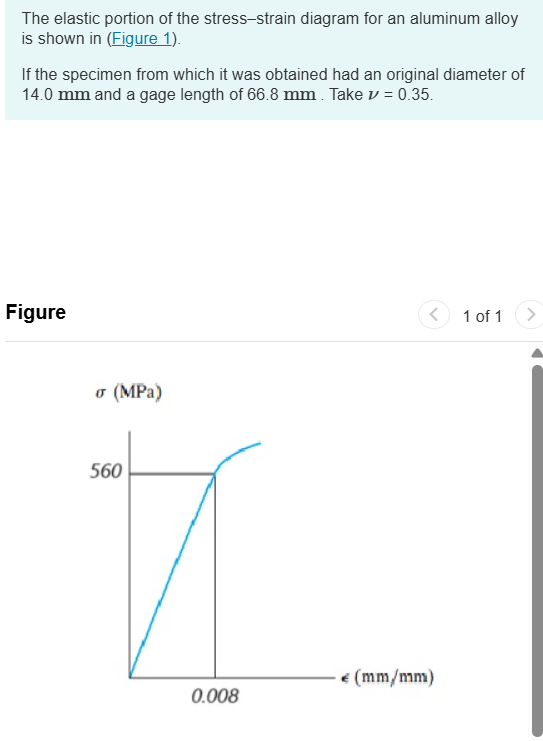 The elastic portion of the stress-strain diagram for an aluminum alloy
is shown in (Figure 1).
If the specimen from which it was obtained had an original diameter of
14.0 mm and a gage length of 66.8 mm . Take v/ = 0.35
Figure 10f1
a
o (MPa)
560 /
« (mm/mm)
0.008
This is AI generated Response.
Asked by: Rahul
Created at: 2026-01-26 03:07:38
Asked by: Rahul
Created at: 2026-01-26 03:07:38
Final Answer:
Rendered
Raw Text
Did you like this answer?
Let's break down the problem step by step using the information provided and the figure.
---
## **Given Data**
- **Original diameter, \( d_ \):** 14. mm
- **Original gage length, \( L_ \):** 66.8 mm
- **Poisson's ratio, \( \nu \):** .35
- **Maximum stress, \( \sigma \):** 560 MPa (from the graph)
- **Maximum strain, \( \epsilon \):** .008 mm/mm (from the graph)
---
## **Step 1: Find Young's Modulus \( E \)**
The slope of the linear (elastic) portion of the stress-strain curve is the **Young's modulus**:
\[
E = \frac{\sigma}{\epsilon}
\]
Plug in the values:
\[
E = \frac{560 \, \text{MPa}}{.008}
\]
\[
E = \frac{560}{.008} = 70,000 \, \text{MPa} = 70 \, \text{GPa}
\]
---
## **Step 2: Find the Change in Length (\( \Delta L \)) at Maximum Stress**
Strain is defined as:
\[
\epsilon = \frac{\Delta L}{L_}
\]
So,
\[
\Delta L = \epsilon \cdot L_
\]
\[
\Delta L = .008 \times 66.8 \, \text{mm}
\]
\[
\Delta L = .5344 \, \text{mm}
\]
---
## **Step 3: Find the Lateral Strain and Change in Diameter (\( \Delta d \))**
Lateral strain is related to axial strain by Poisson's ratio:
\[
\text{Lateral strain} = -\nu \times \text{Axial strain}
\]
\[
\text{Lateral strain} = -.35 \times .008 = -.0028
\]
Change in diameter:
\[
\text{Lateral strain} = \frac{\Delta d}{d_}
\]
\[
\Delta d = \text{Lateral strain} \cdot d_
\]
\[
\Delta d = -.0028 \times 14. \, \text{mm}
\]
\[
\Delta d = -.0392 \, \text{mm}
\]
So, the diameter **decreases** by .0392 mm.
---
## **Step 4: Final Answers**
### **(a) Young's Modulus**
\[
\boxed{E = 70\,\text{GPa}}
\]
### **(b) Change in gage length at 560 MPa**
\[
\boxed{\Delta L = .534\,\text{mm}}
\]
### **(c) Change in diameter at 560 MPa**
\[
\boxed{\Delta d = -.039 \,\text{mm}}
\]
---
### **Summary Table**
| Quantity | Value |
|-----------------------|--------------|
| Young's Modulus (E) | 70 GPa |
| Change in Length | .534 mm |
| Change in Diameter | -.039 mm |
If you need further breakdown or additional calculations (like final area or volume), let me know!
Question:
Then solved
This is AI generated Response.
Asked by: Rahul
Created at: 2026-01-26 03:07:58
Asked by: Rahul
Created at: 2026-01-26 03:07:58
Final Answer:
Rendered
Raw Text
Did you like this answer?
# Step-by-Step Solution for Stress-Strain Problem
## **Given Data**
- **Original diameter, \( d \):** 14.0 mm
- **Original gage length, \( L \):** 66.8 mm
- **Poisson's ratio, \( \nu \):** 0.35
- **Maximum stress, \( \sigma \):** 560 MPa (from the graph)
- **Maximum strain, \( \epsilon \):** 0.008 (mm/mm from the graph)
---
## **Step 1: Calculate Young's Modulus \( E \)**
Young's modulus is calculated using the formula:
\[
E = \frac{\sigma}{\epsilon}
\]
Substituting the values:
\[
E = \frac{560 \, \text{MPa}}{0.008} = 70,000 \, \text{MPa} = 70 \, \text{GPa}
\]
---
## **Step 2: Calculate Change in Length (\( \Delta L \))**
Using the definition of strain:
\[
\epsilon = \frac{\Delta L}{L}
\]
Rearranging gives:
\[
\Delta L = \epsilon \cdot L
\]
Substituting the values:
\[
\Delta L = 0.008 \times 66.8 \, \text{mm} = 0.5344 \, \text{mm}
\]
---
## **Step 3: Calculate Lateral Strain and Change in Diameter (\( \Delta d \))**
Lateral strain is calculated as:
\[
\text{Lateral strain} = -\nu \cdot \text{Axial strain}
\]
Substituting the values:
\[
\text{Lateral strain} = -0.35 \times 0.008 = -0.0028
\]
Next, calculate the change in diameter:
\[
\Delta d = \text{Lateral strain} \cdot d
\]
\[
\Delta d = -0.0028 \times 14.0 \, \text{mm} = -0.0392 \, \text{mm}
\]
---
## **Final Answers**
### **(a) Young's Modulus**
\[
\boxed{E = 70\,\text{GPa}}
\]
### **(b) Change in Gage Length at 560 MPa**
\[
\boxed{\Delta L = 0.534\,\text{mm}}
\]
### **(c) Change in Diameter at 560 MPa**
\[
\boxed{\Delta d = -0.039\,\text{mm}}
\]
---
## **Summary Table**
| Quantity | Value |
|-----------------------|--------------|
| Young's Modulus (E) | 70 GPa |
| Change in Length | 0.534 mm |
| Change in Diameter | -0.039 mm |
This concludes the calculations based on the provided stress-strain diagram for the aluminum alloy specimen. If you have any further questions or need additional calculations, feel free to ask!
📢 Instructions:
- Ask anything relatd to above question only.
- For new Question goto :