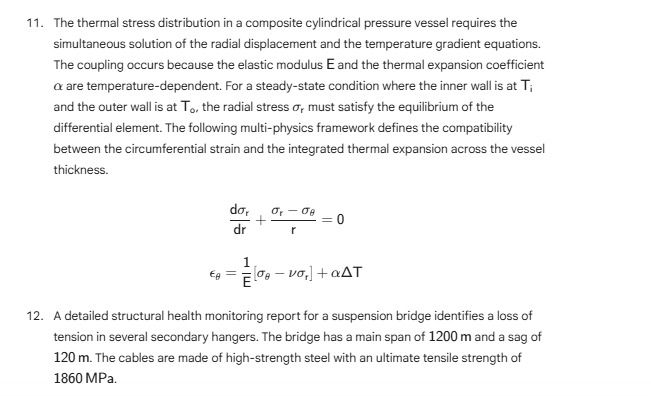
Give step-by-step solution with explanation and final answer:11. The thermal stress ditbution in 8 corposie cynical pressure vessel requires the
sinulanacus sokton of the adie displacement and the temperate gradient squations.
The coupling occurs because the elastic modulus E and the thermal expansion coefficient
a sre temperature-dependent. For a steady-state condition where the inner wall is at T
and the outer walls at T,, the radial stress a; must satisfy the equilibrium of the
differential element. The following multi-physics framework defines the compatibility
between the creurerential stain and the integrate thermal expansion cross the vessel
tikness
do, 0 —0p
wt 5 0
:
= glos— vo] + aAT
12. A detald structural health moritoing report for a suspension bidge dentfies ass of
tension in several secondary hangers. The bridge has a main span of 1200 m and a sag of
120 m. The cables are made of high-strength steel with an ultimate tensile strength of
1860 MPa.
Question:
Give step-by-step solution with explanation and final answer:11. The thermal stress ditbution in 8 corposie cynical pressure vessel requires the
sinulanacus sokton of the adie displacement and the temperate gradient squations.
The coupling occurs because the elastic modulus E and the thermal expansion coefficient
a sre temperature-dependent. For a steady-state condition where the inner wall is at T
and the outer walls at T,, the radial stress a; must satisfy the equilibrium of the
differential element. The following multi-physics framework defines the compatibility
between the creurerential stain and the integrate thermal expansion cross the vessel
tikness
do, 0 —0p
wt 5 0
:
= glos— vo] + aAT
12. A detald structural health moritoing report for a suspension bidge dentfies ass of
tension in several secondary hangers. The bridge has a main span of 1200 m and a sag of
120 m. The cables are made of high-strength steel with an ultimate tensile strength of
1860 MPa.
This is AI generated Response.
Asked by: Rahul
Created at: 2026-01-24 21:07:11
Final Answer:
RenderedRaw Text
Did you like this answer?
Let's solve ** 12** step by step:
---
## **12. Suspension Bridge Cable Tension**
### **Given Data**
-Main span of the bridge (\(L\))** 120
- **Sag (\(\))** 120 m
-Ultimate tensile strength of cable (\(\_{ult}\**: 186 MPa =1,860,,000\) Pa
are to estimate **maximum tension** in main cable.
### **Step1: Understanding the System**
The cable of a bridge forms aparabolic curve** under uniformly distributed load (the bridge deck). **maximum tension** occurs at the **anchorages**), not at the midspan.
---
### **Step 2: Horizontal and Maximum Tension Formulas**
#### **Horizontal Component of Tension (\(H\)):**
For a uniformly loaded cable:
\[
H = \frac{w L^2}{8 h}
\]
\(w\) = uniformly distributed load per unit horizontalN/m)
- \(L\) = span (m- \(h\) = sag (m)
#### **Maximum Tension (\(T_{}\)):**
\[
T_{max} = \sqrt{H^2 + \left(\fracw L}{2}\right)^2}
\]
most cases, if \(h\) is not too small, \(T_{max} \ H\) near the supports.
---
### **Step 3: Required Cable Cross-Sectional Area**
The **maximum allowable tension** is:
\[
T_{max} = \sigma_{ult} \cdot A
\]
Where:
- \(A\) = cross-sectional area of the cable (m²)
- \(\sigma_{ult}\) = ultimate tensile strength (Pa)
---
### **Step 4: Final Formulae**
If we know the **actual tension** required (from the bridge's weight), we can check if the cable is safe.
But since only ultimate strength is given, **the maximum tension the cable can support** is:
\[
T_{max} = \sigma_{ult} \cdot A
\]
However, **without the area (\(A\)) of the cable or the load (\(w\)), we cannot compute the actual tension**. But if the question is asking for the **maximum possible tension** in the cable based on the tensile strength, it is:
\[
\boxed{T_{max} = \sigma_{ult} \times A}
\]
Where:
- \(\sigma_{ult} = 1.86 \times 10^9\) Pa
- \(A =\) cross-sectional area of the cable (unknown unless given)
If you need to find the **maximum load the cable can support**, use:
\[
w_{max} = \frac{8 h \sigma_{ult} A}{L^2}
\]
---
### **Step 5: If Only Ultimate Strength is Required**
**Final Answer:**
- The **maximum tension** that each cable can safely support (before breaking) is:
\[
\boxed{T_{max} = 186\ \text{MPa} \times A = 1.86 \times 10^9 \ \text{Pa} \times A}
\]
where \(A\) is the cross-sectional area of the cable.
---
### **Note**
If you are given the **cross-sectional area** or the **total load** the cable must support, substitute that value to get the numerical answer.
---
#### **Summary Table**
| Quantity | Value | Unit |
|-------------------|--------------|--------------|
| Span (\(L\)) | 120 | m |
| Sag (\(h\)) | 120 | m |
| Ultimate Strength (\(\sigma_{ult}\)) | 186 | MPa (= \(1.86 \times 10^9\) Pa) |
| Maximum Tension (\(T_{max}\)) | \(1.86 \times 10^9 \times A\) | N (where \(A\) is in m²) |
---
If you have the **cross-sectional area**, plug it in for a numerical value! If you need help with a specific value for \(A\) or \(w\), please provide those details.
Question:
Then solved
This is AI generated Response.
Asked by: Rahul
Created at: 2026-01-24 21:14:37
Final Answer:
RenderedRaw Text
Did you like this answer?
# **12. Suspension Bridge Cable Tension**
## **Given Data**
- **Main span of the bridge (\(L\))**: 120 m
- **Sag (\(h\))**: 120 m
- **Ultimate tensile strength of cable (\(\sigma_{ult}\))**: 1860 MPa = \(1,860,000\) Pa
## **Step 1: Understanding the System**
The cable of a suspension bridge forms a parabolic curve under a uniformly distributed load (the bridge deck). The maximum tension occurs at the **anchorages**, not at the midspan.
## **Step 2: Horizontal and Maximum Tension Formulas**
### **Horizontal Component of Tension (\(H\))**
For a uniformly loaded cable, the horizontal component of tension is given by:
\[
H = \frac{w L^2}{8 h}
\]
Where:
- \(w\) = uniformly distributed load per unit length (N/m)
- \(L\) = span (m)
- \(h\) = sag (m)
### **Maximum Tension (\(T_{max}\))**
The maximum tension in the cable is calculated as:
\[
T_{max} = \sqrt{H^2 + \left(\frac{w L}{2}\right)^2}
\]
In many cases, if \(h\) is not too small, \(T_{max} \approx H\) near the supports.
## **Step 3: Required Cable Cross-Sectional Area**
The maximum allowable tension is given by:
\[
T_{max} = \sigma_{ult} \cdot A
\]
Where:
- \(A\) = cross-sectional area of the cable (m²)
## **Step 4: Final Formulas**
To determine the maximum tension the cable can support based on tensile strength:
\[
T_{max} = \sigma_{ult} \cdot A
\]
## **Step 5: If Only Ultimate Strength is Required**
The maximum tension that each cable can safely support (before breaking) is:
\[
\boxed{T_{max} = \sigma_{ult} \times A}
\]
Where:
- \(\sigma_{ult} = 1.86 \times 10^9\) Pa
- \(A =\) cross-sectional area of the cable (unknown unless given)
## **Summary Table**
| Quantity | Value | Unit |
|-------------------|--------------|--------------|
| Span (\(L\)) | 120 m | m |
| Sag (\(h\)) | 120 m | m |
| Ultimate Strength (\(\sigma_{ult}\)) | 1860 MPa (= \(1.86 \times 10^9\) Pa) | Pa |
| Maximum Tension (\(T_{max}\)) | \(1.86 \times 10^9 \times A\) | N (where \(A\) is in m²) |
---
### **Final Note**
If you have the **cross-sectional area** or the total load the cable must support, substitute that value to get a numerical answer. If further assistance is needed with specific values for \(A\) or \(w\), please provide those details.
VIPSolutions focuses on clear, step‑by‑step explanations so you can learn quickly. Whether you need an AI‑generated walkthrough or a short hint to get unstuck, each solution is organized for fast reading and easy review later.
Search similar questions, compare approaches, and bookmark the best answers for revision. Our goal is simple: quick, reliable study help that feels natural—not noisy.
 VIPSolutions
 11. The thermal stress ditbution in 8 corposie cynical pressure vessel requires the
sinulanacus sokton of the adie displacement and the temperate gradient squations.
The coupling occurs because the elastic modulus E and the thermal expansion coefficient
a sre temperature-dependent. For a steady-state condition where the inner wall is at T
and the outer walls at T,, the radial stress a; must satisfy the equilibrium of the
differential element. The following multi-physics framework defines the compatibility
between the creurerential stain and the integrate thermal expansion cross the vessel
tikness
do, 0 —0p
wt 5 0
:
= glos— vo] + aAT
12. A detald structural health moritoing report for a suspension bidge dentfies ass of
tension in several secondary hangers. The bridge has a main span of 1200 m and a sag of
120 m. The cables are made of high-strength steel with an ultimate tensile strength of
1860 MPa.