 VIPSolutions
Give step-by-step solution with explanation and final answer:Required information A ball is dropped from a boat so that it strikes the surface of a lake with a speed of 16.5 fi/s. While in the water, the ball experiences an acceleration of a = 10 — 0.8v, where a and vare expressed in ft/s’ and fis, respectively. The ball takes 4500s to reach the bottom of the lake. BE — — —— — —_———— termine the depth of the lake. © depth of the lake is [ft
Question:
Give step-by-step solution with explanation and final answer: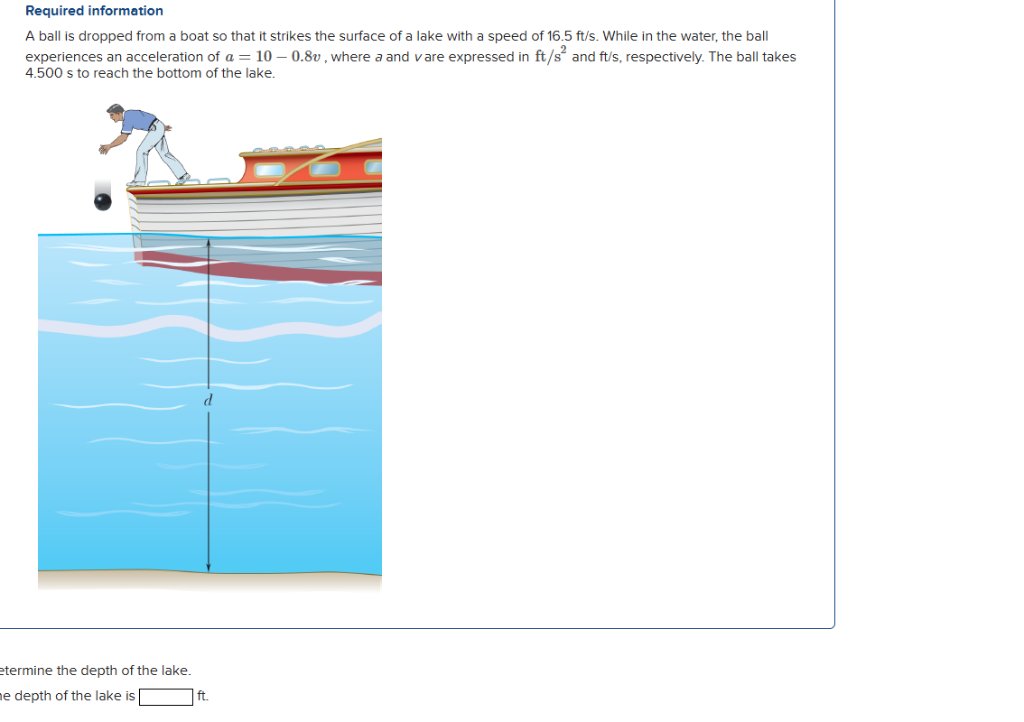 Required information
A ball is dropped from a boat so that it strikes the surface of a lake with a speed of 16.5 fi/s. While in the water, the ball
experiences an acceleration of a = 10 — 0.8v, where a and vare expressed in ft/s’ and fis, respectively. The ball takes
4500s to reach the bottom of the lake.
BE
— — —— —
—_————
termine the depth of the lake.
© depth of the lake is [ft
This is AI generated Response.
Asked by: Rahul
Created at: 2026-01-22 03:26:30
Asked by: Rahul
Created at: 2026-01-22 03:26:30
Final Answer:
Rendered
Raw Text
Did you like this answer?
Let's solve the problem step by step:
---
## **Step 1: Given Information**
- Initial speed of the ball as it enters the water: \( v_ = 16.5 \) ft/s
- Acceleration in water: \( a = 10 - .8v \), where \( a \) in ft/s², \( v \) in ft/s
- Time to reach the bottom: \( t = 4.500 \) s
- We need to find the **depth \( d \) of the lake**.
---
## **Step 2: Set Up the Differential Equation**
The acceleration given is:
\[
a = \frac{dv}{dt} = 10 - .8v
\]
---
## **Step 3: Solve the Differential Equation**
Separate variables:
\[
\frac{dv}{10 - .8v} = dt
\]
Integrate both sides:
\[
\int \frac{dv}{10 - .8v} = \int dt
\]
Let \( u = 10 - .8v \Rightarrow du = -.8 dv \Rightarrow dv = -\frac{1}{.8} du \):
\[
\int \frac{dv}{10 - .8v} = -\frac{1}{.8} \int \frac{du}{u} = -1.25 \ln|u| = -1.25 \ln|10 - .8v|
\]
So:
\[
-1.25 \ln|10 - .8v| = t + C
\]
Solve for \( v \):
\[
\ln|10 - .8v| = -.8t + C'
\]
\[
10 - .8v = A e^{-.8t}
\]
---
## **Step 4: Initial Condition**
At \( t = \), \( v = 16.5 \) ft/s:
\[
10 - .8(16.5) = A e^{}
\]
\[
10 - 13.2 = A
\]
\[
A = -3.2
\]
So,
\[
10 - .8v = -3.2 e^{-.8t}
\]
\[
.8v = 10 + 3.2 e^{-.8t}
\]
\[
v = \frac{10 + 3.2 e^{-.8t}}{.8}
\]
\[
v = 12.5 + 4 e^{-.8t}
\]
---
## **Step 5: Find Displacement (Depth)**
\[
v = \frac{dx}{dt} = 12.5 + 4 e^{-.8t}
\]
Integrate to find \( x \) (from \( t = \) to \( t = 4.5 \)):
\[
dx = \left(12.5 + 4 e^{-.8t}\right) dt
\]
\[
x = \int_^{4.5} \left(12.5 + 4 e^{-.8t}\right) dt
\]
Integrate:
\[
x = \int_^{4.5} 12.5\,dt + \int_^{4.5} 4 e^{-.8t}\,dt
\]
First term:
\[
\int_^{4.5} 12.5\,dt = 12.5 \times 4.5 = 56.25
\]
Second term:
\[
\int_^{4.5} 4 e^{-.8t}\,dt = 4 \times \left[ \frac{e^{-.8t}}{-.8} \right]_^{4.5}
\]
\[
= 4 \times \left( -1.25 \right) \left( e^{-.8 \times 4.5} - e^{} \right)
\]
\[
= -5 \left( e^{-3.6} - 1 \right)
\]
Calculate \( e^{-3.6} \):
\[
e^{-3.6} \approx .02732
\]
So:
\[
-5 \left( .02732 - 1 \right) = -5 \times (-.97268) = 4.8634
\]
Add both terms:
\[
x = 56.25 + 4.8634 = 61.1134\ \text{ft}
\]
---
## **Final Answer**
\[
\boxed{61.1\ \text{ft}}
\]
**The depth of the lake is approximately 61.1 ft.**
Question:
Then solved
This is AI generated Response.
Asked by: Rahul
Created at: 2026-01-22 03:27:12
Asked by: Rahul
Created at: 2026-01-22 03:27:12
Final Answer:
Rendered
Raw Text
Did you like this answer?
# Step-by-Step Solution to Determine the Depth of the Lake
## Step 1: Given Information
- **Initial speed of the ball entering the water:** \( v_0 = 16.5 \) ft/s
- **Acceleration equation in water:** \( a = 10 - 0.8v \) (where \( a \) is in ft/s² and \( v \) is in ft/s)
- **Time to reach the bottom:** \( t = 4.5 \) s
- **Objective:** Find the **depth \( d \)** of the lake.
## Step 2: Set Up the Differential Equation
The acceleration can be expressed as:
\[
a = \frac{dv}{dt} = 10 - 0.8v
\]
## Step 3: Solve the Differential Equation
### Separate Variables
\[
\frac{dv}{10 - 0.8v} = dt
\]
### Integrate Both Sides
Using the substitution \( u = 10 - 0.8v \), then \( du = -0.8 dv \):
\[
\int \frac{dv}{10 - 0.8v} = -\frac{1}{0.8} \int \frac{du}{u}
\]
This simplifies to:
\[
-1.25 \ln|10 - 0.8v| = t + C
\]
### Solve for \( v \)
Rearranging gives:
\[
\ln|10 - 0.8v| = -0.8t + C'
\]
Exponentiating both sides:
\[
10 - 0.8v = A e^{-0.8t}
\]
## Step 4: Apply the Initial Condition
At \( t = 0 \), \( v = 16.5 \) ft/s:
\[
10 - 0.8(16.5) = A
\]
Calculating:
\[
10 - 13.2 = A \implies A = -3.2
\]
### Substitute Back
\[
10 - 0.8v = -3.2 e^{-0.8t}
\]
\[
0.8v = 10 + 3.2 e^{-0.8t} \implies v = \frac{10 + 3.2 e^{-0.8t}}{0.8}
\]
\[
v = 12.5 + 4 e^{-0.8t}
\]
## Step 5: Find Displacement (Depth)
### Relate Velocity to Displacement
\[
v = \frac{dx}{dt} = 12.5 + 4 e^{-0.8t}
\]
Integrating \( dx \):
\[
dx = \left(12.5 + 4 e^{-0.8t}\right) dt
\]
Integrate from \( t = 0 \) to \( t = 4.5 \):
\[
x = \int_0^{4.5} \left(12.5 + 4 e^{-0.8t}\right) dt
\]
### Calculate the Integrals
1. **First integral**:
\[
\int_0^{4.5} 12.5\,dt = 12.5 \times 4.5 = 56.25
\]
2. **Second integral**:
\[
\int_0^{4.5} 4 e^{-0.8t}\,dt = 4 \left[-\frac{1}{0.8} e^{-0.8t}\right]_0^{4.5} = -5 \left( e^{-3.6} - 1 \right)
\]
Calculate \( e^{-3.6} \):
\[
e^{-3.6} \approx 0.02732
\]
So:
\[
-5 \left( 0.02732 - 1 \right) = -5 \times (-0.97268) = 4.8634
\]
### Total Displacement
Combine both results:
\[
x = 56.25 + 4.8634 = 61.1134\ \text{ft}
\]
## Final Answer
The depth of the lake is approximately:
\[
\boxed{61.1\ \text{ft}}
\]
📢 Instructions:
- Ask anything relatd to above question only.
- For new Question goto :