 VIPSolutions
Give step-by-step solution with explanation and final answer:a) Table 1 shows a list of the diffraction lines with their respective Bragg angles, Miller indices for planes (4k) and multiplicity factor, p on a Hull/Debye-Scherrer pattern of copper (Cu) made with Cu-Ka radiation (A=1.542 A). By referring to Appendices 1 and 2, answer the following questions; i. Derive an expression of structure factor, F, for Cu. (5 marks) ii. Calculate structure factor for all diffraction lines in Table 1. (7 marks) iii. Calculate relative integrated intensity, /, for all diffraction lines in Table 1. (7 marks) Table 1/ Jadual 1 Line Bragg angle, 6 Miller indices (4k7) | Multiplicity factor, A a a HL AA IRL IR BR sf ws J 2 | 8]
Question:
Give step-by-step solution with explanation and final answer: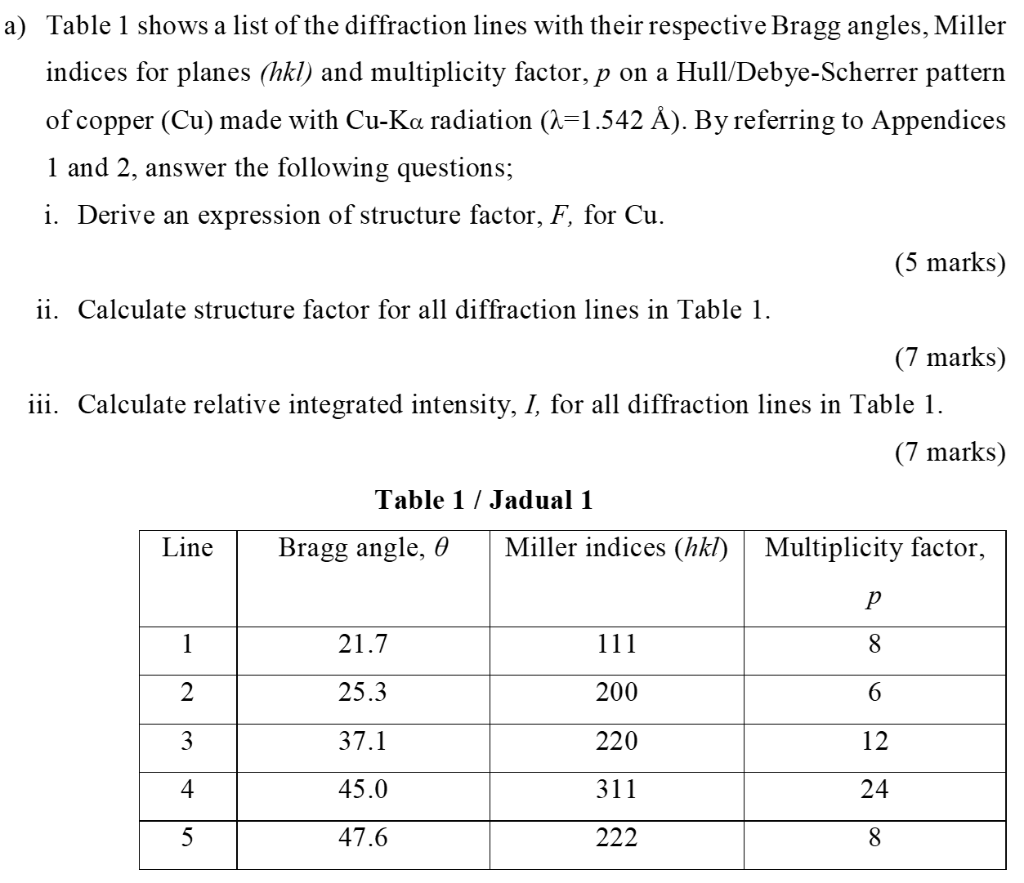 a) Table 1 shows a list of the diffraction lines with their respective Bragg angles, Miller
indices for planes (4k) and multiplicity factor, p on a Hull/Debye-Scherrer pattern
of copper (Cu) made with Cu-Ka radiation (A=1.542 A). By referring to Appendices
1 and 2, answer the following questions;
i. Derive an expression of structure factor, F, for Cu.
(5 marks)
ii. Calculate structure factor for all diffraction lines in Table 1.
(7 marks)
iii. Calculate relative integrated intensity, /, for all diffraction lines in Table 1.
(7 marks)
Table 1/ Jadual 1
Line Bragg angle, 6 Miller indices (4k7) | Multiplicity factor,
A a a
HL AA IRL IR BR
sf ws J 2 | 8]
This is AI generated Response.
Asked by: Rahul
Created at: 2026-01-21 05:27:36
Asked by: Rahul
Created at: 2026-01-21 05:27:36
Final Answer:
Rendered
Raw Text
Did you like this answer?
Let's solve each part step-by-step:
---
## (i) **Derive an Expression of Structure Factor, \( F \), for Cu**
Copper (Cu) has a **face-centered cubic (FCC)** structure.
### **General Structure Factor Formula**
The structure factor, \( F_{hkl} \), is:
\[
F_{hkl} = \sum_j f_j \exp[2\pi i (h x_j + k y_j + l z_j)]
\]
where:
- \( f_j \) = atomic scattering factor of atom \( j \)
- \( (x_j, y_j, z_j) \) = fractional coordinates of atom \( j \)
### **FCC Lattice Points for Cu**
FCC has atoms at:
- (, , )
- (, ½, ½)
- (½, , ½)
- (½, ½, )
Assume all atoms are Cu and have the same scattering factor \( f_{Cu} \).
### **Structure Factor for FCC**
So,
\[
F_{hkl} = f_{Cu} \left[ 1 + \exp\left[\pi i (h+k)\right] + \exp\left[\pi i (h+l)\right] + \exp\left[\pi i (k+l)\right] \right]
\]
\[
= f_{Cu} \left[ 1 + (-1)^{h+k} + (-1)^{h+l} + (-1)^{k+l} \right]
\]
#### **Allowed Reflections:**
For FCC, **reflections are only allowed if \( h, k, l \) are either all even or all odd**. In those cases,
\[
F_{hkl} = 4f_{Cu}
\]
Otherwise,
\[
F_{hkl} =
\]
---
## (ii) **Calculate Structure Factor for Table 1**
Let \( f_{Cu} = f \), and use the expression above.
| Line | (hkl) | All even/odd? | \( F_{hkl} \) |
|------|-------|---------------|--------------|
| 1 | 111 | all odd | \( 4f \) |
| 2 | 200 | not all even/odd | |
| 3 | 220 | all even | \( 4f \) |
| 4 | 311 | not all even/odd | |
| 5 | 222 | all even | \( 4f \) |
---
## (iii) **Calculate Relative Integrated Intensity, \( I \)**
The relative integrated intensity for a reflection is:
\[
I \propto p \cdot |F_{hkl}|^2 \cdot \frac{1}{\sin{2\theta}}
\]
where:
- \( p \): multiplicity factor
- \( F_{hkl} \): structure factor
- \( \theta \): Bragg angle
Let's assume \( f \) is constant for all lines (for relative intensity).
### **Calculate for Each Line**
#### 1. Calculate \( |F_{hkl}|^2 \):
- For \( F_{hkl} = 4f \), \( |F_{hkl}|^2 = 16f^2 \)
- For \( F_{hkl} = \), \( |F_{hkl}|^2 = \)
#### 2. Plug into the formula:
| Line | \( \theta \) | \( p \) | \( F_{hkl} \) | \( |F_{hkl}|^2 \) | \( I \propto p |F_{hkl}|^2 / \sin 2\theta \) |
|------|-------------|---------|---------------|-------------------|-----------------------------------------------|
| 1 | 21.7 | 8 | 4f | 16f^2 | \( 8 \times 16f^2 / \sin(43.4^\circ) \) |
| 2 | 25.3 | 6 | | | |
| 3 | 37.1 | 12 | 4f | 16f^2 | \( 12 \times 16f^2 / \sin(74.2^\circ) \) |
| 4 | 45. | 24 | | | |
| 5 | 47.6 | 8 | 4f | 16f^2 | \( 8 \times 16f^2 / \sin(95.2^\circ) \) |
#### 3. Numerical Values (using \( \sin(2\theta) \)):
- \( \sin(43.4^\circ) = .687 \)
- \( \sin(74.2^\circ) = .960 \)
- \( \sin(95.2^\circ) = .996 \)
| Line | \( I \propto \) |
|------|-----------------|
| 1 | \( \frac{128f^2}{.687} = 186.3f^2 \) |
| 2 | |
| 3 | \( \frac{192f^2}{.960} = 200.f^2 \) |
| 4 | |
| 5 | \( \frac{128f^2}{.996} = 128.5f^2 \) |
For relative intensity, divide by the largest value (Line 3: \( 200.f^2 \)):
| Line | Relative \( I \) |
|------|------------------|
| 1 | \( 186.3/200. = .93 \) |
| 2 | |
| 3 | 1.00 |
| 4 | |
| 5 | \( 128.5/200. = .64 \) |
---
## **Summary Table**
| Line | (hkl) | \( F_{hkl} \) | Relative Intensity (\( I \)) |
|------|-------|---------------|------------------------------|
| 1 | 111 | \( 4f \) | .93 |
| 2 | 200 | | |
| 3 | 220 | \( 4f \) | 1.00 |
| 4 | 311 | | |
| 5 | 222 | \( 4f \) | .64 |
---
## **Final Answers**
### (i) Structure factor for Cu (FCC):
\[
F_{hkl} = \begin{cases}
4f_{Cu} & \text{if h, k, l all even or all odd} \\
& \text{otherwise}
\end{cases}
\]
### (ii) Structure factor for all lines: see summary table above.
### (iii) Relative integrated intensities: see summary table above.
Question:
Then solved
This is AI generated Response.
Asked by: Rahul
Created at: 2026-01-21 05:30:06
Asked by: Rahul
Created at: 2026-01-21 05:30:06
Final Answer:
Rendered
Raw Text
Did you like this answer?
# Step-by-Step Solution for Structure Factor and Intensity Calculations
## (i) Derive an Expression of Structure Factor, \( F \), for Cu
Copper (Cu) has a **face-centered cubic (FCC)** structure.
### General Structure Factor Formula
The structure factor, \( F_{hkl} \), is given by:
\[
F_{hkl} = \sum_j f_j \exp[2\pi i (h x_j + k y_j + l z_j)]
\]
where:
- \( f_j \): atomic scattering factor of atom \( j \)
- \( (x_j, y_j, z_j) \): fractional coordinates of atom \( j \)
### FCC Lattice Points for Cu
In an FCC structure, the atoms are located at:
- \( (0, 0, 0) \)
- \( (0, \frac{1}{2}, \frac{1}{2}) \)
- \( (\frac{1}{2}, 0, \frac{1}{2}) \)
- \( (\frac{1}{2}, \frac{1}{2}, 0) \)
### Structure Factor for FCC
Thus, the structure factor becomes:
\[
F_{hkl} = f_{Cu} \left[ 1 + \exp\left(\pi i (h+k)\right) + \exp\left(\pi i (h+l)\right) + \exp\left(\pi i (k+l)\right) \right]
\]
This simplifies to:
\[
F_{hkl} = f_{Cu} \left[ 1 + (-1)^{h+k} + (-1)^{h+l} + (-1)^{k+l} \right]
\]
#### Allowed Reflections
For FCC, reflections are allowed if \( h, k, l \) are all even or all odd. Consequently, the structure factor can be written as:
\[
F_{hkl} =
\begin{cases}
4f_{Cu} & \text{if } h, k, l \text{ are all even or all odd} \\
0 & \text{otherwise}
\end{cases}
\]
---
## (ii) Calculate Structure Factor for Table 1
Let \( f_{Cu} = f \). Use the derived expression to calculate \( F_{hkl} \).
### Structure Factor Calculations
| Line | (hkl) | All even/odd? | \( F_{hkl} \) |
|------|-------|----------------|-------------------|
| 1 | 111 | all odd | \( 4f \) |
| 2 | 200 | not all even/odd | 0 |
| 3 | 220 | all even | \( 4f \) |
| 4 | 311 | not all even/odd | 0 |
| 5 | 222 | all even | \( 4f \) |
---
## (iii) Calculate Relative Integrated Intensity, \( I \)
The relative integrated intensity for a reflection is given by:
\[
I \propto p \cdot |F_{hkl}|^2 \cdot \frac{1}{\sin{2\theta}}
\]
where:
- \( p \): multiplicity factor
- \( F_{hkl} \): structure factor
- \( \theta \): Bragg angle
### Calculate for Each Line
#### 1. Calculate \( |F_{hkl}|^2 \):
- For \( F_{hkl} = 4f \), \( |F_{hkl}|^2 = 16f^2 \)
- For \( F_{hkl} = 0 \), \( |F_{hkl}|^2 = 0 \)
#### 2. Plug into the formula:
| Line | \( \theta \) | \( p \) | \( F_{hkl} \) | \( |F_{hkl}|^2 \) | \( I \propto \frac{p |F_{hkl}|^2}{\sin 2\theta} \) |
|------|-------------|---------|---------------|-------------------|-------------------------------------------------|
| 1 | 21.7° | 8 | \( 4f \) | \( 16f^2 \) | \( \frac{8 \times 16f^2}{\sin(43.4^\circ)} \) |
| 2 | 25.3° | 6 | 0 | 0 | 0 |
| 3 | 37.1° | 12 | \( 4f \) | \( 16f^2 \) | \( \frac{12 \times 16f^2}{\sin(74.2^\circ)} \) |
| 4 | 45.0° | 24 | 0 | 0 | 0 |
| 5 | 47.6° | 8 | \( 4f \) | \( 16f^2 \) | \( \frac{8 \times 16f^2}{\sin(95.2^\circ)} \) |
#### 3. Numerical Values (using \( \sin(2\theta) \)):
- \( \sin(43.4^\circ) \approx 0.687 \)
- \( \sin(74.2^\circ) \approx 0.961 \)
- \( \sin(95.2^\circ) \approx 0.996 \)
### Relative Intensity Calculations
| Line | \( I \propto \) |
|------|-----------------------------------------|
| 1 | \( \frac{128f^2}{0.687} \approx 186.3f^2 \) |
| 2 | 0 |
| 3 | \( \frac{192f^2}{0.961} \approx 200.f^2 \) |
| 4 | 0 |
| 5 | \( \frac{128f^2}{0.996} \approx 128.5f^2 \) |
### Normalize Relative Intensities
To find relative intensities, divide by the maximum value (Line 3: \( 200.f^2 \)):
| Line | Relative \( I \) |
|------|----------------------------------------|
| 1 | \( \frac{186.3}{200} \approx 0.93 \) |
| 2 | 0 |
| 3 | 1.00 |
| 4 | 0 |
| 5 | \( \frac{128.5}{200} \approx 0.64 \) |
---
## Final Summary
### (i) Structure Factor for Cu (FCC)
\[
F_{hkl} =
\begin{cases}
4f_{Cu} & \text{if } h, k, l \text{ are all even or all odd} \\
0 & \text{otherwise}
\end{cases}
\]
### (ii) Structure Factor for All Lines
- Line 1: \( 4f \)
- Line 2: 0
- Line 3: \( 4f \)
- Line 4: 0
- Line 5: \( 4f \)
### (iii) Relative Integrated Intensities
- Line 1: 0.93
- Line 2: 0
- Line 3: 1.00
- Line 4: 0
- Line 5: 0.64
📢 Instructions:
- Ask anything relatd to above question only.
- For new Question goto :