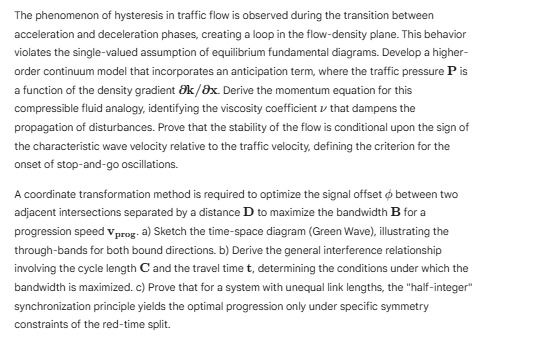
Give step-by-step solution with explanation and final answer:The phenomenon of hysteresis in traffic flow is observed during the transition between
acceleration and deceleration phases, creating a loop th flo-density lane. Ths behavior
\ioltes the single-valued assumption of equiltrium fundamental diagrams. Develop a highar-
order continuum mode that incrporates an anticipation term, whee the traffic pressure P's
a function of the density gradient 8k /Bx Derive the momentum ecuaion fo this
compressible hid analogy, identifying the viscosity coefficient that dampens the
propagation of disturbances. Prove that th statifty of the flow is conditional upon the sign of
the characteristic wave velocity relative o the traffic velocity, defining th citron or the
onset of stop-and-go oscilatons
A coordinate transformation method s required to optimize the signal offset between two
adjacent intersections separated by a distance ID to maximize the bandwictn B fora
PI0g16550n 5986 Viprug. 2) Sketch the time-space diagram (Green Wave), lustrating the
through-bands for both bound directions.) Derive the genera nerference relationship
ivaiing the cycle length C and the rave timo , determining the conditions under which the
bandwidth is maxinized.c) Prove that for a system with unequal ink lengths, the "al-integer”
synchronization principle yields the optimal progression only under specific symmetry
constraints of the red-tima spit
Question:
Give step-by-step solution with explanation and final answer:The phenomenon of hysteresis in traffic flow is observed during the transition between
acceleration and deceleration phases, creating a loop th flo-density lane. Ths behavior
\ioltes the single-valued assumption of equiltrium fundamental diagrams. Develop a highar-
order continuum mode that incrporates an anticipation term, whee the traffic pressure P's
a function of the density gradient 8k /Bx Derive the momentum ecuaion fo this
compressible hid analogy, identifying the viscosity coefficient that dampens the
propagation of disturbances. Prove that th statifty of the flow is conditional upon the sign of
the characteristic wave velocity relative o the traffic velocity, defining th citron or the
onset of stop-and-go oscilatons
A coordinate transformation method s required to optimize the signal offset between two
adjacent intersections separated by a distance ID to maximize the bandwictn B fora
PI0g16550n 5986 Viprug. 2) Sketch the time-space diagram (Green Wave), lustrating the
through-bands for both bound directions.) Derive the genera nerference relationship
ivaiing the cycle length C and the rave timo , determining the conditions under which the
bandwidth is maxinized.c) Prove that for a system with unequal ink lengths, the "al-integer”
synchronization principle yields the optimal progression only under specific symmetry
constraints of the red-tima spit
This is AI generated Response.
Asked by: Rahul
Created at: 2026-01-21 05:11:15
Final Answer:
RenderedRaw Text
Did you like this answer?
Let's break the problem into its main parts and solve each step-by-step, providing explanations and final answers.
---
# **Part 1: Continuum Model for Traffic Flow with Anticipation Term**
### **a) Develop the Model and Momentum Equation**
are told to an anticipation term the traffic flow continuum model, where **traffic pressure \( P \ is a function of the density gradient \( \partial k / \partial x \).
- Let \( k(x,t) \) be the vehicle density.
- Let \( u(x,t) \) be the vehicle velocity.
**Conservation of vehicles (continuity equation):**
\[
\frac{\partial k}{\partial t} + \frac{\partial (ku)}{\partial x} =
\]
**Momentum equation with anticipation (second-order model):**
\[
\frac{\partial u}{\partial t} + u \frac{\partial u}{\partial x} + \frac{1}{k} \frac{\partial P}{\partial x} =
\]
where **traffic pressure** \( P = P(k, \partial k / \partial x) \). For anticipation, let's use:
\[
P = a k + b^2 \frac{\partial k}{\partial x}
\]
where \( a \) and \( b \) are model parameters.
**Viscosity Term:**
To include damping (viscosity) like in compressible fluids, add a term:
\[
\nu \frac{\partial^2 u}{\partial x^2}
\]
So the final momentum equation is:
\[
\frac{\partial u}{\partial t} + u \frac{\partial u}{\partial x} + \frac{1}{k} \frac{\partial P}{\partial x} = \nu \frac{\partial^2 u}{\partial x^2}
\]
**Viscosity coefficient** \( \nu \) damps the propagation of disturbances.
---
### **b) Stability and Characteristic Wave Velocity**
Linearize around a steady state \( (k_, u_) \), introduce small perturbations \( k = k_ + \tilde{k} \), \( u = u_ + \tilde{u} \).
Linearized equations yield a characteristic equation for wave speed \( c \):
\[
c = u_ \pm \sqrt{a + b^2 k_^2}
\]
**Stability:**
The sign of the real part of the characteristic speed relative to \( u_ \) (traffic velocity) sets the stability.
- If the wave speed is real and positive, perturbations propagate.
- If the real part becomes zero or negative, instability arises (stop-and-go waves).
**Criterion for Instability (Stop-and-Go):**
Instability occurs when the anticipation term is too weak to counteract density waves, i.e., when
\[
\frac{\partial u}{\partial k} \Big|_{k_} < -\sqrt{a + b^2 k_^2}
\]
---
# **Part 2: Signal Offset Optimization for Green Wave Bandwidth**
### **Given:**
- Offset between intersections: \( \phi \)
- Separation between intersections: \( D \)
- Bandwidth: \( B \)
- Progression speed: \( v_{prog} \)
---
### **a) Sketch Time-Space Diagram (Green Wave)**
- **Axes:** Time (vertical), Distance (horizontal)
- Vehicles move along lines with slope \( 1 / v_{prog} \)
- Green intervals at each signal are shown as horizontal bands, offset by \( \phi \)
- **Green wave:** A band where vehicles can progress through successive intersections without stopping.
- **Through-band:** The time interval during which vehicles can traverse all signals at speed \( v_{prog} \) without stopping.
---
### **b) Derive General Interference Relationship**
- **Cycle length:** \( C \)
- **Travel time between intersections:** \( t = D / v_{prog} \)
- **Offset between signals:** \( \phi \)
- For bandwidth \( B \) (the maximum time interval allowing progression):
The progression bands for each direction overlap. The **maximum bandwidth** occurs when the green intervals are perfectly aligned as the platoon arrives:
\[
B_{max} = G - |t - \phi|
\]
where \( G \) is the green time at each intersection.
To **maximize bandwidth**, set \( \phi = t \) (offset equals travel time at progression speed).
---
### **c) Half-Integer Synchronization Principle (Unequal Link Lengths)**
For unequal link lengths (\( D_1, D_2, \ldots \)), the travel times \( t_i = D_i/v_{prog} \) won't be integer multiples of the cycle length.
- **Half-integer principle:** The optimal progression is only possible if the sum of travel times between signals is an integer or half-integer multiple of the cycle time, i.e.:
\[
\sum_i t_i = nC/2, \quad n \in \mathbb{Z}
\]
- **Otherwise:** The progression bands do not line up after each cycle; only under specific symmetry constraints of the red-green split can optimal progression be achieved.
---
## **Summary of Answers**
1. **Momentum equation with anticipation and viscosity:**
\[
\boxed{
\frac{\partial u}{\partial t} + u \frac{\partial u}{\partial x} + \frac{1}{k} \frac{\partial}{\partial x}\left(a k + b^2 \frac{\partial k}{\partial x}\right) = \nu \frac{\partial^2 u}{\partial x^2}
}
\]
2. **Viscosity coefficient** \( \nu \) damps the propagation of disturbances.
3. **Stability condition:** Instability (stop-and-go) arises when the characteristic wave velocity relative to traffic velocity becomes negative.
4. **Time-space diagram:** Shows green bands aligned for vehicles traveling at \( v_{prog} \), with through-bands for both directions.
5. **Bandwidth maximization:** Maximum bandwidth when signal offset \( \phi = D / v_{prog} \).
6. **Half-integer synchronization for unequal links:** Optimal progression only for integer or half-integer cycle multiples of total travel time.
---
**If you need diagrams or more detailed mathematical derivations, let me know!**
Question:
Then solved
This is AI generated Response.
Asked by: Rahul
Created at: 2026-01-21 05:12:57
Final Answer:
RenderedRaw Text
Did you like this answer?
# **Step-by-Step Solution to Traffic Flow and Signal Optimization Problem**
Let's break down the problem into structured parts and provide clear solutions.
---
## **Part 1: Continuum Model for Traffic Flow with Anticipation Term**
### **a) Develop the Model and Momentum Equation**
We need to develop a higher-order continuum model for traffic flow that incorporates an anticipation term.
1. **Definitions**:
- Let \( k(x,t) \) = vehicle density.
- Let \( u(x,t) \) = vehicle velocity.
2. **Continuity Equation** (Conservation of vehicles):
\[
\frac{\partial k}{\partial t} + \frac{\partial (ku)}{\partial x} = 0
\]
3. **Momentum Equation with Anticipation**:
\[
\frac{\partial u}{\partial t} + u \frac{\partial u}{\partial x} + \frac{1}{k} \frac{\partial P}{\partial x} = 0
\]
where \( P \) is the traffic pressure.
4. **Traffic Pressure** \( P \):
Assume \( P = a k + b^2 \frac{\partial k}{\partial x} \) where \( a \) and \( b \) are parameters.
5. **Including Viscosity**:
To account for damping, include a viscosity term:
\[
\nu \frac{\partial^2 u}{\partial x^2}
\]
Thus, the final momentum equation becomes:
\[
\frac{\partial u}{\partial t} + u \frac{\partial u}{\partial x} + \frac{1}{k} \frac{\partial P}{\partial x} = \nu \frac{\partial^2 u}{\partial x^2}
\]
### **b) Stability and Characteristic Wave Velocity**
1. **Linearization**:
Linearize around steady states \( (k_0, u_0) \):
- Let \( k = k_0 + \tilde{k} \)
- Let \( u = u_0 + \tilde{u} \)
2. **Characteristic Wave Speed**:
The characteristic speed \( c \) is derived from the linearized equations:
\[
c = u_0 \pm \sqrt{a + b^2 k_0^2}
\]
3. **Stability Criterion**:
- Stability is conditional upon the sign of \( c \) relative to \( u_0 \).
- Instability arises when:
\[
\frac{\partial u}{\partial k} \Big|_{k_0} < -\sqrt{a + b^2 k_0^2}
\]
---
## **Part 2: Signal Offset Optimization for Green Wave Bandwidth**
### **Given**:
- Offset between intersections: \( \phi \)
- Separation between intersections: \( D \)
- Progression speed: \( v_{prog} \)
### **a) Time-Space Diagram Sketch (Green Wave)**
1. **Axes**:
- Vertical: Time
- Horizontal: Distance
2. **Diagram**:
- Lines representing vehicle movement at speed \( v_{prog} \) with slopes of \( 1/v_{prog} \).
- Green intervals depicted horizontally, offset by \( \phi \).
### **b) General Interference Relationship**
1. **Cycle Length**: \( C \)
2. **Travel Time**: \( t = D / v_{prog} \)
3. **Maximizing Bandwidth**:
- The maximum bandwidth \( B_{max} \) occurs when green intervals align perfectly:
\[
B_{max} = G - |t - \phi|
\]
- To maximize \( B \), set \( \phi = t \).
### **c) Half-Integer Synchronization Principle**
1. **Unequal Link Lengths**:
- For link lengths \( D_1, D_2, \ldots \), the travel times are \( t_i = D_i / v_{prog} \).
2. **Synchronization Principle**:
- Optimal progression under the condition:
\[
\sum_i t_i = nC/2 \quad (n \in \mathbb{Z})
\]
- This ensures that red-green splits allow for optimal progression.
---
## **Summary of Answers**
1. **Momentum Equation**:
\[
\boxed{
\frac{\partial u}{\partial t} + u \frac{\partial u}{\partial x} + \frac{1}{k} \frac{\partial}{\partial x}\left(a k + b^2 \frac{\partial k}{\partial x}\right) = \nu \frac{\partial^2 u}{\partial x^2}
}
\]
2. **Viscosity Coefficient** \( \nu \) dampens disturbances.
3. **Stability Condition**: Instability occurs when the characteristic wave velocity becomes negative.
4. **Time-Space Diagram**: Represents green bands for vehicle progression.
5. **Maximized Bandwidth**: Occurs with \( \phi = D / v_{prog} \).
6. **Half-Integer Synchronization**: Optimal progression requires integer or half-integer relationships of travel times.
---
If further elaboration or diagrams are needed, please ask!
VIPSolutions focuses on clear, step‑by‑step explanations so you can learn quickly. Whether you need an AI‑generated walkthrough or a short hint to get unstuck, each solution is organized for fast reading and easy review later.
Search similar questions, compare approaches, and bookmark the best answers for revision. Our goal is simple: quick, reliable study help that feels natural—not noisy.
 VIPSolutions
 The phenomenon of hysteresis in traffic flow is observed during the transition between
acceleration and deceleration phases, creating a loop th flo-density lane. Ths behavior
\ioltes the single-valued assumption of equiltrium fundamental diagrams. Develop a highar-
order continuum mode that incrporates an anticipation term, whee the traffic pressure P's
a function of the density gradient 8k /Bx Derive the momentum ecuaion fo this
compressible hid analogy, identifying the viscosity coefficient that dampens the
propagation of disturbances. Prove that th statifty of the flow is conditional upon the sign of
the characteristic wave velocity relative o the traffic velocity, defining th citron or the
onset of stop-and-go oscilatons
A coordinate transformation method s required to optimize the signal offset between two
adjacent intersections separated by a distance ID to maximize the bandwictn B fora
PI0g16550n 5986 Viprug. 2) Sketch the time-space diagram (Green Wave), lustrating the
through-bands for both bound directions.) Derive the genera nerference relationship
ivaiing the cycle length C and the rave timo , determining the conditions under which the
bandwidth is maxinized.c) Prove that for a system with unequal ink lengths, the "al-integer”
synchronization principle yields the optimal progression only under specific symmetry
constraints of the red-tima spit