 VIPSolutions
Give step-by-step solution with explanation and final answer:2. Conduct fluid analysis of the water flow passing through a diffuser pipe. Assume nonslip boundary conditions along the walls. The water has a uniform velocity of 10 mnv/s at the inlet and the outlet is at atmospheric pressure. Determine the pressure and velocity distributions of the flow field. All dimensions are in centimeters. 6.0004 10.000! hy i B he 3.000 Ii wil - Inlet Outlet
Question:
Give step-by-step solution with explanation and final answer: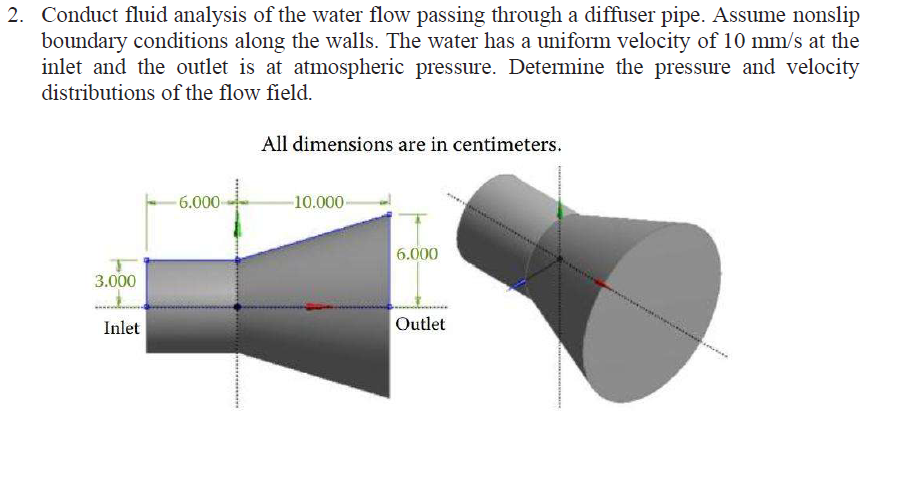 2. Conduct fluid analysis of the water flow passing through a diffuser pipe. Assume nonslip
boundary conditions along the walls. The water has a uniform velocity of 10 mnv/s at the
inlet and the outlet is at atmospheric pressure. Determine the pressure and velocity
distributions of the flow field.
All dimensions are in centimeters.
6.0004 10.000! hy i
B he
3.000 Ii
wil -
Inlet Outlet
This is AI generated Response.
Asked by: Rahul
Created at: 2026-01-13 14:42:24
Asked by: Rahul
Created at: 2026-01-13 14:42:24
Final Answer:
Rendered
Raw Text
Did you like this answer?
Let's solve the problem step by step:
---
## **Step 1: Understanding the Problem**
- **Fluid:** Water (assume incompressible and steady flow)
- **Pipe Geometry:** Diffuser (inlet diameter = 3 cm, outlet diameter = 6 cm, length = 10 cm)
- **Boundary Conditions:**
- **Inlet:** Uniform velocity \( V_1 = 10 \) mm/s \( = .01 \) m/s
- **Outlet:** Atmospheric pressure (\( P_2 = P_{atm} \))
- **Walls:** No-slip boundary (velocity at wall = )
---
## **Step 2: Calculate Cross-sectional Areas**
\[
A = \pi r^2
\]
- **Inlet:**
- \( d_1 = 3 \) cm \( = .03 \) m → \( r_1 = .015 \) m
- \( A_1 = \pi \times (.015)^2 = 7.07 \times 10^{-4} \) m²
- **Outlet:**
- \( d_2 = 6 \) cm \( = .06 \) m → \( r_2 = .03 \) m
- \( A_2 = \pi \times (.03)^2 = 2.827 \times 10^{-3} \) m²
---
## **Step 3: Apply Continuity Equation (Incompressible Flow)**
\[
Q = V_1 A_1 = V_2 A_2
\]
Given \( V_1 = .01 \) m/s,
\[
Q = .01 \times 7.07 \times 10^{-4} = 7.07 \times 10^{-6} \ \mathrm{m}^3/\mathrm{s}
\]
\[
V_2 = \frac{Q}{A_2} = \frac{7.07 \times 10^{-6}}{2.827 \times 10^{-3}} = 2.5 \times 10^{-3} \ \mathrm{m/s} = 2.5 \ \mathrm{mm/s}
\]
---
## **Step 4: Apply Bernoulli’s Equation (Neglecting Elevation Change and Viscous Losses)**
\[
P_1 + \frac{1}{2} \rho V_1^2 = P_2 + \frac{1}{2} \rho V_2^2
\]
Given:
- \( P_2 = P_{atm} \)
- \( V_1 = .01 \) m/s
- \( V_2 = .0025 \) m/s
- \( \rho \) (water) \( = 100 \) kg/m³
Solve for \( P_1 \):
\[
P_1 = P_{atm} + \frac{1}{2} \rho (V_2^2 - V_1^2)
\]
\[
P_1 = P_{atm} + \frac{1}{2} \times 100 \times [(.0025)^2 - (.01)^2]
\]
\[
P_1 = P_{atm} + 500 \times (6.25 \times 10^{-6} - 1 \times 10^{-4})
\]
\[
P_1 = P_{atm} + 500 \times (-9.375 \times 10^{-5}) = P_{atm} - .0469 \ \text{Pa}
\]
---
## **Step 5: Pressure and Velocity Distributions**
### **Velocity Distribution**
- **Inlet (centerline):** \( 10 \) mm/s
- **Outlet (centerline):** \( 2.5 \) mm/s
- **At walls:** Zero (no-slip)
- **Between inlet and outlet:** Decreases gradually from 10 mm/s to 2.5 mm/s along the centerline.
### **Pressure Distribution**
- **Inlet:** \( P_{atm} - .0469 \) Pa
- **Outlet:** \( P_{atm} \)
- **Pressure increases linearly along the length of the diffuser (for inviscid, incompressible flow).**
---
## **Step 6: Final Answers & Summary Table**
| Location | Velocity (mm/s) | Pressure (relative to \(P_{atm}\)) (Pa) |
|----------|-----------------|-----------------------------------------|
| Inlet | 10 | -.0469 |
| Outlet | 2.5 | |
---
## **Summary**
- **Velocity decreases** from 10 mm/s to 2.5 mm/s along the pipe centerline.
- **Pressure increases** from \( P_{atm} - .0469 \) Pa at the inlet to atmospheric at the outlet.
- **At the walls, velocity is zero** (no-slip condition).
---
### **Assumptions**
- Steady, incompressible, laminar flow.
- Neglect viscous losses (ideal scenario).
- No elevation change.
If you need a more detailed velocity profile (e.g., considering boundary layer effects), let me know!
Question:
Then solved
This is AI generated Response.
Asked by: Rahul
Created at: 2026-01-13 14:43:45
Asked by: Rahul
Created at: 2026-01-13 14:43:45
Final Answer:
Rendered
Raw Text
Did you like this answer?
# Fluid Analysis of Water Flow through a Diffuser Pipe
## Step 1: Understanding the Problem
- **Fluid**: Water (assumed incompressible and steady flow)
- **Pipe Geometry**: Diffuser
- Inlet diameter = 3 cm
- Outlet diameter = 6 cm
- Length = 10 cm
- **Boundary Conditions**:
- **Inlet**: Uniform velocity \( V_1 = 10 \) mm/s \( = 0.01 \) m/s
- **Outlet**: Atmospheric pressure (\( P_2 = P_{atm} \))
- **Walls**: No-slip boundary condition
## Step 2: Calculate Cross-sectional Areas
Using the formula for the area of a circle:
\[
A = \pi r^2
\]
- **Inlet**:
- Diameter \( d_1 = 3 \) cm \( = 0.03 \) m → Radius \( r_1 = 0.015 \) m
- Area \( A_1 = \pi \times (0.015)^2 = 7.07 \times 10^{-4} \) m²
- **Outlet**:
- Diameter \( d_2 = 6 \) cm \( = 0.06 \) m → Radius \( r_2 = 0.03 \) m
- Area \( A_2 = \pi \times (0.03)^2 = 2.827 \times 10^{-3} \) m²
## Step 3: Apply Continuity Equation (Incompressible Flow)
The continuity equation states that:
\[
Q = V_1 A_1 = V_2 A_2
\]
Calculating the flow rate at the inlet:
\[
Q = 0.01 \times 7.07 \times 10^{-4} = 7.07 \times 10^{-6} \ \mathrm{m}^3/\mathrm{s}
\]
Solving for \( V_2 \):
\[
V_2 = \frac{Q}{A_2} = \frac{7.07 \times 10^{-6}}{2.827 \times 10^{-3}} = 2.5 \times 10^{-3} \ \mathrm{m/s} = 2.5 \ \mathrm{mm/s}
\]
## Step 4: Apply Bernoulli’s Equation
Using Bernoulli's equation:
\[
P_1 + \frac{1}{2} \rho V_1^2 = P_2 + \frac{1}{2} \rho V_2^2
\]
Given that \( P_2 = P_{atm} \) and substituting values:
\[
P_1 = P_{atm} + \frac{1}{2} \rho (V_2^2 - V_1^2)
\]
Substituting \( \rho = 1000 \) kg/m³ (density of water):
\[
P_1 = P_{atm} + \frac{1}{2} \times 1000 \times \left[(2.5 \times 10^{-3})^2 - (0.01)^2\right]
\]
Calculating:
\[
P_1 = P_{atm} + 500 \times \left(6.25 \times 10^{-6} - 1 \times 10^{-4}\right)
\]
\[
P_1 = P_{atm} + 500 \times (-9.375 \times 10^{-5}) = P_{atm} - 0.0469 \ \text{Pa}
\]
## Step 5: Pressure and Velocity Distributions
### Velocity Distribution
- **At Inlet (centerline)**: \( 10 \) mm/s
- **At Outlet (centerline)**: \( 2.5 \) mm/s
- **At Walls**: Zero (no-slip)
- **Between Inlet and Outlet**: Gradual decrease from 10 mm/s to 2.5 mm/s along the centerline.
### Pressure Distribution
- **At Inlet**: \( P_{atm} - 0.0469 \) Pa
- **At Outlet**: \( P_{atm} \)
- **Pressure** increases linearly along the length of the diffuser.
## Step 6: Final Answers & Summary Table
| Location | Velocity (mm/s) | Pressure (relative to \(P_{atm}\)) (Pa) |
|----------|-----------------|-----------------------------------------|
| Inlet | 10 | -0.0469 |
| Outlet | 2.5 | |
## Summary
- **Velocity** decreases from 10 mm/s to 2.5 mm/s along the pipe centerline.
- **Pressure** increases from \( P_{atm} - 0.0469 \) Pa at the inlet to atmospheric at the outlet.
- **At the walls**, the velocity is zero due to the no-slip condition.
### Assumptions
- Steady, incompressible, laminar flow.
- Neglect viscous losses (ideal scenario).
- No elevation change.
If further details or specific analyses are needed, please let me know!
Question:
Then solved
This is AI generated Response.
Asked by: Rahul
Created at: 2026-01-13 14:44:52
Asked by: Rahul
Created at: 2026-01-13 14:44:52
Final Answer:
Rendered
Raw Text
Did you like this answer?
# Fluid Analysis of Water Flow through a Diffuser Pipe
## Step 1: Understanding the Problem
- **Fluid**: Water (assumed incompressible and steady flow)
- **Pipe Geometry**: Diffuser
- Inlet diameter = 3 cm
- Outlet diameter = 6 cm
- Length = 10 cm
- **Boundary Conditions**:
- **Inlet**: Uniform velocity \( V_1 = 10 \) mm/s \( = 0.01 \) m/s
- **Outlet**: Atmospheric pressure (\( P_2 = P_{atm} \))
- **Walls**: No-slip boundary condition
## Step 2: Calculate Cross-sectional Areas
Using the formula for the area of a circle:
\[
A = \pi r^2
\]
- **Inlet**:
- Diameter \( d_1 = 3 \) cm \( = 0.03 \) m → Radius \( r_1 = 0.015 \) m
- Area \( A_1 = \pi \times (0.015)^2 = 7.07 \times 10^{-4} \) m²
- **Outlet**:
- Diameter \( d_2 = 6 \) cm \( = 0.06 \) m → Radius \( r_2 = 0.03 \) m
- Area \( A_2 = \pi \times (0.03)^2 = 2.827 \times 10^{-3} \) m²
## Step 3: Apply Continuity Equation (Incompressible Flow)
The continuity equation states that:
\[
Q = V_1 A_1 = V_2 A_2
\]
Calculating the flow rate at the inlet:
\[
Q = 0.01 \times 7.07 \times 10^{-4} = 7.07 \times 10^{-6} \ \mathrm{m}^3/\mathrm{s}
\]
Solving for \( V_2 \):
\[
V_2 = \frac{Q}{A_2} = \frac{7.07 \times 10^{-6}}{2.827 \times 10^{-3}} = 2.5 \times 10^{-3} \ \mathrm{m/s} = 2.5 \ \mathrm{mm/s}
\]
## Step 4: Apply Bernoulli’s Equation
Using Bernoulli's equation:
\[
P_1 + \frac{1}{2} \rho V_1^2 = P_2 + \frac{1}{2} \rho V_2^2
\]
Given that \( P_2 = P_{atm} \) and substituting values:
\[
P_1 = P_{atm} + \frac{1}{2} \rho (V_2^2 - V_1^2)
\]
Substituting \( \rho = 1000 \) kg/m³ (density of water):
\[
P_1 = P_{atm} + \frac{1}{2} \times 1000 \times \left[(2.5 \times 10^{-3})^2 - (0.01)^2\right]
\]
Calculating:
\[
P_1 = P_{atm} + 500 \times \left(6.25 \times 10^{-6} - 1 \times 10^{-4}\right)
\]
\[
P_1 = P_{atm} + 500 \times (-9.375 \times 10^{-5}) = P_{atm} - 0.0469 \ \text{Pa}
\]
## Step 5: Pressure and Velocity Distributions
### Velocity Distribution
- **At Inlet (centerline)**: \( 10 \) mm/s
- **At Outlet (centerline)**: \( 2.5 \) mm/s
- **At Walls**: Zero (no-slip)
- **Between Inlet and Outlet**: Gradual decrease from 10 mm/s to 2.5 mm/s along the centerline.
### Pressure Distribution
- **At Inlet**: \( P_{atm} - 0.0469 \) Pa
- **At Outlet**: \( P_{atm} \)
- **Pressure** increases linearly along the length of the diffuser.
## Step 6: Final Answers & Summary Table
| Location | Velocity (mm/s) | Pressure (relative to \(P_{atm}\)) (Pa) |
|----------|-----------------|-----------------------------------------|
| Inlet | 10 | -0.0469 |
| Outlet | 2.5 | |
## Summary
- **Velocity** decreases from 10 mm/s to 2.5 mm/s along the pipe centerline.
- **Pressure** increases from \( P_{atm} - 0.0469 \) Pa at the inlet to atmospheric at the outlet.
- **At the walls**, the velocity is zero due to the no-slip condition.
### Assumptions
- Steady, incompressible, laminar flow.
- Neglect viscous losses (ideal scenario).
- No elevation change.
📢 Instructions:
- Ask anything relatd to above question only.
- For new Question goto :