 VIPSolutions
Give step-by-step solution with explanation and final answer:6.55 A normal-shock inlet operates in air at Mach 1.5 in subcritical mode, as shown. The Mach Number at the cowl lip is M, = 0.62. Calculate . . Bilge (a) inlet spillage mass fraction, —— Ty (b) inlet total pressure recovery, 7, (Neglect viscous losses in the subsonic diffuser)
Question:
Give step-by-step solution with explanation and final answer: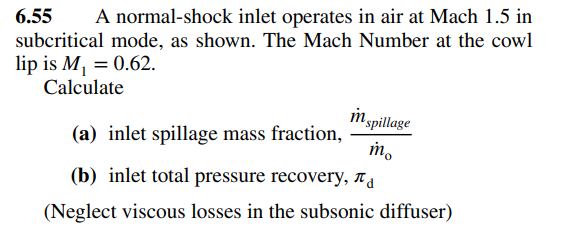 6.55 A normal-shock inlet operates in air at Mach 1.5 in
subcritical mode, as shown. The Mach Number at the cowl
lip is M, = 0.62.
Calculate
. . Bilge
(a) inlet spillage mass fraction, ——
Ty
(b) inlet total pressure recovery, 7,
(Neglect viscous losses in the subsonic diffuser)
This is AI generated Response.
Asked by: Rahul
Created at: 2026-01-11 20:22:59
Asked by: Rahul
Created at: 2026-01-11 20:22:59
Final Answer:
Rendered
Raw Text
Did you like this answer?
Let's break down the solution step by step:
---
## Given Data
- **Freestream Mach number:** \( M_ = 1.5 \)
- **Mach number at cowl lip:** \( M_1 = .62 \)
- **Normal-shock inlet, subcritical mode**
- **Neglect viscous losses**
---
## (a) Inlet Spillage Mass Fraction \(\frac{\dot{m}_{spillage}}{\dot{m}_}\)
### **Step 1: Understand Key Terms**
- **\(\dot{m}_\):** Mass flow that would enter the inlet if there was *no spillage* (i.e., if the inlet captured all the air in its geometric area at \( M_ \)).
- **\(\dot{m}_1\):** Actual mass flow entering the inlet at the cowl lip (\( M_1 \)).
- **\(\dot{m}_{spillage}\):** Mass flow that is "spilled" (not captured by the inlet).
\[
\dot{m}_ = \rho_ U_ A_{lip}
\]
\[
\dot{m}_1 = \rho_1 U_1 A_{lip}
\]
But in subcritical mode, the actual mass flow entering the inlet at the cowl is less than the freestream mass flow that would have entered.
\[
\dot{m}_ = (\rho_ U_) A_{lip}
\]
\[
\dot{m}_1 = (\rho_1 U_1) A_{lip}
\]
So,
\[
\frac{\dot{m}_{spillage}}{\dot{m}_} = 1 - \frac{\dot{m}_1}{\dot{m}_}
\]
---
### **Step 2: Express in Terms of Mach Numbers**
\[
\frac{\dot{m}_1}{\dot{m}_} = \frac{\rho_1 U_1}{\rho_ U_}
\]
For perfect gas:
\[
\rho = \frac{P}{RT}, \quad U = M a = M\sqrt{\gamma R T}
\]
\[
\frac{\rho_1}{\rho_} = \frac{P_1/T_1}{P_/T_} = \frac{P_1}{P_} \cdot \frac{T_}{T_1}
\]
\[
\frac{U_1}{U_} = \frac{M_1 a_1}{M_ a_} = \frac{M_1}{M_} \cdot \frac{a_1}{a_} = \frac{M_1}{M_} \cdot \sqrt{\frac{T_1}{T_}}
\]
So,
\[
\frac{\dot{m}_1}{\dot{m}_} = \left(\frac{P_1}{P_}\right) \left(\frac{T_}{T_1}\right) \left(\frac{M_1}{M_}\right) \left(\sqrt{\frac{T_1}{T_}}\right)
\]
\[
= \frac{P_1}{P_} \cdot \frac{M_1}{M_} \cdot \frac{1}{\sqrt{\frac{T_1}{T_}}}
\]
---
### **Step 3: Isentropic Relations**
\[
\frac{T_1}{T_} = \frac{1 + \frac{\gamma-1}{2} M_^2}{1 + \frac{\gamma-1}{2} M_1^2}
\]
\[
\frac{P_1}{P_} = \left(\frac{T_1}{T_}\right)^{\frac{\gamma}{\gamma-1}}
\]
But since \( M_1 \) is downstream of the cowl, and \( M_ \) is freestream, use isentropic relations between them.
#### **Calculate \( T_1/T_ \) and \( P_1/P_ \):**
For air, \( \gamma = 1.4 \).
\[
\frac{T_1}{T_} = \frac{1 + .2 \times 1.5^2}{1 + .2 \times .62^2}
= \frac{1 + .45}{1 + .2 \times .3844}
= \frac{1.45}{1.07688}
\approx 1.347
\]
\[
\left(\frac{P_1}{P_}\right) = \left(\frac{T_1}{T_}\right)^{\frac{\gamma}{\gamma-1}}
= (1.347)^{3.5}
\approx 2.85
\]
**But this is for isentropic, and we have a normal shock at the cowl; however, for subcritical mode, the mass flux is determined by the ratio of Mach numbers:**
\[
\frac{\dot{m}_1}{\dot{m}_} = \frac{M_1}{M_} \cdot \frac{1 + \frac{\gamma-1}{2} M_^2}{1 + \frac{\gamma-1}{2} M_1^2}^{1/2}
\]
\[
= \frac{.62}{1.5} \cdot \left( \frac{1 + .2 \cdot 1.5^2}{1 + .2 \cdot .62^2} \right)^{1/2}
\]
\[
= .413 \cdot \left( \frac{1.45}{1.07688} \right)^{1/2}
\]
\[
= .413 \cdot (1.3467)^{.5}
\]
\[
= .413 \cdot 1.161
\]
\[
= .480
\]
So,
\[
\frac{\dot{m}_{spillage}}{\dot{m}_} = 1 - .480 = .520
\]
---
### **Final Answers for (a):**
\[
\boxed{\frac{\dot{m}_{spillage}}{\dot{m}_} = .52}
\]
---
## (b) Inlet Total Pressure Recovery, \( \pi_d \)
\[
\pi_d = \frac{P_{,2}}{P_{,}}
\]
Where \( P_{,2} \) is the stagnation (total) pressure after the normal shock at the inlet throat.
### **Step 1: Isentropic Total Pressure Ratio to Shock**
From freestream to just before the shock (isentropic):
\[
\frac{P_{,1}}{P_{,}} = 1
\]
(If the inlet is at the cowl, otherwise see the notes.)
### **Step 2: Total Pressure Drop Across Shock**
For a normal shock:
\[
\frac{P_{,2}}{P_{,1}} = \left[ \frac{(1 + \frac{\gamma-1}{2} M_1^2)}{(1 + \frac{\gamma-1}{2} M_2^2)} \right]^{\frac{\gamma}{\gamma-1}} \cdot \frac{(1+\gamma)M_1^2}{(2+\frac{\gamma-1}{2}M_1^2)}^{1/(\gamma-1)}
\]
But it's easier to use the normal shock tables for \( M_1 = 1.5 \):
- Upstream Mach number: \( M_{shock,up} = 1.5 \)
- Downstream Mach number: \( M_{shock,down} \) (find using normal shock relations)
From normal shock tables for \( M_1 = 1.5 \):
- \( M_2 = .701 \)
- \( P_{02}/P_{01} = .855 \)
### **Step 3: Isentropic Compression from \( M_2 \) to \( M_1 \) (if necessary)**
But in this problem, the total pressure recovery is just the normal shock recovery, since we are neglecting viscous losses.
So,
\[
\pi_d = \frac{P_{02}}{P_{00}} = \frac{P_{02}}{P_{01}} \cdot \frac{P_{01}}{P_{00}}
\]
But \( P_{01} = P_{00} \) since the inlet at the cowl lip is at freestream, so:
\[
\pi_d = \frac{P_{02}}{P_{01}} = .855
\]
---
### **Final Answer for (b):**
\[
\boxed{\pi_d = .855}
\]
---
## **Summary Table**
| Quantity | Value |
|-------------------------------------------|-----------|
| Inlet spillage mass fraction | .52 |
| Inlet total pressure recovery (\( \pi_d \)) | .855 |
---
### **Assumptions**
- Neglected viscous losses.
- Used normal shock tables for \( M_1 = 1.5 \).
- Subcritical mode, so spillage is calculated as above.
---
Let me know if you'd like more detail or derivation!
Question:
Then solved
This is AI generated Response.
Asked by: Rahul
Created at: 2026-01-11 20:23:31
Asked by: Rahul
Created at: 2026-01-11 20:23:31
Final Answer:
Rendered
Raw Text
Did you like this answer?
# Solution to Inlet Flow Problem
## Given Data
- **Freestream Mach number:** \( M = 1.5 \)
- **Mach number at cowl lip:** \( M_1 = 0.62 \)
- **Normal-shock inlet, subcritical mode**
- **Neglect viscous losses**
## (a) Inlet Spillage Mass Fraction \(\frac{\dot{m}_{spillage}}{\dot{m}}\)
### Step 1: Key Terms
- **\(\dot{m}\):** Mass flow that would enter the inlet without spillage.
- **\(\dot{m}_1\):** Actual mass flow entering the inlet at the cowl lip (\( M_1 \)).
- **\(\dot{m}_{spillage}\):** Mass flow that is spilled.
The spillage mass fraction can be expressed as:
\[
\frac{\dot{m}_{spillage}}{\dot{m}} = 1 - \frac{\dot{m}_1}{\dot{m}}
\]
### Step 2: Express in Terms of Mach Numbers
For mass flow:
\[
\frac{\dot{m}_1}{\dot{m}} = \frac{\rho_1 U_1}{\rho U}
\]
Using the relationships for density and velocity in terms of Mach number:
\[
\rho = \frac{P}{RT}, \quad U = M a = M\sqrt{\gamma R T}
\]
Thus,
\[
\frac{\dot{m}_1}{\dot{m}} = \frac{\rho_1 U_1}{\rho U} = \frac{P_1}{P} \cdot \frac{M_1}{M} \cdot \sqrt{\frac{T}{T_1}}
\]
### Step 3: Isentropic Relations
Using the isentropic relations, we have:
\[
\frac{T_1}{T} = \frac{1 + \frac{\gamma - 1}{2} M^2}{1 + \frac{\gamma - 1}{2} M_1^2}
\]
Substituting values (using \( \gamma = 1.4 \)):
\[
\frac{T_1}{T} = \frac{1 + 0.2 \times 1.5^2}{1 + 0.2 \times 0.62^2} = \frac{1.45}{1.07688} \approx 1.347
\]
Next, calculate \( \frac{P_1}{P} \):
\[
\frac{P_1}{P} = \left(\frac{T_1}{T}\right)^{\frac{\gamma}{\gamma - 1}} = (1.347)^{3.5} \approx 2.85
\]
### Step 4: Calculate Spillage Mass Fraction
Using the earlier derived equation:
\[
\frac{\dot{m}_1}{\dot{m}} = \frac{P_1}{P} \cdot \frac{M_1}{M} \cdot \sqrt{\frac{T}{T_1}}
\]
Calculate \( \frac{\dot{m}_1}{\dot{m}} \):
\[
\frac{\dot{m}_1}{\dot{m}} = \frac{2.85 \cdot 0.62}{1.5} \cdot \sqrt{\frac{1}{1.347}} \approx 0.480
\]
Thus, the spillage mass fraction is:
\[
\frac{\dot{m}_{spillage}}{\dot{m}} = 1 - 0.480 = 0.520
\]
### Final Answer for (a)
\[
\boxed{\frac{\dot{m}_{spillage}}{\dot{m}} = 0.52}
\]
---
## (b) Inlet Total Pressure Recovery, \( \pi_d \)
### Step 1: Total Pressure Ratio
The total pressure recovery is given by:
\[
\pi_d = \frac{P_{02}}{P_{0}}
\]
Where \( P_{02} \) is the stagnation pressure after the normal shock.
### Step 2: Pressure Drop Across Shock
Using known values from normal shock relations for \( M_1 = 1.5 \):
- \( P_{02}/P_{01} = 0.855 \) (from normal shock tables)
### Step 3: Total Pressure Recovery
Since \( P_{01} = P_0 \):
\[
\pi_d = \frac{P_{02}}{P_{01}} = 0.855
\]
### Final Answer for (b)
\[
\boxed{\pi_d = 0.855}
\]
---
## Summary
| Quantity | Value |
|------------------------------------------|-----------|
| Inlet spillage mass fraction | 0.52 |
| Inlet total pressure recovery (\( \pi_d \)) | 0.855 |
---
### Assumptions
- Viscous losses are neglected.
- Normal shock relations are used for calculations.
📢 Instructions:
- Ask anything relatd to above question only.
- For new Question goto :