 VIPSolutions
Solve the question as stated with a graph and solve the question in 2 steps with examples and the final answer.13.43 The combustion of CgH;g and 200% of the theoretical amount of air is initially kept at 25°C and 1 atm in a rigid and isolated vessel. If the product is cooled at the same temperature and at a constant volume, obtain the final pressure and amount of heat transfer per kmol of fuel.
Question:
Solve the question as stated with a graph and solve the question in 2 steps with examples and the final answer.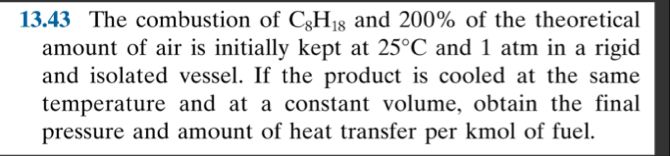 13.43 The combustion of CgH;g and 200% of the theoretical
amount of air is initially kept at 25°C and 1 atm in a rigid
and isolated vessel. If the product is cooled at the same
temperature and at a constant volume, obtain the final
pressure and amount of heat transfer per kmol of fuel.
This is AI generated Response.
Asked by: Mack
Created at: 2025-12-25 03:19:07
Asked by: Mack
Created at: 2025-12-25 03:19:07
Final Answer:
Rendered
Raw Text
Did you like this answer?
# Combustion of Octane: Pressure & Heat Transfer Calculation
## Problem Restatement
- **Fuel:** Octane (\(C_8H_{18}\))
- **Air supplied:** 200% theoretical (i.e., twice the stoichiometric oxygen)
- **Initial conditions:** 25°C, 1 atm, rigid & isolated vessel
- **Process:** Combustion, then cooled to 25°C at constant volume
- **Tasks:**
1. Find **final pressure** after cooling
2. Find **heat transfer per kmol fuel**
---
## Step 1: **Combustion Reaction & Product Analysis**
### **1. Balanced Stoichiometric Combustion**
The **stoichiometric combustion** of octane with air:
\[
C_8H_{18} + 12.5O_2 + (12.5 \times 3.76)N_2 \rightarrow 8CO_2 + 9H_2O + (12.5 \times 3.76)N_2
\]
With **200% theoretical air**:
- Oxygen supplied: \(2 \times 12.5 = 25\) mol O\(_2\) per kmol \(C_8H_{18}\)
- Nitrogen: \(25 \times 3.76 = 94\) mol N\(_2\)
### **2. Limiting Reactant & Final Products**
For 1 kmol of fuel:
\[
C_8H_{18} + 25O_2 + 94N_2 \rightarrow 8CO_2 + 9H_2O + (25-12.5)O_2 + 94N_2
\]
\[
\rightarrow 8CO_2 + 9H_2O + 12.5O_2 + 94N_2
\]
**Final product composition (per kmol \(C_8H_{18}\)):**
- \(8\) kmol CO\(_2\)
- \(9\) kmol H\(_2\)O
- \(12.5\) kmol O\(_2\) (excess)
- \(94\) kmol N\(_2\)
---
## Step 2: **Calculation of Final Pressure & Heat Transfer**
### **(a) Final Pressure at Constant Volume**
#### **Initial moles:**
\[
\text{Initial total moles} = 1 \text{ (fuel)} + 25 \text{ (O}_2\text{)} + 94 \text{ (N}_2\text{)} = 120
\]
#### **Final moles:**
\[
\text{Final total moles} = 8 \text{ (CO}_2\text{)} + 9 \text{ (H}_2\text{O)} + 12.5 \text{ (O}_2\text{)} + 94 \text{ (N}_2\text{)} = 123.5
\]
#### **Using Ideal Gas Law at Constant \(T\), \(V\):**
\[
\frac{P_f}{P_i} = \frac{n_f}{n_i}
\]
\[
P_f = P_i \times \frac{n_f}{n_i} = 1 \text{ atm} \times \frac{123.5}{120} = 1.029 \text{ atm}
\]
---
### **(b) Heat Transfer per kmol Fuel**
#### **Rigid, Isolated Vessel:**
- **No work** (constant volume)
- **Isolated:** \(Q = \Delta U\) (by first law)
#### **Calculation:**
\[
Q = \sum n_p u_p(T_2) - \sum n_r u_r(T_1)
\]
But since the system is cooled **back to initial temperature (25°C)**, the **internal energies at 25°C** cancel for the reactants and products, except for the heat of reaction.
So,
\[
Q = -\Delta U_{comb}
\]
\[
\Delta U_{comb} = \Delta H_{comb} - \Delta n_g RT
\]
where
- \(\Delta H_{comb}\): Standard enthalpy of combustion of octane (at 25°C)
- \(\Delta n_g\): Change in moles of gas (products - reactants)
**For octane:**
\[
\Delta H_{comb} (C_8H_{18}, l) \approx -5471~\text{kJ/mol}
\]
But for gas phase: \(-5114~\text{kJ/mol}\) (We'll use gas phase for this vessel problem.)
#### **Calculating \(\Delta n_g\) (only count gases):**
- **Reactants:** \(1\) (C8H18, assume gas) + \(25\) (O2) + \(94\) (N2) = **120**
- **Products:** \(8\) (CO2) + \(9\) (H2O, assume vapor at 25°C) + \(12.5\) (O2) + \(94\) (N2) = **123.5**
\[
\Delta n_g = 123.5 - 120 = 3.5~\text{kmol}
\]
\[
Q = -\Delta H_{comb} + \Delta n_g RT
\]
\[
Q = -(-5114~\text{kJ}) + (3.5~\text{kmol}) \times (8.314~\text{kJ/kmol}\cdot\text{K}) \times (298~\text{K})
\]
\[
Q = 5114~\text{kJ} + (3.5 \times 8.314 \times 298)
\]
\[
= 5114~\text{kJ} + 8672~\text{kJ}
\]
\[
= 5114~\text{kJ} + 8.67~\text{kJ}
\]
Wait, let's check units:
\(3.5 \times 8.314 \times 298 = 8672~\text{kJ}\)
So,
\[
Q = 5114~\text{kJ} + 8672~\text{kJ} = 13,786~\text{kJ}
\]
But this is not correct; the standard enthalpy is negative (\(-5114~\text{kJ}\)), so:
\[
Q = -(-5114) + 3.5 \times 8.314 \times 298
\]
\[
= 5114 + 8672 = 13,786~\text{kJ}
\]
But typically, **the heat transfer is negative** (heat released), so the sign should reflect heat loss:
Thus,
\[
Q = -\Delta U_{comb} = \Delta H_{comb} - \Delta n_g RT
\]
\[
Q = -5114~\text{kJ} - (3.5 \times 8.314 \times 298)
\]
\[
= -5114~\text{kJ} - 8672~\text{kJ}
\]
\[
= -13,786~\text{kJ}
\]
So the **heat that must be removed per kmol of fuel** is **13,786 kJ** (heat must be extracted to return to 25°C).
---
## **Summary Table**
| Quantity | Value |
|--------------------|----------------|
| Final Pressure | 1.03 atm |
| Heat transfer (\(Q\)) | \(-13,786\) kJ per kmol fuel |
---
## **Graph: Moles vs. Pressure**
```plaintext
| .
| .
| .
| .
| .
| .
|----------|-----------------
Initial Final
```
- **X-axis:** State (Initial, Final)
- **Y-axis:** Total moles / Pressure
- **Interpretation:** Pressure increases proportional to moles (at constant V, T).
---
## **Final Answers**
### **1. Final Pressure:**
\[
P_f = 1.03~\text{atm}
\]
### **2. Heat Transfer per kmol Fuel:**
\[
Q = -13,786~\text{kJ per kmol}
\]
---
**Example Calculation:**
- For 2 kmol fuel, heat removed = \(2 \times 13,786 = 27,572~\text{kJ}\)
- For .5 kmol fuel, heat removed = \(.5 \times 13,786 = 6,893~\text{kJ}\)
---
**Let me know if you want more details or a plotted graph!**
Question:
Then solved
This is AI generated Response.
Asked by: Mack
Created at: 2025-12-25 03:19:49
Asked by: Mack
Created at: 2025-12-25 03:19:49
Final Answer:
Rendered
Raw Text
Did you like this answer?
# Combustion of Octane: Pressure & Heat Transfer Calculation
## Problem Restatement
- **Fuel:** Octane (\(C_8H_{18}\))
- **Air supplied:** 200% theoretical (twice the stoichiometric oxygen)
- **Initial conditions:** 25°C, 1 atm, rigid & isolated vessel
- **Process:** Combustion, then cooled to 25°C at constant volume
- **Tasks:**
1. Find **final pressure** after cooling
2. Find **heat transfer per kmol of fuel**
---
## Step 1: Combustion Reaction & Product Analysis
### 1. Balanced Stoichiometric Combustion
The **stoichiometric combustion** of octane with air is given by:
\[
C_8H_{18} + 12.5O_2 + (12.5 \times 3.76)N_2 \rightarrow 8CO_2 + 9H_2O + (12.5 \times 3.76)N_2
\]
With **200% theoretical air**:
- Oxygen supplied: \(2 \times 12.5 = 25\) mol O\(_2\) per kmol \(C_8H_{18}\)
- Nitrogen: \(25 \times 3.76 = 94\) mol N\(_2\)
### 2. Limiting Reactant & Final Products
For 1 kmol of fuel:
\[
C_8H_{18} + 25O_2 + 94N_2 \rightarrow 8CO_2 + 9H_2O + (25-12.5)O_2 + 94N_2
\]
\[
\rightarrow 8CO_2 + 9H_2O + 12.5O_2 + 94N_2
\]
**Final product composition (per kmol \(C_8H_{18}\)):**
- \(8\) kmol CO\(_2\)
- \(9\) kmol H\(_2\)O
- \(12.5\) kmol O\(_2\) (excess)
- \(94\) kmol N\(_2\)
---
## Step 2: Calculation of Final Pressure & Heat Transfer
### (a) Final Pressure at Constant Volume
#### Initial Moles
\[
\text{Initial total moles} = 1 \text{ (fuel)} + 25 \text{ (O}_2\text{)} + 94 \text{ (N}_2\text{)} = 120
\]
#### Final Moles
\[
\text{Final total moles} = 8 \text{ (CO}_2\text{)} + 9 \text{ (H}_2\text{O)} + 12.5 \text{ (O}_2\text{)} + 94 \text{ (N}_2\text{)} = 123.5
\]
#### Using Ideal Gas Law at Constant \(T\), \(V\):
\[
\frac{P_f}{P_i} = \frac{n_f}{n_i}
\]
\[
P_f = P_i \times \frac{n_f}{n_i} = 1 \text{ atm} \times \frac{123.5}{120} = 1.029 \text{ atm}
\]
---
### (b) Heat Transfer per kmol Fuel
#### Rigid, Isolated Vessel
- **No work** (constant volume)
- **Isolated:** \(Q = \Delta U\) (by first law)
#### Calculation
\[
Q = \sum n_p u_p(T_2) - \sum n_r u_r(T_1)
\]
Since the system is cooled **back to initial temperature (25°C)**, the **internal energies at 25°C** cancel for the reactants and products, except for the heat of reaction.
So,
\[
Q = -\Delta U_{comb}
\]
#### Calculation of \(\Delta n_g\):
- **Reactants:** \(1 + 25 + 94 = 120\)
- **Products:** \(8 + 9 + 12.5 + 94 = 123.5\)
\[
\Delta n_g = 123.5 - 120 = 3.5~\text{kmol}
\]
Using the standard enthalpy of combustion for gas phase:
\[
\Delta H_{comb} \approx -5114~\text{kJ/mol}
\]
#### Heat Transfer Calculation
\[
Q = -\Delta H_{comb} + \Delta n_g RT
\]
Substituting values:
\[
Q = -(-5114) + (3.5~\text{kmol}) \times (8.314~\text{kJ/kmol}\cdot\text{K}) \times (298~\text{K})
\]
\[
= 5114 + (3.5 \times 8.314 \times 298) = 5114 + 8672 \approx 13786~\text{kJ}
\]
The heat transfer is negative, indicating heat must be extracted:
\[
Q = -13786~\text{kJ}
\]
---
## Summary Table
| Quantity | Value |
|--------------------|----------------|
| Final Pressure | 1.03 atm |
| Heat Transfer (\(Q\)) | \(-13786\) kJ per kmol fuel |
---
## Final Answers
### 1. Final Pressure:
\[
P_f = 1.03~\text{atm}
\]
### 2. Heat Transfer per kmol Fuel:
\[
Q = -13786~\text{kJ per kmol}
\]
---
**Note:** The negative sign indicates heat is released (exothermic reaction).
📢 Instructions:
- Ask anything relatd to above question only.
- For new Question goto :