give answer in 2 step with explanation at the end of each step and final answer at the end:C.2 (40 points) A Public Good Model
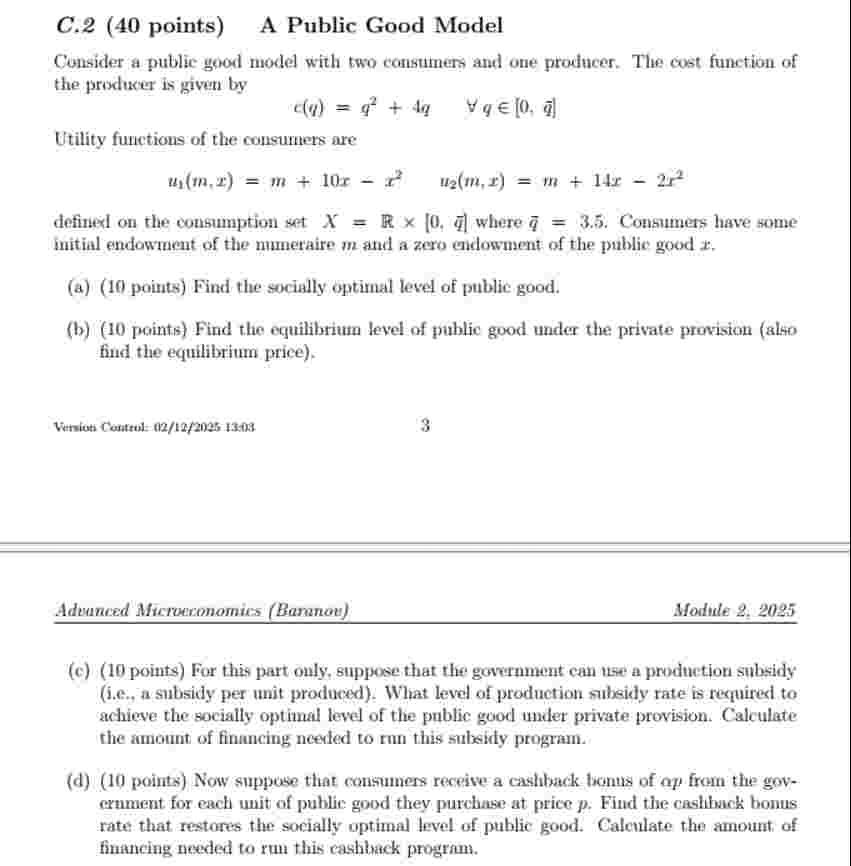
Consider a public good model with two consumers and one producer. The cost function of
the producer is given by
da) =¢ +g Voge.
Utility functions of the consumers are
wimz) =m + 10r = 2 wm) =m + Mr = 27°
defined on the consumption set X = R x [0, §] where § = 3.5. Consumers have some
initial endowment of the numeraire im and a zero endowment of the public good +.
(a) (10 points) Find the socially optimal level of public good.
(b) (10 points) Find the equilibrium level of public good under the private provision (also
find the equilibrium price),
Version Canteol: 02/12/2025 13403 3
Advanced Microeconomics (Baranov) Module 2. 2025
(¢) (10 points) For this part only, suppose that the government can use a production subsidy
(i.e, a subsidy per unit produced). What level of production subsidy rate is required to
achieve the socially optimal level of the public good under private provision. Calculate
the amount of financing needed to ran this subsidy program.
(d) (10 points) Now suppose that consumers receive a cashback tionus of ap from the gov-
ernment for each unit of public good they purchase at price p. Find the cashback bonus
rate that restores the socially optimal level of public good. Caleulate the amount of
financing needed to run this cashback program.
Question:
give answer in 2 step with explanation at the end of each step and final answer at the end:C.2 (40 points) A Public Good Model
Consider a public good model with two consumers and one producer. The cost function of
the producer is given by
da) =¢ +g Voge.
Utility functions of the consumers are
wimz) =m + 10r = 2 wm) =m + Mr = 27°
defined on the consumption set X = R x [0, §] where § = 3.5. Consumers have some
initial endowment of the numeraire im and a zero endowment of the public good +.
(a) (10 points) Find the socially optimal level of public good.
(b) (10 points) Find the equilibrium level of public good under the private provision (also
find the equilibrium price),
Version Canteol: 02/12/2025 13403 3
Advanced Microeconomics (Baranov) Module 2. 2025
(¢) (10 points) For this part only, suppose that the government can use a production subsidy
(i.e, a subsidy per unit produced). What level of production subsidy rate is required to
achieve the socially optimal level of the public good under private provision. Calculate
the amount of financing needed to ran this subsidy program.
(d) (10 points) Now suppose that consumers receive a cashback tionus of ap from the gov-
ernment for each unit of public good they purchase at price p. Find the cashback bonus
rate that restores the socially optimal level of public good. Caleulate the amount of
financing needed to run this cashback program.
This is AI generated Response.
Asked by: Rahul
Created at: 2025-12-12 04:01:42
Final Answer:
RenderedRaw Text
Did you like this answer?
Let's solve part (a) step by step as requested:
---
## (a) Find the socially optimal level of public good
### **Step 1: Write the Social Planner's Problem**
The social planner maximizes the sum of utilities of the two consumers minus the cost of providing the public good:
\[
\max_x \left[ u_1(m, x) + u_2(m, x) - c(x) \right]
\]
Given utility functions:
- \( u_1(m, x) = m + 10x - x^2 \)
- \( u_2(m, x) = m + 14x - 2x^2 \)
And cost function:
- \( c(x) = x^2 + 4x \)
Sum up the utilities and subtract the cost (ignore \(m\), as it doesn't affect optimal \(x\)):
\[
\text{Objective} = (10x - x^2) + (14x - 2x^2) - (x^2 + 4x)
\]
\[
= (10x + 14x - 4x) - (x^2 + 2x^2 + x^2)
\]
\[
= 20x - 4x^2
\]
---
**Explanation:**
We added the utility from both consumers and subtracted the cost. Only terms involving \(x\) matter for the optimal public good level.
---
### **Step 2: Maximize the Objective and Solve for \(x^*\)**
Take the derivative with respect to \(x\) and set it to zero:
\[
\frac{d}{dx}(20x - 4x^2) = 20 - 8x =
\]
\[
8x = 20 \implies x^* = \frac{20}{8} = 2.5
\]
---
**Explanation:**
Setting the derivative to zero gives the maximum of the quadratic objective. \(x^* = 2.5\) is the socially optimal level of the public good.
---
### **Final Answer:**
\[
\boxed{x^* = 2.5}
\]
---
Let me know if you want to proceed to part (b) next!
Question:
Then solved
This is AI generated Response.
Asked by: Rahul
Created at: 2025-12-12 04:02:17
Final Answer:
RenderedRaw Text
Did you like this answer?
## (b) Find the equilibrium level of public good under private provision
### **Step 1: Set Up the Demand for Public Good**
To find the equilibrium level of public good under private provision, we need to determine how much of the public good each consumer is willing to pay. The marginal willingness to pay (MWTP) for the public good can be derived from the utility functions.
From the utility functions:
- For consumer 1: \( \text{MWTP}_1 = \frac{d}{dx}u_1(m, x) = 10 - 2x \)
- For consumer 2: \( \text{MWTP}_2 = \frac{d}{dx}u_2(m, x) = 14 - 4x \)
The total MWTP is the sum of both consumers' MWTPs:
\[
\text{Total MWTP} = (10 - 2x) + (14 - 4x) = 24 - 6x
\]
---
**Explanation:**
We derived the MWTP for each consumer by differentiating their respective utility functions with respect to the public good \(x\).
---
### **Step 2: Set Total MWTP Equal to the Marginal Cost**
The marginal cost (MC) of providing one more unit of the public good is given by the derivative of the cost function:
\[
MC = \frac{d}{dx}c(x) = 2x + 4
\]
Set total MWTP equal to MC for equilibrium:
\[
24 - 6x = 2x + 4
\]
Solving for \(x\):
\[
24 - 4 = 8x \implies 20 = 8x \implies x^* = \frac{20}{8} = 2.5
\]
The equilibrium price \(p\) is the marginal cost at this quantity:
\[
p = 2(2.5) + 4 = 5 + 4 = 9
\]
---
**Explanation:**
We found the equilibrium level of the public good by equating total MWTP with marginal cost. The equilibrium price corresponds to the marginal cost at that quantity.
---
### **Final Answer:**
\[
\text{Equilibrium Level of Public Good: } \boxed{x^* = 2.5}
\]
\[
\text{Equilibrium Price: } \boxed{p = 9}
\]
---
Let me know if you want to proceed to part (c) next!
VIPSolutions focuses on clear, step‑by‑step explanations so you can learn quickly. Whether you need an AI‑generated walkthrough or a short hint to get unstuck, each solution is organized for fast reading and easy review later.
Search similar questions, compare approaches, and bookmark the best answers for revision. Our goal is simple: quick, reliable study help that feels natural—not noisy.
 VIPSolutions
 C.2 (40 points) A Public Good Model
Consider a public good model with two consumers and one producer. The cost function of
the producer is given by
da) =¢ +g Voge.
Utility functions of the consumers are
wimz) =m + 10r = 2 wm) =m + Mr = 27°
defined on the consumption set X = R x [0, §] where § = 3.5. Consumers have some
initial endowment of the numeraire im and a zero endowment of the public good +.
(a) (10 points) Find the socially optimal level of public good.
(b) (10 points) Find the equilibrium level of public good under the private provision (also
find the equilibrium price),
Version Canteol: 02/12/2025 13403 3
Advanced Microeconomics (Baranov) Module 2. 2025
(¢) (10 points) For this part only, suppose that the government can use a production subsidy
(i.e, a subsidy per unit produced). What level of production subsidy rate is required to
achieve the socially optimal level of the public good under private provision. Calculate
the amount of financing needed to ran this subsidy program.
(d) (10 points) Now suppose that consumers receive a cashback tionus of ap from the gov-
ernment for each unit of public good they purchase at price p. Find the cashback bonus
rate that restores the socially optimal level of public good. Caleulate the amount of
financing needed to run this cashback program.