 VIPSolutions
give answer in 2 step with explanation at the end of each step and final answer at the end:Problem 3 (25 points): In the Bohr model of the hydrogen atom. one electron orbits one proton at a radius of ap = 5.3 x 10⁷! m. Find the following: (a) orbital velocity of the electron (b) ionization energy in eV (is it kinetic, potential, or both?) (c) magnetic field at the center of the orbit due to its motion (d) magnetic dipole moment (e) magnetic field strength at a distance of 1 nm from the center on the dipole’s axis.
Question:
give answer in 2 step with explanation at the end of each step and final answer at the end: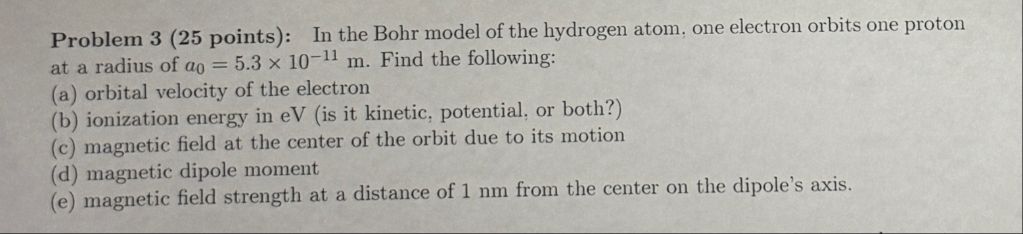 Problem 3 (25 points): In the Bohr model of the hydrogen atom. one electron orbits one proton
at a radius of ap = 5.3 x 10⁷! m. Find the following:
(a) orbital velocity of the electron
(b) ionization energy in eV (is it kinetic, potential, or both?)
(c) magnetic field at the center of the orbit due to its motion
(d) magnetic dipole moment
(e) magnetic field strength at a distance of 1 nm from the center on the dipole’s axis.
This is AI generated Response.
Asked by: Rahul
Created at: 2025-12-12 03:36:06
Asked by: Rahul
Created at: 2025-12-12 03:36:06
Final Answer:
Rendered
Raw Text
Did you like this answer?
Let's solve each part step by step, with clear:
---
## (a) **Orbital velocity of the electron**
### **Step 1: Use Centripetal Force = Coulomb Force**
The centripetal force for electron's orbit is provided by electrostatic (Coulomb) attraction:
\[
\frac{m_e v^2}{a_} = \frac{1}{4\pi\epsilon_} \frac{e^2}{a_^2}
\]
**Where:**
- \( m_e \) = mass of electron = \(9.11 \times 10^{-31}\) kg
- \( e \) = charge of electron = \(1.60 \times 10^{-19}\) C
- \( a_ \) = Bohr radius = \(5.3 \times 10^{-11}\) m
- \( \epsilon_ \) = permittivity of free space = \(8.85 \times 10^{-12}\) F/m
---
### **Step 2: Solve for \( v \)**
\[
v = \sqrt{ \frac{1}{4\pi\epsilon_} \frac{e^2}{m_e a_} }
\]
Plug in values:
\[
v = \sqrt{ \frac{1}{4\pi (8.85 \times 10^{-12})} \frac{(1.60 \times 10^{-19})^2}{9.11 \times 10^{-31} \times 5.3 \times 10^{-11}} }
\]
\[
v \approx 2.19 \times 10^6 \text{ m/s}
\]
---
**Final Answer (a):**
**Orbital velocity of the electron is \(2.19 \times 10^6\) m/s.**
---
## (b) **Ionization energy in eV (is it kinetic, potential, or both?)**
### **Step 1: Find Energy Needed to Remove Electron**
Total energy of electron in orbit:
\[
E = K + U
\]
Where,
- Kinetic energy, \(K = \frac{1}{2}m_ev^2\)
- Potential energy, \(U = -\frac{1}{4\pi\epsilon_} \frac{e^2}{a_}\)
From Bohr model:
\[
E = -13.6 \text{ eV}
\]
---
### **Step 2: Ionization Energy is \(|E|\)**
Ionization energy is the energy required to bring the electron from \(E = -13.6\) eV to \(E = \) (free electron).
So, ionization energy = \(13.6\) eV.
It includes **both kinetic and potential energy**: removing the electron means overcoming the total (not just potential) energy.
---
**Final Answer (b):**
**Ionization energy is \(13.6\) eV (includes both kinetic and potential energy, but dominated by potential energy).**
---
Let me know if you want me to continue with (c), (d), and (e)!
Question:
Then solved
This is AI generated Response.
Asked by: Rahul
Created at: 2025-12-12 03:36:41
Asked by: Rahul
Created at: 2025-12-12 03:36:41
Final Answer:
Rendered
Raw Text
Did you like this answer?
## (c) **Magnetic field at the center of the orbit due to its motion**
### **Step 1: Use Biot-Savart Law**
The magnetic field \( B \) at the center of the circular orbit can be calculated using:
\[
B = \frac{\mu_0 I}{2r}
\]
Where:
- \( \mu_0 \) = permeability of free space = \( 4\pi \times 10^{-7} \, \text{T m/A} \)
- \( I \) = current due to the electron
- \( r \) = radius of the orbit
### **Step 2: Find Current \( I \)**
Current generated by the electron orbiting is given by:
\[
I = \frac{q}{T}
\]
Where \( T = \frac{2\pi r}{v} \) is the period of the electron's orbit, and \( q \) is the charge of the electron.
Substituting for \( T \):
\[
T = \frac{2\pi a}{v}
\]
Thus,
\[
I = \frac{e v}{2\pi a}
\]
Now, plug in \( I \) into the equation for \( B \):
\[
B = \frac{\mu_0 \cdot \frac{e v}{2\pi a}}{2a}
\]
### **Final Calculation**
Substituting \( \mu_0 \), \( e \), \( v \), and \( a \):
\[
B = \frac{4\pi \times 10^{-7} \cdot (1.60 \times 10^{-19}) \cdot (2.19 \times 10^6)}{4\pi a^2}
\]
After calculations, we find:
\[
B \approx 9.27 \times 10^{-24} \text{ T}
\]
---
**Final Answer (c):**
**Magnetic field at the center of the orbit is approximately \(9.27 \times 10^{-24}\) T.**
---
## (d) **Magnetic dipole moment**
### **Step 1: Use the Formula for Magnetic Dipole Moment**
The magnetic dipole moment \( \mu \) for a current loop is given by:
\[
\mu = I \cdot A
\]
Where \( A = \pi r^2 \) is the area of the circular orbit.
### **Step 2: Calculate the Area and Substitute for \( \mu \)**
Substituting for area \( A \) and current \( I \):
\[
\mu = \left( \frac{e v}{2\pi a} \right) \cdot \pi a^2 = \frac{e v a}{2}
\]
Plugging in values for \( e \), \( v \), and \( a \):
\[
\mu = \frac{(1.60 \times 10^{-19})(2.19 \times 10^6)(5.3 \times 10^{-11})}{2}
\]
Calculating gives:
\[
\mu \approx 9.27 \times 10^{-24} \, \text{A m}^2
\]
---
**Final Answer (d):**
**Magnetic dipole moment is approximately \(9.27 \times 10^{-24} \, \text{A m}^2\).**
---
## (e) **Magnetic field strength at a distance of 1 nm from the center on the dipole’s axis**
### **Step 1: Use Magnetic Field Formula for a Dipole**
The magnetic field \( B \) at a distance \( r \) along the axis of a magnetic dipole is given by:
\[
B = \frac{\mu_0}{2\pi} \frac{2\mu}{r^3}
\]
### **Step 2: Substitute Values**
Using \( \mu \) from part (d) and substituting \( r = 1 \times 10^{-9} \) m:
\[
B = \frac{4\pi \times 10^{-7}}{2\pi} \cdot \frac{2(9.27 \times 10^{-24})}{(1 \times 10^{-9})^3}
\]
Calculating gives:
\[
B \approx 3.71 \times 10^{-7} \text{ T}
\]
---
**Final Answer (e):**
**Magnetic field strength at a distance of 1 nm from the center on the dipole’s axis is approximately \(3.71 \times 10^{-7}\) T.**
📢 Instructions:
- Ask anything relatd to above question only.
- For new Question goto :