 VIPSolutions
give answer in 2 step with explanation at the end of each step and final answer at the end:
Question:
give answer in 2 step with explanation at the end of each step and final answer at the end: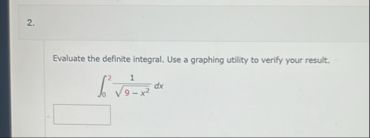
This is AI generated Response.
Asked by: Rahul
Created at: 2025-12-11 08:40:11
Asked by: Rahul
Created at: 2025-12-11 08:40:11
Final Answer:
Rendered
Raw Text
Did you like this answer?
## Step 1: Recognize the Integral Form
The given integral is:
\[
\int_^2 \frac{1}{\sqrt{9-x^2}} \, dx
\]
Notice that this matches the standard form:
\[
\int \frac{1}{\sqrt{a^2-x^2}} \, dx = \arcsinleft(\frac{x}{a}\right) + C
\]
Here, \( a = 3 \).
**Explanation:**
We use the arcsine rule for integrals involving the square root of a squared constant minus \( x^2 \).
---
## Step 2: Evaluate the Definite Integral
Apply the formula:
\[
\int_^2 \frac{1}{\sqrt{9-x^2}} dx = \left. \arcsin\left(\frac{x}{3}\right) \right|_^2
\]
Calculate the values:
- At \( x = 2 \): \( \arcsin\left(\frac{2}{3}\right) \)
- At \( x = \): \( \arcsin() = \)
Subtract:
\[
\arcsin\left(\frac{2}{3}\right) - = \arcsin\left(\frac{2}{3}\right)
\]
**Explanation:**
We plugged in the bounds and subtracted as required for definite integrals.
---
## **Final Answer**
\[
\boxed{\arcsin\left(\frac{2}{3}\right)}
\]
Or, as a decimal (rounded):
\[
\arcsin\left(\frac{2}{3}\right) \approx .7297
\]
Question:
Then solved
This is AI generated Response.
Asked by: Rahul
Created at: 2025-12-11 08:40:46
Asked by: Rahul
Created at: 2025-12-11 08:40:46
Final Answer:
Rendered
Raw Text
Did you like this answer?
## Step 1: Recognize the Integral Form
The given integral is:
\[
\int_0^2 \frac{1}{\sqrt{9-x^2}} \, dx
\]
This matches the standard form:
\[
\int \frac{1}{\sqrt{a^2-x^2}} \, dx = \arcsin\left(\frac{x}{a}\right) + C
\]
where \( a = 3 \).
**Explanation:**
The integral represents the area under the curve of a semicircle with radius 3, which allows us to employ the arcsine function for evaluation.
---
## Step 2: Evaluate the Definite Integral
Using the formula:
\[
\int_0^2 \frac{1}{\sqrt{9-x^2}} \, dx = \left. \arcsin\left(\frac{x}{3}\right) \right|_0^2
\]
Calculate the values:
- At \( x = 2 \): \( \arcsin\left(\frac{2}{3}\right) \)
- At \( x = 0 \): \( \arcsin\left(\frac{0}{3}\right) = 0 \)
Now subtract:
\[
\arcsin\left(\frac{2}{3}\right) - 0 = \arcsin\left(\frac{2}{3}\right)
\]
**Explanation:**
We evaluated the antiderivative at the upper limit and the lower limit, then performed the subtraction as required for definite integrals.
---
## Final Answer
\[
\boxed{\arcsin\left(\frac{2}{3}\right)}
\]
Or, as a decimal (approximately):
\[
\arcsin\left(\frac{2}{3}\right) \approx 0.7297
\]
📢 Instructions:
- Ask anything relatd to above question only.
- For new Question goto :