 VIPSolutions
give answer in 2 step with explanation at the end of each step and final answer at the end:1) Given the equation h(t) = — 3sin (Fle - 3]) + 4, where h is height measured in metres and ¢ is time measured in seconds, a) Sketch a well labelled graph for at least 2 cycles. [4 marks] b) Determine(algebraically) the time(s) in the first 20 seconds that have a height of 3m. [5 marks]
Question:
give answer in 2 step with explanation at the end of each step and final answer at the end: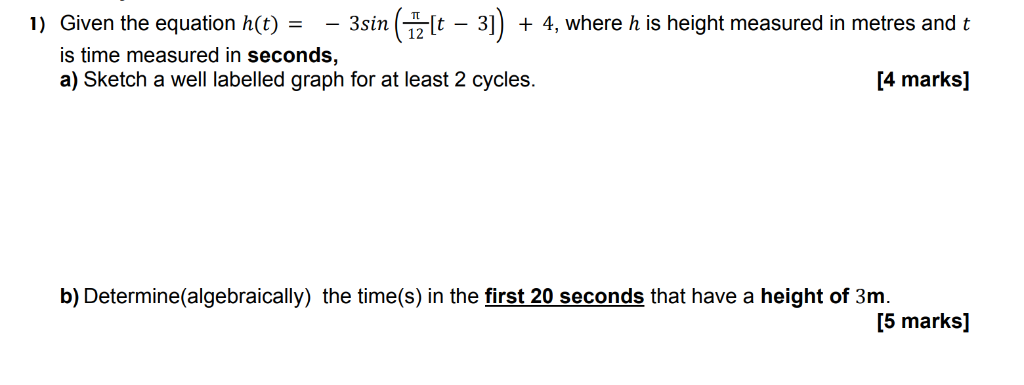 1) Given the equation h(t) = — 3sin (Fle - 3]) + 4, where h is height measured in metres and ¢
is time measured in seconds,
a) Sketch a well labelled graph for at least 2 cycles. [4 marks]
b) Determine(algebraically) the time(s) in the first 20 seconds that have a height of 3m.
[5 marks]
This is AI generated Response.
Asked by: Pagal
Created at: 2025-07-17 06:02:42
Asked by: Pagal
Created at: 2025-07-17 06:02:42
Final Answer:
Rendered
Raw Text
Did you like this answer?
Let's solve part **b)** step by step:
---
### **Step 1: Set Up the Equation**
Given:
\[
h(t) = -3\sin\left(\frac{\pi}{12}(t-3)\right) + 4
\]
We want \( h(t) = 3 \) in the first 20 seconds.
Set \( h(t) = 3 \):
\[
3 = -3\sin\left(\frac{\pi}{12}(t-3)\right) + 4
\]
Subtract 4 from both sides:
\[
3 - 4 = -3\sin\left(\frac{\pi}{12}(t-3)\right)
\]
\[
-1 = -3\sin\left(\frac{\pi}{12}(t-3)\right)
\]
Divide both sides by -3:
\[
\frac{-1}{-3} = \sin\left(\frac{\pi}{12}(t-3)\right)
\]
\[
\frac{1}{3} = \sin\left(\frac{\pi}{12}(t-3)\right)
\]
**Explanation:**
We isolated the sine function to solve for \( t \).
---
### **Step 2: Solve for \( t \) in the First 20 Seconds**
Take the inverse sine:
\[
\frac{\pi}{12}(t-3) = \arcsin\left(\frac{1}{3}\right)
\]
Or, since sine is periodic:
\[
\frac{\pi}{12}(t-3) = \arcsin\left(\frac{1}{3}\right) \quad \text{or} \quad \pi - \arcsin\left(\frac{1}{3}\right)
\]
Let \( \theta = \arcsin\left(\frac{1}{3}\right) \).
So:
\[
t-3 = \frac{12}{\pi} \arcsin\left(\frac{1}{3}\right)
\]
\[
t = 3 + \frac{12}{\pi} \arcsin\left(\frac{1}{3}\right)
\]
And for the other solution:
\[
t-3 = \frac{12}{\pi} \left[\pi - \arcsin\left(\frac{1}{3}\right)\right]
\]
\[
t = 3 + \frac{12}{\pi} \left[\pi - \arcsin\left(\frac{1}{3}\right)\right]
\]
Since sine is periodic with period \( 2\pi \), add multiples of the period:
\[
\text{Period} = \frac{2\pi}{\frac{\pi}{12}} = 24
\]
So, general solutions:
\[
t_1 = 3 + \frac{12}{\pi} \arcsin\left(\frac{1}{3}\right) + 24n
\]
\[
t_2 = 3 + \frac{12}{\pi} \left[\pi - \arcsin\left(\frac{1}{3}\right)\right] + 24n
\]
for integer \( n \).
Now, we want \( 0 \leq t \leq 20 \):
Calculate \( \arcsin\left(\frac{1}{3}\right) \approx 0.3398 \) radians.
So:
\[
t_1 = 3 + \frac{12}{\pi}(0.3398) \approx 3 + 1.297 \approx 4.30
\]
\[
t_2 = 3 + \frac{12}{\pi}(\pi - 0.3398) = 3 + \frac{12}{\pi}(2.8018) \approx 3 + 10.708 \approx 13.71
\]
For \( n = 0 \), \( t_1 \approx 4.30 \), \( t_2 \approx 13.71 \).
For \( n = 1 \), \( t_1 \approx 4.30 + 24 = 28.30 \) (out of range), \( t_2 \approx 13.71 + 24 = 37.71 \) (out of range).
So, the times in the first 20 seconds are:
\[
\boxed{t \approx 4.30\, \text{seconds and}\; 13.71\, \text{seconds}}
\]
---
## **Final Answer**
**The time(s) in the first 20 seconds that have a height of 3 m are:**
\[
\boxed{t \approx 4.3\, \text{seconds and}\; 13.7\, \text{seconds}}
\]
Question:
The question solved a,b.
This is AI generated Response.
Asked by: Pagal
Created at: 2025-07-17 06:03:54
Asked by: Pagal
Created at: 2025-07-17 06:03:54
Final Answer:
Rendered
Raw Text
Did you like this answer?
Let's proceed step by step to answer the question thoroughly.
---
### Part (a): Sketch a well-labelled graph for at least 2 cycles
**Step 1: Understand the given function**
Given:
\[
h(t) = -3 \sin\left(\frac{\pi}{12}(t - 3)\right) + 4
\]
- Amplitude: \( |\text{-}3| = 3 \)
- Vertical shift: \( +4 \)
- Inside sine (phase): \( \frac{\pi}{12}(t - 3) \)
**Explanation:**
The amplitude tells us the height variation from the midline. The midline is at \( h = 4 \). The period \( T \) of the sine wave is found by:
\[
T = \frac{2\pi}{\text{coefficient of } t} = \frac{2\pi}{\pi/12} = 2\pi \times \frac{12}{\pi} = 24 \text{ seconds}
\]
**Step 2: Sketch the graph**
- The wave has a period of 24 seconds; so two cycles will cover 48 seconds.
- At \( t = 3 \), the sine argument is zero, so:
\[
h(3) = -3 \sin(0) + 4 = 4
\]
- Key points:
- Maximum at \( t \) where \( \sin \) is \(-1\):
\[
\sin\left(\frac{\pi}{12}(t - 3)\right) = -1
\]
which occurs at:
\[
\frac{\pi}{12}(t - 3) = \frac{3\pi}{2} \implies t - 3 = \frac{3\pi/2 \times 12}{\pi} = 18
\]
\[
t = 3 + 18 = 21
\]
At this point:
\[
h(21) = -3 \times (-1) + 4 = 3 + 4 = 7
\]
- Minimum at \( \sin \) is 1:
\[
\frac{\pi}{12}(t - 3) = \frac{\pi}{2} \implies t - 3 = \frac{\pi/2 \times 12}{\pi} = 6
\]
\[
t = 3 + 6 = 9
\]
At this point:
\[
h(9) = -3 \times 1 + 4 = -3 + 4 = 1
\]
- Key points:
- \( (3, 4) \) (midline)
- \( (9, 1) \) (minimum)
- \( (21, 7) \) (maximum)
- Next cycle will start at \( t = 3 + 24 = 27 \), repeating similar points.
**Label these points and sketch the sinusoidal wave over \( t = 0 \) to \( t = 48 \).**
---
### Part (b): Determine the times in the first 20 seconds when height \( h(t) = 3 \)
**Step 1: Set \( h(t) = 3 \) and solve**
\[
3 = -3 \sin\left(\frac{\pi}{12}(t - 3)\right) + 4
\]
Subtract 4:
\[
-1 = -3 \sin\left(\frac{\pi}{12}(t - 3)\right)
\]
Divide both sides by -3:
\[
\frac{1}{3} = \sin\left(\frac{\pi}{12}(t - 3)\right)
\]
**Explanation:**
We isolated the sine term to find \( t \).
---
**Step 2: Solve for \( t \)**
\[
\frac{\pi}{12}(t - 3) = \arcsin\left(\frac{1}{3}\right)
\]
or
\[
\frac{\pi}{12}(t - 3) = \pi - \arcsin\left(\frac{1}{3}\right)
\]
Let:
\[
\theta = \arcsin\left(\frac{1}{3}\right) \approx 0.3398 \text{ radians}
\]
Calculate the solutions:
\[
t - 3 = \frac{12}{\pi} \times \theta \approx \frac{12}{3.1416} \times 0.3398 \approx 3.82 \times 0.3398 \approx 1.297
\]
So:
\[
t = 3 + 1.297 \approx 4.30 \text{ seconds}
\]
Similarly, for the second solution:
\[
t - 3 = \frac{12}{\pi} \times (\pi - \theta) = \frac{12}{\pi} \times (3.1416 - 0.3398) \approx 3.82 \times 2.8018 \approx 10.70
\]
\[
t = 3 + 10.70 \approx 13.70 \text{ seconds}
\]
Since the period is 24 seconds and both solutions are within 20 seconds, these are valid.
---
### **Final answer:**
The times in the first 20 seconds when the height is 3 meters are approximately:
\[
\boxed{
\textbf{t} \approx 4.3 \text{ seconds and } 13.7 \text{ seconds}
}
\]
---
**Summary:**
- **Part (a):** The graph is a sine wave oscillating between 1 m and 7 m, centered at 4 m, with a period of 24 seconds, starting at \( t=3 \).
- **Part (b):** The times when height is 3 m are approximately at 4.3 s and 13.7 s within the first 20 seconds.
📢 Instructions:
- Ask anything relatd to above question only.
- For new Question goto :