 VIPSolutions
The manager of Liquid Sleeve Inc, a company that makes a sealing solution for machine shaft surfaces that have been compromised by abrasion, high pressures, or inadequate lubrication, is considering adding AI or Fe nanoparticles to its solution to increase the product's performance at high temperatures. The costs associated with each are shown below. The company / s MARR is 2 0 % per year: Determine which nanoparticle type the company should select using an incremental rate of return analysis. \ table [ [ , Type Fe , Type AI ] , [ First cost , $ , - 1 4 5 , 0 0 0 , - 3 0 6 , 0 0 0s me lly J i | it
Question:
The manager of Liquid Sleeve Inc, a company that makes a sealing solution for machine shaft surfaces that have been compromised by abrasion, high pressures, or inadequate lubrication, is considering adding AI or Fe nanoparticles to its solution to increase the product's performance at high temperatures. The costs associated with each are shown below. The company
/
s MARR is
2
0
%
per year: Determine which nanoparticle type the company should select using an incremental rate of return analysis.
\
table
[
[
,
Type Fe
,
Type AI
]
,
[
First cost
,
$
,
-
1
4
5
,
0
0
0
,
-
3
0
6
,
0
0
0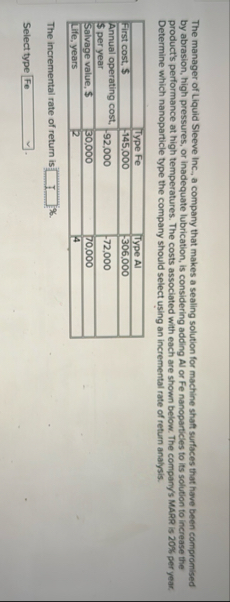 s
me
lly
J
i
| it
This is AI generated Response.
Asked by: Veera manikanta
Created at: 2025-07-30 03:24:28
Asked by: Veera manikanta
Created at: 2025-07-30 03:24:28
Final Answer:
Rendered
Raw Text
Did you like this answer?
Let's solve the problem step by step using **incremental rate of return analysis**:
### **Given Data**
| | Type Fe | Type Al |
|----------------|--------------|--------------|
| First Cost | $145,000 | $306,000 |
| Annual O&M Cost| $52,000 | $27,000 |
| Salvage Value | $20,000 | $70,000 |
| Life (years) | 5 | 10 |
| MARR | 20% | 20% |
---
### **Step 1: Find the Present Worth (PW) of Each Option**
#### **Type Fe:**
- \( \text{First Cost} = -\$145,000 \)
- \( \text{Annual O\&M} = -\$52,000 \) for 5 years
- \( \text{Salvage Value} = +\$20,000 \) at year 5
**PW calculation formula:**
\[
PW = -FC - \text{O\&M} \times (P/A, i, n) + S \times (P/F, i, n)
\]
Where:
- \( (P/A, i, n) \) is the Present Worth factor for an annuity
- \( (P/F, i, n) \) is the Present Worth factor for a future sum
Let's calculate these factors for 20% and 5 years:
- \( (P/A, 20\%, 5) = \frac{1 - (1 + 0.2)^{-5}}{0.2} = \frac{1 - (1.2)^{-5}}{0.2} \)
- \( (1.2)^{-5} = 0.4013 \)
- \( (P/A) = \frac{1 - 0.4013}{0.2} = \frac{0.5987}{0.2} = 2.9935 \)
- \( (P/F, 20\%, 5) = (1.2)^{-5} = 0.4013 \)
So,
\[
PW_{Fe} = -145,000 - 52,000 \times 2.9935 + 20,000 \times 0.4013
\]
\[
PW_{Fe} = -145,000 - 155,662 + 8,026 = -145,000 - 155,662 + 8,026
\]
\[
PW_{Fe} = -292,636
\]
---
#### **Type Al:**
- \( \text{First Cost} = -\$306,000 \)
- \( \text{Annual O\&M} = -\$27,000 \) for 10 years
- \( \text{Salvage Value} = +\$70,000 \) at year 10
For 10 years:
- \( (1.2)^{-10} = 0.1615 \)
- \( (P/A, 20\%, 10) = \frac{1 - 0.1615}{0.2} = \frac{0.8385}{0.2} = 4.1925 \)
- \( (P/F, 20\%, 10) = 0.1615 \)
\[
PW_{Al} = -306,000 - 27,000 \times 4.1925 + 70,000 \times 0.1615
\]
\[
PW_{Al} = -306,000 - 113,197.5 + 11,305
\]
\[
PW_{Al} = -306,000 - 113,197.5 + 11,305 = -407,892.5
\]
---
### **Step 2: Find the IRR of the Incremental Investment**
Incremental = Al - Fe
- Incremental Cost = $306,000 - $145,000 = $161,000 (at year 0)
- Incremental O&M = $27,000 - $52,000 = -$25,000 per year (for 10 years)
- Incremental Salvage = $70,000 - $20,000 = $50,000 (at year 10)
The cash flow for the incremental investment:
- Year 0: -$161,000
- Year 1-10: +$25,000 per year
- Year 10: +$50,000
Set up the equation for IRR (\(i^*\)):
\[
-161,000 + 25,000 \times (P/A, i^*, 10) + 50,000 \times (P/F, i^*, 10) = 0
\]
Let's estimate IRR:
Try \(i^* = 20\%\):
- \( (P/A, 20\%, 10) = 4.1925 \)
- \( (P/F, 20\%, 10) = 0.1615 \)
\[
-161,000 + 25,000 \times 4.1925 + 50,000 \times 0.1615 = -161,000 + 104,812.5 + 8,075 = -48,112.5
\]
Still negative, try 10%:
- \( (P/A, 10\%, 10) = 6.1446 \)
- \( (P/F, 10\%, 10) = 0.3855 \)
\[
-161,000 + 25,000 \times 6.1446 + 50,000 \times 0.3855 = -161,000 + 153,615 + 19,275 = 11,890
\]
So, at 10% → +$11,890, at 20% → -$48,112.5.
IRR is between 10% and 20%.
Slope:
\[
\frac{11,890 - (-48,112.5)}{10\% - 20\%} = \frac{60,002.5}{-10\%} = -6,000.25 \text{ per percent}
\]
Let’s interpolate:
\[
i^* = 10\% + \left(\frac{11,890}{60,002.5}\right) \times 10\% = 10\% + 0.198 \times 10\% = 10\% + 1.98\% = 12\%
\]
#### **Estimated IRR ≈ 12%**
---
### **Step 3: Compare IRR to MARR**
- MARR = 20%
- Incremental IRR = 12% < 20%
### **Conclusion**
**Select Type Fe nanoparticle**.
Because the incremental IRR is less than the company’s MARR, Type Fe (the cheaper option) should be selected.
---
#### **Summary Table**
| Option | Present Worth (\$) |
|----------|-------------------|
| Type Fe | -292,636 |
| Type Al | -407,892.5 |
**Type Fe is preferred.**
**Incremental IRR (Al vs. Fe): 12%** (which is less than 20% MARR).
---
If you need the step-by-step in Excel or another format, let me know!
📢 Instructions:
- Ask anything relatd to above question only.
- For new Question goto :