 VIPSolutions
The following information is given about Anzac Corporation. Using the information, estimate the value of the company using free cash flow method (FCFF). The free cash flow will grow at the following rates for the following five years, respectively: 130, 70, 50, 30, 20, and 5 percent, thereafter. Sales and Administrative Expenses 250 Capital 3000 Tax rate 02 Debt 600 Other operating expenses 120 Depreciation 500 Interest Expense 90 Capital expenditures 380 Cost of Goods Sold (COGS) 3000 Change in working capital 120 Sales Revenue 4500 market return 0.12 Cost of debt 0.1 beta 12 risk-free rate 0.04
Question:
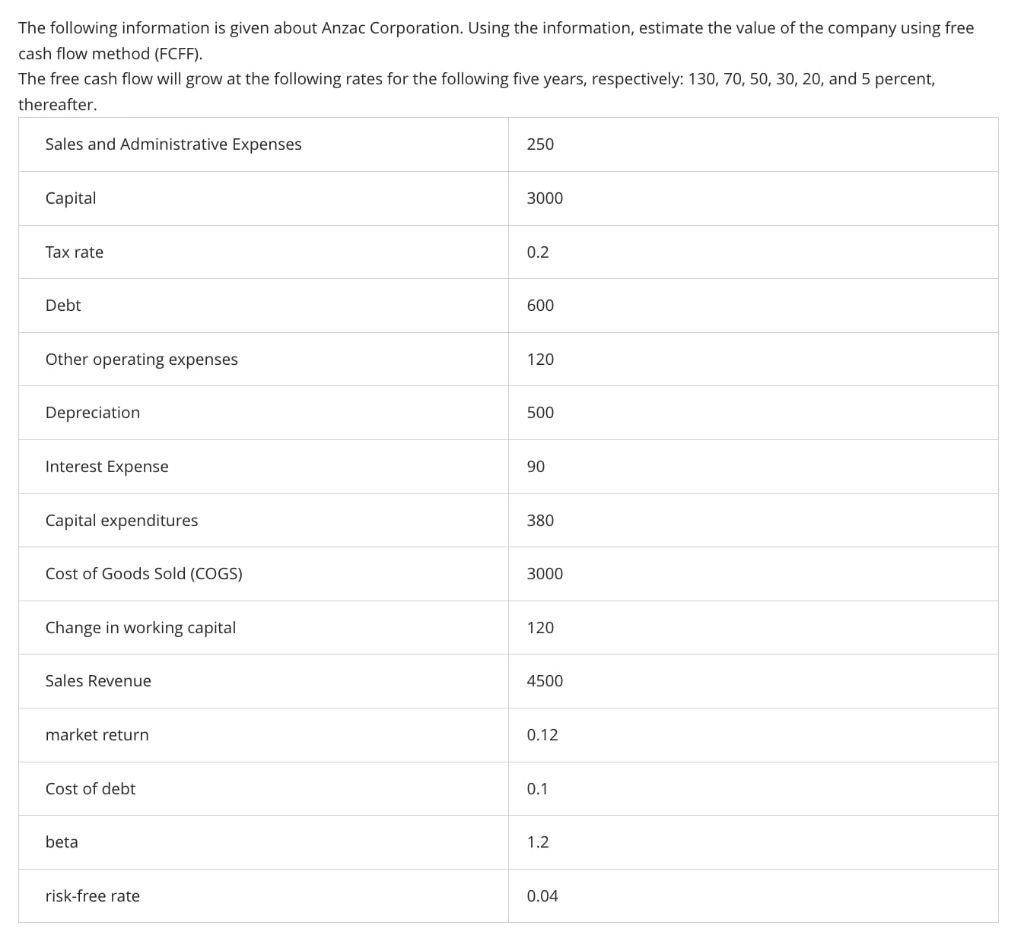 The following information is given about Anzac Corporation. Using the information, estimate the value of the company using free
cash flow method (FCFF).
The free cash flow will grow at the following rates for the following five years, respectively: 130, 70, 50, 30, 20, and 5 percent,
thereafter.
Sales and Administrative Expenses 250
Capital 3000
Tax rate 02
Debt 600
Other operating expenses 120
Depreciation 500
Interest Expense 90
Capital expenditures 380
Cost of Goods Sold (COGS) 3000
Change in working capital 120
Sales Revenue 4500
market return 0.12
Cost of debt 0.1
beta 12
risk-free rate 0.04
This is AI generated Response.
Asked by: DIMMIRI
Created at: 2025-10-16 10:32:19
Asked by: DIMMIRI
Created at: 2025-10-16 10:32:19
Thought Process:
Rendered
Raw Text
**Calculating company value through FCFF**
I need to compute the company's value using Free Cash Flow to the Firm (FCFF). The data includes sales and admin expenses and what seems to be capital at 3000, which might be equity capital or just initial capital. For FCFF, I'll use the formula: FCFF = EBIT*(1 - tax rate) + Depreciation - CapEx - Increase in NWC. First, I’ll calculate EBIT by subtracting COGS, sales/admin, and other operating expenses from revenue. Let's get those figures sorted.**Calculating FCFF and growth rates**
I'm calculating NOPAT as EBIT times (1 - tax rate), which gives me 630 multiplied by 0.8, resulting in 504. Then I add back depreciation of 500, leading to a total of 1004. After subtracting capital expenditures of 380 and a change in working capital of 120, I get a final FCFF of 504.
Next, I'm looking at the projected growth rates for free cash flow over the next five years, which are 130%, 70%, 50%, 30%, and 20%, with a terminal growth rate of 5%. It seems well-structured, combining both short-term and long-term growth expectations.**Interpreting growth rates and calculating WACC**
I see the numbers as high growth rates: 130%, 70%, 50%, 30%, and 20% for the first five years, followed by a 5% terminal growth rate. The phrasing indicates that "5 percent thereafter" isn't part of the five-year list. So, I'll interpret it as Year 1 at 130%, Year 2 at 70%, and so on. Now, for WACC, I have a risk-free rate of 0.04, a market return of 0.12, and a beta of 1.2. The cost of equity using CAPM will be 13.6%, and with a cost of debt at 10%, the after-tax cost comes out to 8%. I need to figure out the weights next.**Determining capital structure and WACC**
I need to establish the capital structure: with "Capital 3000" and "Debt 600," it's likely that the 3000 refers to equity. So, total capital combining debt and equity is 3600. The weights come out to E = 3000/3600 = 0.8333 and D = 600/3600 = 0.1667.
Now for WACC calculation: I’ll use WACC = (E/V * r_e) + (D/V * r_d*(1 - t)). Since I've already noted after-tax cost of debt as 8%, my calculations yield WACC around 12.67%. We can also check using a pretax cost of debt— it seems consistent! Next, I’ll compute FCFF projections starting with FCFF0 at 504.**Projecting FCFF and calculating enterprise value**
I’m calculating future FCFF growth: Year 1 at 130% leads to FCFF1 of 1159.2, and then for Years 2 through 5, I calculate growth rates, resulting in FCFF values up to approximately 4611.3. The terminal value at Year 5, using a perpetual growth of 5%, gives a sizable figure—over 63,000.
I need to discount each FCFF to present value, applying a WACC of about 12.67%. With total enterprise value computed around 44,345, I’ll adjust for debt to find equity value, which might be around 43,745. Time to finalize these calculations for clarity!**Calculating present values**
I'm computing the present values (PVs) accurately for each FCFF. For instance, PV1 gives me about 1028.79, while PV2 roughly estimates at 1552.76. I proceed with the calculations for PV3, PV4, and PV5, determining them as well.
Next, I calculate the terminal value (TV5) using the Gordon growth model, which results in around 63,154.724. I then multiply this by the discount factor for Year 5 to get the present value of the terminal value. This leads me to a total enterprise value of roughly 44,345, factoring in debt to estimate equity. Time to wrap this up neatly!
Final Answer:
Rendered
Raw Text
Did you like this answer?
Here’s a clean FCFF valuation using the data in your image.
1) Operating inputs
- Sales = 4,500
- COGS = 3,000
- SG&A = 250
- Other operating expenses = 120
- Depreciation = 500
- Interest expense = 90 (not used in FCFF)
- Tax rate = 20%
- Capex = 380
- Change in working capital = 120
2) Current FCFF (FCFF0)
- EBIT = Sales − COGS − SG&A − Other op. exp. − Depreciation
= 4,500 − 3,000 − 250 − 120 − 500 = 630
- NOPAT = EBIT × (1 − tax) = 630 × 0.80 = 504
- FCFF0 = NOPAT + Depreciation − Capex − ΔWC
= 504 + 500 − 380 − 120 = 504
3) Cost of capital
- Cost of equity (CAPM) = Rf + β(Mkt − Rf) = 0.04 + 1.2(0.12 − 0.04) = 13.6%
- After‑tax cost of debt = 10% × (1 − 0.20) = 8.0%
- Capital structure (using given “Capital” as equity): Equity = 3,000; Debt = 600
Weights: E/V = 3,000/3,600 = 0.8333; D/V = 0.1667
- WACC = 0.8333×13.6% + 0.1667×8.0% = 12.6667%
4) FCFF forecast (growth rates for years 1–5: 130%, 70%, 50%, 30%, 20%; terminal growth 5%)
- FCFF1 = 504 × 2.30 = 1,159.20
- FCFF2 = 1,159.20 × 1.70 = 1,970.64
- FCFF3 = 1,970.64 × 1.50 = 2,955.96
- FCFF4 = 2,955.96 × 1.30 = 3,842.748
- FCFF5 = 3,842.748 × 1.20 = 4,611.2976
- Terminal value at t=5:
FCFF6 = 4,611.2976 × 1.05 = 4,841.86248
TV5 = FCFF6 / (WACC − g) = 4,841.86248 / (0.126667 − 0.05) ≈ 63,154.72
5) Discount to present at WACC (1 + WACC = 1.126667)
- PV(FCFF1) ≈ 1,159.20 / 1.126667 = 1,028.79
- PV(FCFF2) ≈ 1,970.64 / 1.126667^2 = 1,552.28
- PV(FCFF3) ≈ 2,955.96 / 1.126667^3 = 2,067.10
- PV(FCFF4) ≈ 3,842.748 / 1.126667^4 = 2,384.81
- PV(FCFF5) ≈ 4,611.2976 / 1.126667^5 = 2,538.98
- PV(TV5) ≈ 63,154.72 / 1.126667^5 = 34,772.99
6) Value
- Enterprise value (EV) = sum of PVs = about 44,344.95
- Equity value ≈ EV − Debt = 44,344.95 − 600 ≈ 43,744.95
(If there is excess cash, add it; not provided here.)
Answer
- Estimated enterprise value using FCFF ≈ 44,345 (same currency units as inputs).
- Implied equity value ≈ 43,745, assuming no excess cash.
Notes
- These results rely on the assumed capital structure weights (Equity 3,000; Debt 600) and very high near‑term FCFF growth rates; EV is sensitive to WACC and terminal growth.
📢 Instructions:
- Ask anything relatd to above question only.
- For new Question goto :