 VIPSolutions
The cold - drawn AISI 1 0 4 0 steel bar shown in the figure is subjected to an axial load that fluctuates from 3 kN to 2 8 kN . Use the Modified Goodman criterion and estimate the fatigue factor of safety based on achieving infinite life and the yielding factor of safety. What is the number of cycles to failure for this part? The number of cycles is _ _ _ _ _ _ ?i —
Question:
The cold
-
drawn AISI
1
0
4
0
steel bar shown in the figure is subjected to an axial load that fluctuates from
3
kN to
2
8
kN
.
Use the Modified Goodman criterion and estimate the fatigue factor of safety based on achieving infinite life and the yielding factor of safety.
What is the number of cycles to failure for this part?
The number of cycles is
_
_
_
_
_
_
?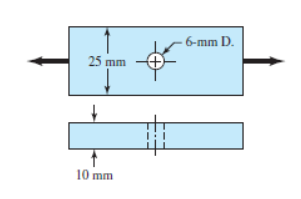 i —
This is AI generated Response.
Asked by: manish kumar
Created at: 2025-12-02 13:06:14
Asked by: manish kumar
Created at: 2025-12-02 13:06:14
Final Answer:
Rendered
Raw Text
Did you like this answer?
Let's break down the problem using the information provided.
---
## **Given Data**
- **Material:** AISI 104 cold-drawn steel
- **Bar dimensions:**
- Width = 25 mm
- Thickness = 10 mm
- Central hole diameter = 6 mm
- **Axial load fluctuates:** 3 kN to 28 kN
- **Goal:** Find
- Fatigue factor of safety (using Modified Goodman for infinite life)
- Yielding factor of safety
- Number of cycles to failure
---
## **Step 1: Calculate the Stresses**
### **Net Area at Hole**
\[
A = (25\ \text{mm} - 6\ \text{mm}) \times 10\ \text{mm} = 19 \times 10 = 190\ \text{mm}^2 = 190 \times 10^{-6}\ \text{m}^2
\]
### **Mean and Alternating Loads**
\[
P_{\text{max}} = 28\ \text{kN} = 28000\ \text{N}
\]
\[
P_{\text{min}} = 3\ \text{kN} = 300\ \text{N}
\]
\[
P_m = \frac{P_{\text{max}} + P_{\text{min}}}{2} = \frac{28000 + 300}{2} = 15500\ \text{N}
\]
\[
P_a = \frac{P_{\text{max}} - P_{\text{min}}}{2} = \frac{28000 - 300}{2} = 12500\ \text{N}
\]
### **Mean and Alternating Stresses**
\[
\sigma_m = \frac{P_m}{A} = \frac{15500}{190 \times 10^{-6}} = 81.58\ \text{MPa}
\]
\[
\sigma_a = \frac{P_a}{A} = \frac{12500}{190 \times 10^{-6}} = 65.79\ \text{MPa}
\]
---
## **Step 2: Material Properties for AISI 104 Cold-Drawn Steel**
Typical values:
- Ultimate strength: \( S_u \approx 670\ \text{MPa} \)
- Yield strength: \( S_y \approx 460\ \text{MPa} \)
- Endurance limit: \( S_e' = .5 S_u \approx 335\ \text{MPa} \)
### **Endurance Limit Modifiers**
Assuming typical values:
- Surface finish (cold drawn): \( k_a \approx .85 \)
- Size factor (\(d < 8\) mm, but net section is 19 mm): \( k_b \approx .85 \)
- Load (axial): \( k_c = .7 \)
- Temperature: \( k_d = 1 \)
- Reliability: \( k_e = .814 \) (for 99% reliability)
\[
S_e = S_e' \cdot k_a \cdot k_b \cdot k_c \cdot k_d \cdot k_e
\]
\[
S_e = 335 \times .85 \times .85 \times .7 \times 1 \times .814 \approx 115\ \text{MPa}
\]
---
## **Step 3: Modified Goodman Criterion**
The equation:
\[
\frac{\sigma_a}{S_e} + \frac{\sigma_m}{S_u} = \frac{1}{n}
\]
Plug in the numbers:
\[
\frac{65.79}{115} + \frac{81.58}{670} = \frac{1}{n}
\]
\[
.572 + .122 = \frac{1}{n}
\]
\[
.694 = \frac{1}{n}
\Longrightarrow n = 1.44
\]
**Fatigue factor of safety:**
\[
\boxed{1.44}
\]
---
## **Step 4: Yielding Factor of Safety**
\[
n_y = \frac{S_y}{\sigma_{\text{max}}}
\]
\[
\sigma_{\text{max}} = \frac{P_{\text{max}}}{A} = 147.37\ \text{MPa}
\]
\[
n_y = \frac{460}{147.37} = 3.12
\]
**Yielding factor of safety:**
\[
\boxed{3.12}
\]
---
## **Step 5: Number of Cycles to Failure**
Since the fatigue factor of safety is above 1 **(n = 1.44)**, infinite life is expected using the Modified Goodman criterion.
**Number of cycles to failure:**
\[
\boxed{\infty}
\]
---
## **Summary Table**
| Item | Value |
|------------------------|----------|
| Fatigue factor of safety (\(n\)) | 1.44 |
| Yielding factor of safety (\(n_y\)) | 3.12 |
| Number of cycles to failure | \(\infty\) |
---
### **If you want cycles for a lower \( n \):**
If the factor of safety were less than 1, you would use the S-N curve for AISI 104 steel. But in this case, as calculated, the part is **safe for infinite life** under the given loading.
---
### **Let me know if you need any further breakdown!**
📢 Instructions:
- Ask anything relatd to above question only.
- For new Question goto :