give answer in 3 steps with explanation at the end of each step and final answer at the endView Policies
Current Attempt in Progress
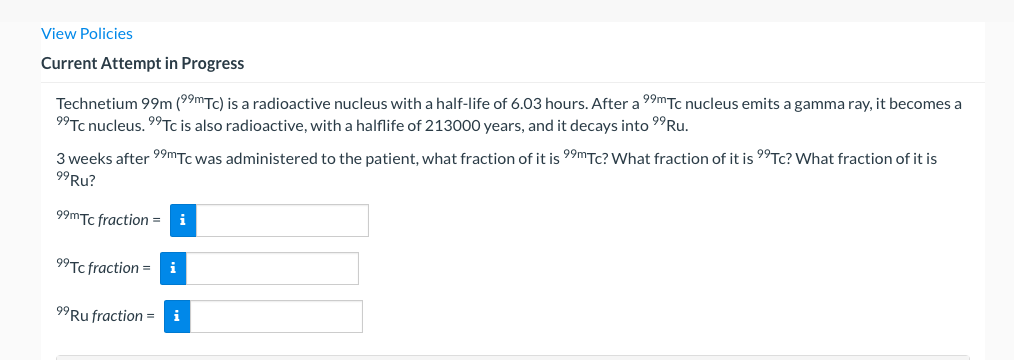
Technetium 99m (*”™Tc) is a radioactive nucleus with a half-life of 6.03 hours. After a *”™Tc nucleus emits a gamma ray, it becomes a
99Tc nucleus. **Tc is also radioactive, with a halflife of 213000 years, and it decays into “Ru.
3 weeks after ?™Tc was administered to the patient, what fraction of it is ?™Tc? What fraction of it is Tc? What fraction of it is.
PRU?
#7 fraction - [|
#Tcracton - |
Prufraction- [Fl]
EEE EE oo ST
View Policies
Current Attempt in Progress
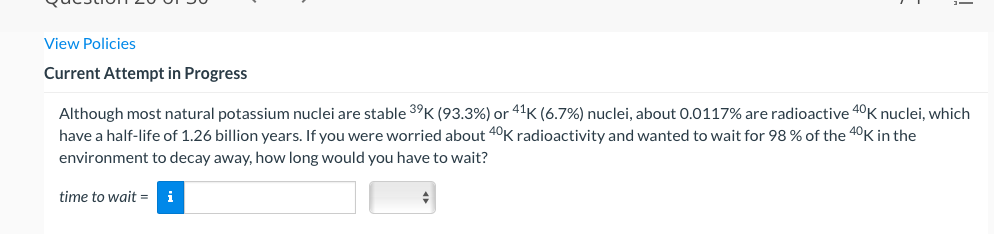
Although most natural potassium nuclei are stable 3K (93.3%) or 41K (6.7%) nuclei, about 0.0117% are radioactive “°K nuclei, which
have a half-life of 1.26 billion years. If you were worried about “°K radioactivity and wanted to wait for 98 % of the “*K in the
environment to decay away, how long would you have to wait?
time towai - [|] :
Question:
give answer in 3 steps with explanation at the end of each step and final answer at the endView Policies
Current Attempt in Progress
Technetium 99m (*”™Tc) is a radioactive nucleus with a half-life of 6.03 hours. After a *”™Tc nucleus emits a gamma ray, it becomes a
99Tc nucleus. **Tc is also radioactive, with a halflife of 213000 years, and it decays into “Ru.
3 weeks after ?™Tc was administered to the patient, what fraction of it is ?™Tc? What fraction of it is Tc? What fraction of it is.
PRU?
#7 fraction - [|
#Tcracton - |
Prufraction- [Fl]
EEE EE oo ST
View Policies
Current Attempt in Progress
Although most natural potassium nuclei are stable 3K (93.3%) or 41K (6.7%) nuclei, about 0.0117% are radioactive “°K nuclei, which
have a half-life of 1.26 billion years. If you were worried about “°K radioactivity and wanted to wait for 98 % of the “*K in the
environment to decay away, how long would you have to wait?
time towai - [|] :
This is AI generated Response.
Asked by: amu
Created at: 2025-07-26 13:03:01
Final Answer:
RenderedRaw Text
Did you like this answer?
Let's solve both questions step by step, with explanations after each step.
---
### **First Question: Decay of 99mTc and 99Tc to 99Ru**
#### **Step 1: Calculate time in hours (3 weeks)**
- **1 week = 7 days**
- **3 weeks = 21 days**
- **1 day = 24 hours**
- **Total time = 21 × 24 = 504 hours**
**Explanation:**
We need the total time elapsed in hours to use it in half-life calculations.
---
#### **Step 2: Fraction of original 99mTc left after 504 hours**
The fraction remaining after time \( t \) is:
\[
\text{Fraction remaining} = \left(\frac{1}{2}\right)^{t/t_{1/2}}
\]
For \( ^{99m}\text{Tc} \), \( t_{1/2} = 6.03 \) hours:
\[
\frac{504}{6.03} \approx 83.75
\]
\[
\text{Fraction of } ^{99m}\text{Tc} = \left(\frac{1}{2}\right)^{83.75} \approx 7.2 \times 10^{-26}
\]
**Explanation:**
Almost all \( ^{99m}\text{Tc} \) will have decayed after 3 weeks.
---
#### **Step 3: Fraction of 99Tc and 99Ru**
Now, \( ^{99m}\text{Tc} \) decays to \( ^{99}\text{Tc} \), which then decays to \( ^{99}\text{Ru} \) (with a much longer half-life, so it builds up slowly).
The fraction of \( ^{99}\text{Tc} \) left after 504 hours:
- \( t_{1/2} = 213,000 \) years = \( 213,000 \times 365.25 \times 24 = 1.87 \times 10^9 \) hours
- \( \frac{504}{1.87 \times 10^9} \approx 2.7 \times 10^{-7} \)
- \( \left(\frac{1}{2}\right)^{2.7 \times 10^{-7}} \approx 1 - 1.87 \times 10^{-7} \) (essentially unchanged)
Nearly all the original atoms are now \( ^{99}\text{Tc} \), except for the tiny amount that has decayed to \( ^{99}\text{Ru} \) (which is negligible).
So:
- \( ^{99m}\text{Tc} \) fraction ≈ \( 7.2 \times 10^{-26} \)
- \( ^{99}\text{Tc} \) fraction ≈ 1 (almost all nuclei)
- \( ^{99}\text{Ru} \) fraction ≈ 0 (almost none, since very little \( ^{99}\text{Tc} \) has decayed)
**Final Answer:**
- \( ^{99m}\text{Tc} \) fraction = \( 7.2 \times 10^{-26} \)
- \( ^{99}\text{Tc} \) fraction ≈ 1
- \( ^{99}\text{Ru} \) fraction ≈ 0
---
### **Second Question: 40K Decay for 98% to Decay**
#### **Step 1: Understand what fraction remains**
If 98% has decayed, 2% remains.
\[
\text{Fraction remaining} = 0.02
\]
**Explanation:**
We're looking for the time when only 2% of the original \( ^{40}\text{K} \) is left.
---
#### **Step 2: Use decay formula**
\[
\text{Fraction remaining} = \left(\frac{1}{2}\right)^{t/t_{1/2}}
\]
\[
0.02 = \left(\frac{1}{2}\right)^{t/1.26 \text{ billion years}}
\]
Take logarithms:
\[
\ln(0.02) = \frac{t}{1.26 \times 10^9} \ln(0.5)
\]
\[
-3.912 = \frac{t}{1.26 \times 10^9} \times (-0.693)
\]
\[
3.912 = \frac{t}{1.26 \times 10^9} \times 0.693
\]
\[
t = \frac{3.912}{0.693} \times 1.26 \times 10^9
\]
\[
t \approx 5.645 \times 1.26 \times 10^9
\]
\[
t \approx 7.12 \times 10^9 \text{ years}
\]
**Explanation:**
We used the logarithm form of the decay equation to solve for time.
---
#### **Step 3: Final Answer**
\[
\boxed{7.1 \text{ billion years}}
\]
**Explanation:**
It would take about 7.1 billion years for 98% of \( ^{40}\text{K} \) to decay.
---
## **Summary of Final Answers**
**1. Tc/Ru decay question:**
- \( ^{99m}\text{Tc} \) fraction = \( 7.2 \times 10^{-26} \)
- \( ^{99}\text{Tc} \) fraction ≈ 1
- \( ^{99}\text{Ru} \) fraction ≈ 0
**2. 40K decay question:**
- **Time to wait = 7.1 billion years** (for 98% decay)
Question:
tell concept used in answering the question in paragraph form in very brief
This is AI generated Response.
Asked by: amu
Created at: 2025-07-26 13:18:07
Final Answer:
RenderedRaw Text
Did you like this answer?
The concepts used involve radioactive decay principles, primarily the half-life formula, which relates the remaining fraction of a radioactive isotope to the elapsed time. For the first question, we applied the exponential decay law to determine how much of the short-lived technetium-99m remains after several weeks, and how it transitions to longer-lived technetium-99 and ultimately to ruthenium-99. In the second question, we used logarithmic calculations of decay to find the time required for a specific percentage of potassium-40 to decay, based on its known half-life. These concepts rely on understanding exponential decay and the relationship between half-life and elapsed time.
VIPSolutions focuses on clear, step‑by‑step explanations so you can learn quickly. Whether you need an AI‑generated walkthrough or a short hint to get unstuck, each solution is organized for fast reading and easy review later.
Search similar questions, compare approaches, and bookmark the best answers for revision. Our goal is simple: quick, reliable study help that feels natural—not noisy.
 VIPSolutions
 View Policies
Current Attempt in Progress
Technetium 99m (*”™Tc) is a radioactive nucleus with a half-life of 6.03 hours. After a *”™Tc nucleus emits a gamma ray, it becomes a
99Tc nucleus. **Tc is also radioactive, with a halflife of 213000 years, and it decays into “Ru.
3 weeks after ?™Tc was administered to the patient, what fraction of it is ?™Tc? What fraction of it is Tc? What fraction of it is.
PRU?
#7 fraction - [|
#Tcracton - |
Prufraction- [Fl]
EEE EE oo ST
View Policies
Current Attempt in Progress
Although most natural potassium nuclei are stable 3K (93.3%) or 41K (6.7%) nuclei, about 0.0117% are radioactive “°K nuclei, which
have a half-life of 1.26 billion years. If you were worried about “°K radioactivity and wanted to wait for 98 % of the “*K in the
environment to decay away, how long would you have to wait?
time towai - [|] :