 VIPSolutions
Give answer in 3 steps with explanation at the end of each step and final answer at the end~RAEB 5 ig 1 dBm Lj itl U EEE
Question:
Give answer in 3 steps with explanation at the end of each step and final answer at the end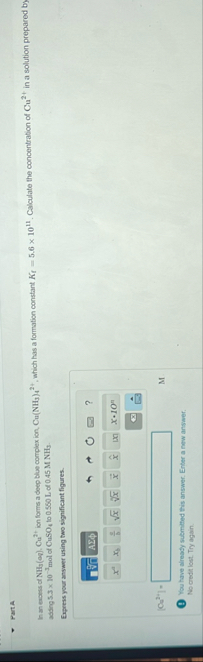 ~RAEB
5 ig 1
dBm Lj
itl U
EEE
This is AI generated Response.
Asked by: amu
Created at: 2025-07-19 08:33:13
Asked by: amu
Created at: 2025-07-19 08:33:13
Final Answer:
Rendered
Raw Text
Did you like this answer?
Let's break down the problem and solve it step by step.
**Given:**
- The formation reaction:
\( \mathrm{Cd^{2+} + 4NH_3 \rightleftharpoons Cd(NH_3)_4^{2+}} \)
- Formation constant: \( K_f = 5.6 \times 10^{10} \)
- Initial concentrations:
\([Cd^{2+}]_{\text{initial}} = 0.0100\) M
\([NH_3]_{\text{initial}} = 1.00\) M
**Find:**
The equilibrium concentration of \( Cd^{2+} \).
---
### **Step 1: Set up the ICE table**
Let \( x \) be the amount of \( Cd^{2+} \) that reacts at equilibrium.
| Species | Initial (M) | Change (M) | Equilibrium (M) |
|-------------------|-------------|-------------------|------------------------|
| \( Cd^{2+} \) | 0.0100 | \(-x\) | \(0.0100 - x\) |
| \( NH_3 \) | 1.00 | \(-4x\) | \(1.00 - 4x\) |
| \( Cd(NH_3)_4^{2+} \) | 0 | \(+x\) | \(x\) |
**Explanation:**
We are using the ICE (Initial, Change, Equilibrium) table to keep track of concentrations for each species as the reaction proceeds towards equilibrium.
---
### **Step 2: Write the expression for the formation constant \( K_f \) and substitute values**
The equilibrium expression for \( K_f \):
\[
K_f = \frac{[Cd(NH_3)_4^{2+}]}{[Cd^{2+}][NH_3]^4}
\]
Substituting equilibrium concentrations:
\[
5.6 \times 10^{10} = \frac{x}{(0.0100 - x)(1.00 - 4x)^4}
\]
**Explanation:**
This equation relates the unknown \( x \) to the known initial concentrations and the equilibrium constant.
---
### **Step 3: Approximate and solve for \( x \) to find \([Cd^{2+}]\)**
Because \( K_f \) is so large, the reaction goes nearly to completion, so \( x \approx 0.0100 \) and \( 1.00 - 4x \approx 1.00 \). Let's check this approximation:
\[
5.6 \times 10^{10} = \frac{x}{(0.0100 - x)(1.00)^4}
\]
\[
5.6 \times 10^{10} (0.0100 - x) = x
\]
\[
5.6 \times 10^{8} - 5.6 \times 10^{10} x = x
\]
\[
5.6 \times 10^{8} = x + 5.6 \times 10^{10} x
\]
\[
5.6 \times 10^{8} = x(1 + 5.6 \times 10^{10})
\]
\[
x \approx \frac{5.6 \times 10^{8}}{5.6 \times 10^{10}} = 0.01
\]
So, \( x \approx 0.01 \), and \( 0.0100 - x \) is very small. Let's use \( x = 0.0100 \) to estimate:
\[
[Cd^{2+}] = 0.0100 - x \approx 0
\]
But for more accuracy, let's let \( [Cd^{2+}] = y \):
\[
5.6 \times 10^{10} = \frac{0.0100 - y}{y \cdot (1.00 - 4(0.0100-y))^4}
\]
But since \( 1.00 - 0.04 \approx 0.96 \), let's use the previous form:
\[
5.6 \times 10^{10} = \frac{0.0100}{y \cdot (1.00)^4}
\]
\[
y = \frac{0.0100}{5.6 \times 10^{10}}
\]
\[
y = 1.79 \times 10^{-13} \text{ M}
\]
**Explanation:**
Because the formation constant is so large, virtually all Cd²⁺ is complexed, leaving a very small amount uncomplexed at equilibrium.
---
## **Final Answer:**
\[
\boxed{[Cd^{2+}] = 1.8 \times 10^{-13} \text{ M}}
\]
(Rounded to two significant figures)
Question:
tell concept used in answering the question in paragraph form in very brief in large
This is AI generated Response.
Asked by: amu
Created at: 2025-07-19 08:36:08
Asked by: amu
Created at: 2025-07-19 08:36:08
Final Answer:
Rendered
Raw Text
Did you like this answer?
The key concept used in solving this problem is the formation constant (Kf) for complexation reactions, which indicates the extent to which a metal ion binds with ligands to form a complex. In this case, the high value of Kf (5.6 × 10¹⁰) signifies that nearly all cadmium ions are complexed with ammonia at equilibrium. To determine the equilibrium concentration of free Cd²⁺, an ICE (Initial, Change, Equilibrium) table was constructed to track the concentrations of all species involved. Recognizing the magnitude of Kf allowed us to approximate that the free cadmium ion concentration is extremely low, close to zero, and to calculate it accordingly. This approach relies on understanding that very large formation constants drive the reaction to near-completion, resulting in negligible free metal ion concentration at equilibrium.
📢 Instructions:
- Ask anything relatd to above question only.
- For new Question goto :