 VIPSolutions
Give step-by-step solution with explanation and final answer: A 13.5 percent solution of Sodium Hypochlorite in a beaker with a 250mL needs to be diluted to make a 10% solution. However, the same beaker must be used and the final 10% solution must have a volume of 250mL. How much of the initial solution needs to be removed, and how much DI water must be added to mak e the final solution?
Question:
Give step-by-step solution with explanation and final answer:
A 13.5 percent solution of Sodium Hypochlorite in a beaker with a 250mL needs to be diluted to make a 10% solution. However, the same beaker must be used and the final 10% solution must have a volume of 250mL. How much of the initial solution needs to be removed, and how much DI water must be added to mak
e the final solution?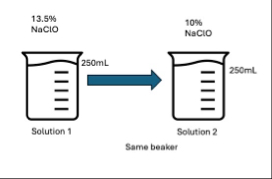
This is AI generated Response.
Asked by: amu
Created at: 2025-06-24 07:27:55
Asked by: amu
Created at: 2025-06-24 07:27:55
Final Answer:
Rendered
Raw Text
Did you like this answer?
Let's solve the problem step by step:
### **Step 1: Define the Situation**
- You have **250 mL** of a **13.5% NaClO** solution (Solution 1).
- You need to **dilute** it to make a **10% NaClO** solution (Solution 2) in the **same beaker**, with a final volume of **250 mL**.
- You can only achieve this by **removing some of the original solution** and replacing it with **DI water**.
---
### **Step 2: Set Up the Equation**
Let's call:
- \( V \) = amount of 13.5% solution **left** in the beaker after removal (in mL)
- Therefore, \( 250 - V \) = amount of solution **removed** (which will be replaced with DI water)
After you remove \( 250 - V \) mL and add the same amount of DI water, the final volume is still **250 mL**.
---
#### **Amount of NaClO in final solution:**
- Initial amount of NaClO: \( 250 \text{ mL} \times 0.135 = 33.75 \text{ mL NaClO} \)
- After removal: \( V \text{ mL} \times 0.135 = 0.135V \) mL NaClO remains.
- After adding DI water, the amount of NaClO stays the same (no NaClO in DI water).
---
#### **Final concentration equation:**
\[
\frac{\text{Amount of NaClO left}}{\text{Final volume}} = \text{Final Concentration}
\]
\[
\frac{0.135V}{250} = 0.10
\]
---
### **Step 3: Solve for \( V \)**
\[
0.135V = 0.10 \times 250
\]
\[
0.135V = 25
\]
\[
V = \frac{25}{0.135} \approx 185.19 \text{ mL}
\]
---
### **Step 4: Calculate Amount to Remove and Water to Add**
- **Amount to remove:** \( 250 - 185.19 = 64.81 \) mL
- **Amount of DI water to add:** \( 64.81 \) mL
---
### **Step 5: Final Answers**
#### **How much of the initial solution needs to be removed?**
\[
\boxed{64.8 \text{ mL} \ (\text{rounded to 1 decimal place})}
\]
#### **How much DI water must be added?**
\[
\boxed{64.8 \text{ mL}}
\]
---
## **Summary Table**
| Step | Volume (mL) |
|-----------------------------|-------------|
| Initial Solution | 250 |
| Volume to Remove | 64.8 |
| Volume to Add (DI water) | 64.8 |
| Final Volume | 250 |
| Final Concentration | 10% |
---
**In words:**
Remove **64.8 mL** of the 13.5% solution and replace it with **64.8 mL** of DI water to get **250 mL** of a 10% solution.
Let me know if you need a diagram or further clarification!
Question:
tell concept used in answering the question in paragraph form in very brief in large
This is AI generated Response.
Asked by: amu
Created at: 2025-06-24 07:29:16
Asked by: amu
Created at: 2025-06-24 07:29:16
Final Answer:
Rendered
Raw Text
Did you like this answer?
The concept used in answering this question is based on the principle of dilution and conservation of solute. When diluting a solution, the amount of solute (in this case, sodium hypochlorite) remains constant; only the solvent volume changes. To achieve the desired concentration, we calculate the initial amount of solute in the original solution and determine how much of that solution must be retained to contain the correct amount of solute for the target concentration. By removing a certain volume of the higher-concentration solution and replacing it with an equal volume of pure solvent (DI water), the total volume remains constant, but the concentration decreases. The key step involves setting up an equation that relates the initial amount of solute, the volume retained, and the final concentration, then solving for the volume to remove. This approach ensures precise control over the final concentration while maintaining the total volume.
📢 Instructions:
- Ask anything relatd to above question only.
- For new Question goto :